Event submissions
Events1st International Electronic Conference on Actuator Technology: Materials, Devices and Applications
Published
 10.3390/IeCAT2020-08477 (registering DOI)
 This submission belongs to the session H. Actuators for hydraulic systems of the event 1st International Electronic Conference on Actuator Technology: Materials, Devices and Applications
Published date
20 Nov, 2020
Citation
Tobias Vonderbank, Katharina Schmitz, Electromechanical actuators for large sized valves, in Proceedings of 1st International Electronic Conference on Actuator Technology: Materials, Devices and Applications, 23 November–27 November 2020, MDPI: Basel, Switzerland, doi: 10.3390/IeCAT2020-08477
Share
Email
Facebook
Twitter
LinkedIn
Electromechanical actuators for large sized valves
'%3e%3cpath%20d='M12.6647%2010.9104C12.4176%2010.325%2012.0589%209.7933%2011.6088%209.34485C11.16%208.89511%2010.6283%208.53653%2010.0432%208.28891C10.038%208.28629%2010.0327%208.28498%2010.0275%208.28236C10.8437%207.69282%2011.3743%206.73252%2011.3743%205.64907C11.3743%203.85423%209.92005%202.40002%208.12522%202.40002C6.33038%202.40002%204.87618%203.85423%204.87618%205.64907C4.87618%206.73252%205.40677%207.69282%206.22296%208.28367C6.21772%208.28629%206.21248%208.2876%206.20724%208.29022C5.62031%208.53783%205.09365%208.89287%204.64167%209.34616C4.19192%209.79496%203.83334%2010.3266%203.58573%2010.9117C3.34247%2011.4846%203.21128%2012.0987%203.19925%2012.721C3.1989%2012.735%203.20135%2012.7489%203.20646%2012.7619C3.21157%2012.7749%203.21924%2012.7868%203.22901%2012.7968C3.23877%2012.8068%203.25045%2012.8148%203.26334%2012.8202C3.27623%2012.8256%203.29007%2012.8284%203.30406%2012.8284H4.09012C4.14776%2012.8284%204.19362%2012.7825%204.19493%2012.7262C4.22113%2011.7148%204.62726%2010.7676%205.34519%2010.0497C6.08802%209.30686%207.07452%208.89811%208.12522%208.89811C9.17592%208.89811%2010.1624%209.30686%2010.9052%2010.0497C11.6232%2010.7676%2012.0293%2011.7148%2012.0555%2012.7262C12.0568%2012.7839%2012.1027%2012.8284%2012.1603%2012.8284H12.9464C12.9604%2012.8284%2012.9742%2012.8256%2012.9871%2012.8202C13%2012.8148%2013.0117%2012.8068%2013.0214%2012.7968C13.0312%2012.7868%2013.0389%2012.7749%2013.044%2012.7619C13.0491%2012.7489%2013.0515%2012.735%2013.0512%2012.721C13.0381%2012.0947%2012.9084%2011.4856%2012.6647%2010.9104ZM8.12522%207.90243C7.52388%207.90243%206.95792%207.66793%206.53214%207.24215C6.10636%206.81636%205.87185%206.2504%205.87185%205.64907C5.87185%205.04773%206.10636%204.48177%206.53214%204.05599C6.95792%203.63021%207.52388%203.3957%208.12522%203.3957C8.72655%203.3957%209.29252%203.63021%209.7183%204.05599C10.1441%204.48177%2010.3786%205.04773%2010.3786%205.64907C10.3786%206.2504%2010.1441%206.81636%209.7183%207.24215C9.29252%207.66793%208.72655%207.90243%208.12522%207.90243Z'%20fill='%235D1EE1'/%3e%3c/g%3e%3c/svg%3e)
Tobias Vonderbank 1
Katharina Schmitz 1
1. Institut for Fluid Power Drives and Systems
Abstract
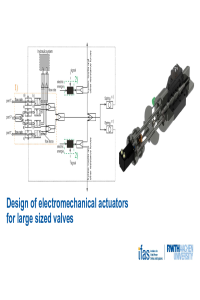
In modern hydraulics, it is crucial to investigate possible enhancements for components, which lead to increased performance or new improved system designs. Previous research of the switching process of a large valve pointed out that electromechanical valve actuators can replace hydraulic pilot control systems. Especially in systems, which currently, depend on a separate pilot circuit electromechanical actuators can lead to a huge decrease in the system acquistion costs. Actuators for large valves have to fulfill varying requirements. For example they need to apply high forces over large strokes. In order to define these requirements conveniently and to develop new valve actuators a functional structure of the “valve and his actuation system” has been derived in this paper. Using this design tool, the main function of the component is devided into different elementary functions. The graphical presentation of the system helps to define the requierements by outlining the correlations and to develop a new system by adding or deleting elementary functions. Using the functional structure, all acting forces have been identified and a prototype of a new electromechanical actuator for large directional control vales. A Force of up to 500 N and a stroke larger than 10 mm is realizible. Due to the new actuator design, further friction, clamping and resistance forces occur. Therefore, possible improvements on the actuator are suggested. In conclusion the paper summarizes significant points during the design process of electromechanical valve actuators and is intended as a basis for the development of new valve actuators.
Keywords
Valve
Hydraulic System Design
Electromechanical
Valve Acutator
Spool Resistance Forces
Switching Process
Manuscript
sciforum-035309-final.pdf
Poster
Präsentation Design of electromechanical actuators for large sized valves.pdf
A method for smoothly disengaging the load-holding valves of energy-efficient electro-hydraulic systems