Event submissions
Published

This submission belongs to the session B. Bioorganic, Medicinal and Natural Products Chemistry of the event The 24th International Electronic Conference on Synthetic Organic Chemistry
Published date
20 Nov, 2020
Citation
Anamika Sharma, Zainab Almarhoon, Rotimi Sheyi, Rakia Alhameed, Beatriz de la Torre, Fernando Albericio, Ayman El-Faham, s-Triazine: A Multidisciplinary and International Journey, in Proceedings of The 24th International Electronic Conference on Synthetic Organic Chemistry, 15 November–15 December 2020, MDPI: Basel, Switzerland, doi: 10.3390/ecsoc-24-08502
Share
Email
Facebook
Twitter
LinkedIn
s-Triazine: A Multidisciplinary and International Journey

Anamika Sharma 1
'%3e%3cpath%20d='M12.6647%2010.9104C12.4176%2010.325%2012.0589%209.7933%2011.6088%209.34485C11.16%208.89511%2010.6283%208.53653%2010.0432%208.28891C10.038%208.28629%2010.0327%208.28498%2010.0275%208.28236C10.8437%207.69282%2011.3743%206.73252%2011.3743%205.64907C11.3743%203.85423%209.92005%202.40002%208.12522%202.40002C6.33038%202.40002%204.87618%203.85423%204.87618%205.64907C4.87618%206.73252%205.40677%207.69282%206.22296%208.28367C6.21772%208.28629%206.21248%208.2876%206.20724%208.29022C5.62031%208.53783%205.09365%208.89287%204.64167%209.34616C4.19192%209.79496%203.83334%2010.3266%203.58573%2010.9117C3.34247%2011.4846%203.21128%2012.0987%203.19925%2012.721C3.1989%2012.735%203.20135%2012.7489%203.20646%2012.7619C3.21157%2012.7749%203.21924%2012.7868%203.22901%2012.7968C3.23877%2012.8068%203.25045%2012.8148%203.26334%2012.8202C3.27623%2012.8256%203.29007%2012.8284%203.30406%2012.8284H4.09012C4.14776%2012.8284%204.19362%2012.7825%204.19493%2012.7262C4.22113%2011.7148%204.62726%2010.7676%205.34519%2010.0497C6.08802%209.30686%207.07452%208.89811%208.12522%208.89811C9.17592%208.89811%2010.1624%209.30686%2010.9052%2010.0497C11.6232%2010.7676%2012.0293%2011.7148%2012.0555%2012.7262C12.0568%2012.7839%2012.1027%2012.8284%2012.1603%2012.8284H12.9464C12.9604%2012.8284%2012.9742%2012.8256%2012.9871%2012.8202C13%2012.8148%2013.0117%2012.8068%2013.0214%2012.7968C13.0312%2012.7868%2013.0389%2012.7749%2013.044%2012.7619C13.0491%2012.7489%2013.0515%2012.735%2013.0512%2012.721C13.0381%2012.0947%2012.9084%2011.4856%2012.6647%2010.9104ZM8.12522%207.90243C7.52388%207.90243%206.95792%207.66793%206.53214%207.24215C6.10636%206.81636%205.87185%206.2504%205.87185%205.64907C5.87185%205.04773%206.10636%204.48177%206.53214%204.05599C6.95792%203.63021%207.52388%203.3957%208.12522%203.3957C8.72655%203.3957%209.29252%203.63021%209.7183%204.05599C10.1441%204.48177%2010.3786%205.04773%2010.3786%205.64907C10.3786%206.2504%2010.1441%206.81636%209.7183%207.24215C9.29252%207.66793%208.72655%207.90243%208.12522%207.90243Z'%20fill='%235D1EE1'/%3e%3c/g%3e%3c/svg%3e)
Zainab Almarhoon 2

Rotimi Sheyi 3
Rakia Alhameed 2

Beatriz de la Torre 4

Fernando Albericio 3

Ayman El-Faham 2
1. Peptide Science Laboratory, School of Chemistry and Physics, University of KwaZulu-Natal, Durban 4001, South Africa
KwaZulu-Natal Research Innovation and Sequencing Platform (KRISP), School of Laboratory Medicine and Medical Sciences, College of Health S
2. Department of Chemistry, College of Science, King Saud University, P.O. Box 2455, Riyadh 11451, Saudi Arabia
3. Peptide Science Laboratory, School of Chemistry and Physics, University of KwaZulu-Natal, Durban 4001, South Africa
4. KwaZulu-Natal Research Innovation and Sequencing Platform (KRISP), School of Laboratory Medicine and Medical Sciences, College of Health Sciences, University of KwaZulu-Natal, Durban 4041, South Africa
Peptide Science Laboratory, School of Chemistry and
Abstract
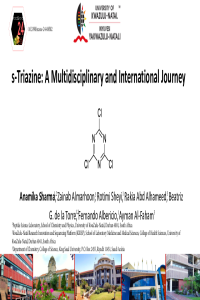
2,4,6-Trichloro-1,3,5-triazine (TCT) offers unique ability to undergo sequential nucleophilic substitution reaction using regular nucleophiles (first Cl replacement at 0 ºC, second at rt and third at > 90 ºC) making s-triazine a privileged scaffold finding application in drug development with an extension towards development of new materials.
This selective chemical property of TCT fulfills the goal of the chemists to control the organic structures and make it react in the required condition for achieving each objective. In this regard, orthogonality and chemoselectivity are two modern organic chemistry concepts which have been exploited in various areas of research ranging from supramolecular chemistry to organic/bioconjugation chemistry. We have demonstrated the fusion of these two concepts using TCT as “Orthogonal Chemoselectivity” and defined it as discrimination between reactive sites in any order. The usage of azide as one of the nucleophiles modulated the reactivity of s-triazine core for the last Cl replacement. This allowed us to overcome the barrier of higher temperature (> 90 ºC) for the last Cl replacement which happened at rt taking advantage of side chain of Cys, Tyr and Lys in biological context.
In this presentation, we revise the chemistry developed in our laboratories to manipulate the TCT core for application in our medicinal chemistry programs and in bioconjugation.
Keywords
Orthogonality
Chemoselectivity
Orthogonal Chemoselectivity
Cyanuric chloride
Manuscript
sciforum-041571 -j.pdf
Poster
manuscript--.pdf
SYNTHESIS AND APPLICATION OF 1,2-AMINOALCOHOLS WITH NEOISOPULEGOL-BASED OCTAHYDROBENZOFURAN CORE
Synthesis of Amidines and its application to heterocycles synthesis