Event submissions
Published

This submission belongs to the session PS. Poster Session of the event The 1st International Electronic Conference on Biomolecules
Published date
30 Nov, 2020
Citation
Stefano D'Errico, Nicola Borbone, Andrea Patrizia Falanga, Maria Marzano, Monica Terracciano, Francesca Greco, Gennaro Piccialli, Giorgia Oliviero, Design and Synthesis of a cADPR Mimic as a Novel Tool for Monitoring the Intracellular Ca²⁺ concentration, in Proceedings of The 1st International Electronic Conference on Biomolecules, 1 December–13 December 2020, MDPI: Basel, Switzerland, doi: 10.3390/IECBM2020-08578
Share
Email
Facebook
Twitter
LinkedIn
Design and Synthesis of a cADPR Mimic as a Novel Tool for Monitoring the Intracellular Ca2+ concentration

Stefano D'Errico 1

Nicola Borbone 1

Andrea Patrizia Falanga 2

Maria Marzano 1

Monica Terracciano 1

Francesca Greco 1
'%3e%3cpath%20d='M12.6647%2010.9104C12.4176%2010.325%2012.0589%209.7933%2011.6088%209.34485C11.16%208.89511%2010.6283%208.53653%2010.0432%208.28891C10.038%208.28629%2010.0327%208.28498%2010.0275%208.28236C10.8437%207.69282%2011.3743%206.73252%2011.3743%205.64907C11.3743%203.85423%209.92005%202.40002%208.12522%202.40002C6.33038%202.40002%204.87618%203.85423%204.87618%205.64907C4.87618%206.73252%205.40677%207.69282%206.22296%208.28367C6.21772%208.28629%206.21248%208.2876%206.20724%208.29022C5.62031%208.53783%205.09365%208.89287%204.64167%209.34616C4.19192%209.79496%203.83334%2010.3266%203.58573%2010.9117C3.34247%2011.4846%203.21128%2012.0987%203.19925%2012.721C3.1989%2012.735%203.20135%2012.7489%203.20646%2012.7619C3.21157%2012.7749%203.21924%2012.7868%203.22901%2012.7968C3.23877%2012.8068%203.25045%2012.8148%203.26334%2012.8202C3.27623%2012.8256%203.29007%2012.8284%203.30406%2012.8284H4.09012C4.14776%2012.8284%204.19362%2012.7825%204.19493%2012.7262C4.22113%2011.7148%204.62726%2010.7676%205.34519%2010.0497C6.08802%209.30686%207.07452%208.89811%208.12522%208.89811C9.17592%208.89811%2010.1624%209.30686%2010.9052%2010.0497C11.6232%2010.7676%2012.0293%2011.7148%2012.0555%2012.7262C12.0568%2012.7839%2012.1027%2012.8284%2012.1603%2012.8284H12.9464C12.9604%2012.8284%2012.9742%2012.8256%2012.9871%2012.8202C13%2012.8148%2013.0117%2012.8068%2013.0214%2012.7968C13.0312%2012.7868%2013.0389%2012.7749%2013.044%2012.7619C13.0491%2012.7489%2013.0515%2012.735%2013.0512%2012.721C13.0381%2012.0947%2012.9084%2011.4856%2012.6647%2010.9104ZM8.12522%207.90243C7.52388%207.90243%206.95792%207.66793%206.53214%207.24215C6.10636%206.81636%205.87185%206.2504%205.87185%205.64907C5.87185%205.04773%206.10636%204.48177%206.53214%204.05599C6.95792%203.63021%207.52388%203.3957%208.12522%203.3957C8.72655%203.3957%209.29252%203.63021%209.7183%204.05599C10.1441%204.48177%2010.3786%205.04773%2010.3786%205.64907C10.3786%206.2504%2010.1441%206.81636%209.7183%207.24215C9.29252%207.66793%208.72655%207.90243%208.12522%207.90243Z'%20fill='%235D1EE1'/%3e%3c/g%3e%3c/svg%3e)
Gennaro Piccialli 1

Giorgia Oliviero 2
1. Dipartimento di Farmacia, Università degli Studi di Napoli 'Federico II'
2. Dipartimento di Medicina Molecolare e Biotecnologie Mediche, Università degli Studi di Napoli 'Federico II'
Abstract
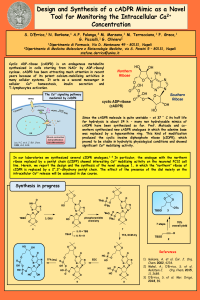
Cyclic ADP-ribose (cADPR) is a natural occurring metabolite of NAD+ capable of mobilizing Ca2+ ions from intracellular stores. It was firstly isolated from sea urchin eggs extract, but it was later established that it is also produced in many other mammalian cells, including pancreatic β-cells, T-lymphocytes, smooth and cardiac muscle cells and cerebellar neurons, acting as a Ca2+-mobilizing agent. For this activity, cADPR has been classified as a second messenger that, activating the ryanodine receptors of the sarcoplasmatic reticulum, is able to mobilize the calcium ions from intracellular stores. cADPR is involved in many physiological processes related to the variation of the Ca2+ concentration, such as the synaptic homeostasis in neurons, as well as fertilization and cellular proliferation. This cyclic nucleotide, characterized by a very labile glycosidic bond at the N1, is rapidly hydrolysed also in neutral aqueous solutions to the inactive ADP-ribose. Matsuda and co-workers were the first who synthesized new analogues of the cADPR in which the adenine base was replaced by a hypoxanthine ring. This kind of modification produced the cyclic inosine diphosphate ribose (cIDPR) which proved to be stable in hydrolytic physiological conditions and showed significant Ca2+ mobilizing activity. A lot of modifications regarding the northern and southern ribose, as well as the purine base of cADPR, have been proposed so far. In our laboratories we have synthesized several analogues of cIDPR. In particular, the analogue with the northern ribose replaced by a pentyl chain (cpIDP) showed interesting Ca2+ mobilizing activity on the neuronal PC12 cell line. Starting from these results, we report here the synthesis of a novel analogue , in which the “northern” ribose of cIDPR was replaced by a 2”,3”-dihydroxy pentyl chain.
Keywords
cADPR
Ca2+ mobilization
pyrophosphate bond formation
Manuscript
D'Errico.pdf
Poster
D'Errico_poster.pdf
Biodegradable wet-spun fibers as delivery platforms for the bactericidal effect of the natural-origin biomolecules, cinnamon, clove and cajeput essential oils
De Novo Drug Design using Artificial Intelligence ASYNT-GAN