Event submissions
Published

This submission belongs to the session S3. Pathways for the discovery of new bio-inspired and natural drugs and their derivatives of the event The 1st International Electronic Conference on Biomolecules
Published date
30 Nov, 2020
Citation
Ivan Jacobs, Manolis Maragoudakis, De Novo Drug Design using Artificial Intelligence ASYNT-GAN, in Proceedings of The 1st International Electronic Conference on Biomolecules, 1 December–13 December 2020, MDPI: Basel, Switzerland, doi: 10.3390/IECBM2020-08579
Share
Email
Facebook
Twitter
LinkedIn
De Novo Drug Design using Artificial Intelligence ASYNT-GAN

Ivan Jacobs 1

Manolis Maragoudakis 2
1. AI4U S.A.
2. Ionian University
Abstract
Since the last few decades, proteins have emerged as the major class of pharmaceuticals with more than 200 protein-based products currently available in the market, of which 90% are used as therapeutics. The protein engineering market is bolstered by the need for drugs with improved efficiency, specificity, technological capabilities, rise of antibody based drugs and steady growth in the therapeutic market. Monoclonal antibodies (mAbs) is the fastest growing segment in the therapeutic market, though the other segments comprising non-mAb recombinant proteins like Insulin, Erythropoetin (EPO), Interferons (INF),Interleukins (ILs) and Somatotropin (hGH) are also in great demand for therapy.
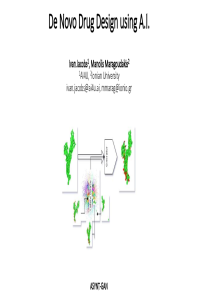
In this paper we propose the generation of synthetic small and more sophisticated molecule structures that optimize the binding affinity to a target (ASYNT-GAN). To achieve this we leverage on three important achievements in A.I.: Attention, Deep Learning on Graphs and Generative Adversarial Networks. Similar to text generation based on parts of text we are able to generate a molecule architecture based on an existing target.
By adopting this approach, we propose a novel way of searching for existing compounds that are suitable candidates. Similar to question and answer Natural Language solutions we are able to find drugs with highest relevance to a target. We are able to identify substructures of the molecular structure that are the most suitable for binding.
In addition, we are proposing a novel way of generating the molecule in 3D space in such a way that the binding is optimized. We show that we are able to generate compound structures and protein structures that are optimised for binding to a target.
Keywords
drug discovery
artificial intelligence
Manuscript
layout-sciforum_037478_original_De_Novo_Drug_Design_def.pdf
Poster
sciforum_037478_slides_DeNovoDrugDesign.pdf
Design and Synthesis of a cADPR Mimic as a Novel Tool for Monitoring the Intracellular Ca2+ concentration
Antibacterial activity of marine-derived chitosan and plant-derived cajeput oil as loaded blended films in Staphylococcus aureus and Pseudomonas aeruginosa-enriched settings