Event submissions
Published

This submission belongs to the session S3. Pathways for the discovery of new bio-inspired and natural drugs and their derivatives of the event The 1st International Electronic Conference on Biomolecules
Published date
30 Nov, 2020
Citation
Irene Gómez-Cruz, Cristóbal Cara, María del Mar Contreras, Inmaculada Romero, RECOVERY OF BIOACTIVE COMPOUNDS FROM EXHAUSTED OLIVE POMACE, in Proceedings of The 1st International Electronic Conference on Biomolecules, 1 December–13 December 2020, MDPI: Basel, Switzerland, doi: 10.3390/IECBM2020-08582
Share
Email
Facebook
Twitter
LinkedIn
RECOVERY OF BIOACTIVE COMPOUNDS FROM EXHAUSTED OLIVE POMACE

Irene Gómez-Cruz 1
'%3e%3cpath%20d='M12.6647%2010.9104C12.4176%2010.325%2012.0589%209.7933%2011.6088%209.34485C11.16%208.89511%2010.6283%208.53653%2010.0432%208.28891C10.038%208.28629%2010.0327%208.28498%2010.0275%208.28236C10.8437%207.69282%2011.3743%206.73252%2011.3743%205.64907C11.3743%203.85423%209.92005%202.40002%208.12522%202.40002C6.33038%202.40002%204.87618%203.85423%204.87618%205.64907C4.87618%206.73252%205.40677%207.69282%206.22296%208.28367C6.21772%208.28629%206.21248%208.2876%206.20724%208.29022C5.62031%208.53783%205.09365%208.89287%204.64167%209.34616C4.19192%209.79496%203.83334%2010.3266%203.58573%2010.9117C3.34247%2011.4846%203.21128%2012.0987%203.19925%2012.721C3.1989%2012.735%203.20135%2012.7489%203.20646%2012.7619C3.21157%2012.7749%203.21924%2012.7868%203.22901%2012.7968C3.23877%2012.8068%203.25045%2012.8148%203.26334%2012.8202C3.27623%2012.8256%203.29007%2012.8284%203.30406%2012.8284H4.09012C4.14776%2012.8284%204.19362%2012.7825%204.19493%2012.7262C4.22113%2011.7148%204.62726%2010.7676%205.34519%2010.0497C6.08802%209.30686%207.07452%208.89811%208.12522%208.89811C9.17592%208.89811%2010.1624%209.30686%2010.9052%2010.0497C11.6232%2010.7676%2012.0293%2011.7148%2012.0555%2012.7262C12.0568%2012.7839%2012.1027%2012.8284%2012.1603%2012.8284H12.9464C12.9604%2012.8284%2012.9742%2012.8256%2012.9871%2012.8202C13%2012.8148%2013.0117%2012.8068%2013.0214%2012.7968C13.0312%2012.7868%2013.0389%2012.7749%2013.044%2012.7619C13.0491%2012.7489%2013.0515%2012.735%2013.0512%2012.721C13.0381%2012.0947%2012.9084%2011.4856%2012.6647%2010.9104ZM8.12522%207.90243C7.52388%207.90243%206.95792%207.66793%206.53214%207.24215C6.10636%206.81636%205.87185%206.2504%205.87185%205.64907C5.87185%205.04773%206.10636%204.48177%206.53214%204.05599C6.95792%203.63021%207.52388%203.3957%208.12522%203.3957C8.72655%203.3957%209.29252%203.63021%209.7183%204.05599C10.1441%204.48177%2010.3786%205.04773%2010.3786%205.64907C10.3786%206.2504%2010.1441%206.81636%209.7183%207.24215C9.29252%207.66793%208.72655%207.90243%208.12522%207.90243Z'%20fill='%235D1EE1'/%3e%3c/g%3e%3c/svg%3e)
Cristóbal Cara 1

María del Mar Contreras 1
Inmaculada Romero 1
1. Department of Chemical, Environmental and Materials Engineering, Universidad de Jaén, Jaén, Spain
Abstract
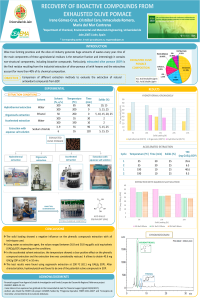
Olive tree farming practices and the olive oil industry generate huge amounts of wastes every year. One of the main components of these agroindustrial residues is the extractive fraction and interestingly it contains non-structural components, including bioactive compounds. Particularly, exhausted olive pomace (EOP) is the final residue resulting from the industrial extraction of olive-pomace oil with hexane and the extractives account for more than 40% of its chemical composition.
In this work, different extraction methods, including green technologies, have been compared to evaluate the extraction of antioxidants from EOP. Hydrothermal extraction using medium (85 ºC) and high thermal conditions (200 ºC) were carried out. Aqueous accelerated extraction was also assessed at different temperatures (55 ºC and 190 ºC). Likewise, the effect of organosolv extraction (50% ethanol at 200 ºC), alkaline hydrolysis at 55 ºC and different NaCl concentrations (3-9% w/v) were also tested. Moreover, the influence of the time extraction (up to 120 min) and the solid loading (up to 25%) were evaluated in the aforementioned experiments.
The extracts obtained were characterized regarding the content of total phenols by the Folin-Ciocalteu method. In general, the solid loading showed a negative influence on the phenolic compounds extraction with all techniques used. Using water as extractive agent, the values ranged between 26.8 and 50.8 mg gallic acid equivalents (GAE)/g EOP, depending on the conditions. In particular, when the accelerated solvent extraction was used, the temperature showed a clear positive effect on the phenolic compound extraction and the extration time was considerably reduced. It enables the obtention of 40.6 mg GAE/g EOP at 190 ºC in 10 min. Nevertheless, the best results were found using organosolv extraction at 200 ºC (82.1 mg/g GAE/g EOP). After characterization, hydroxytyrosol was found to be one of the potential active compounds in EOP.
Keywords
Exhausted olive pomace
natural antioxidants
green technologies
Manuscript
Layout-Gómez-Cruz_Manuscript_IECBM20.pdf
Poster
sciforum_039613_slides_Gomez_Cruz_Poster_IECBM_2020.pdf
Antibacterial activity of marine-derived chitosan and plant-derived cajeput oil as loaded blended films in Staphylococcus aureus and Pseudomonas aeruginosa-enriched settings
Role of DHA metabolites in protective effects of DHA supplementation in the brains of rotenone-induced rat models of Parkinson’s disease