Event submissions
Published

This submission belongs to the session S1. The natural and bio-inspired drug universe of the event The 1st International Electronic Conference on Biomolecules
Published date
30 Nov, 2020
Citation
María del Mar Contreras, Irene Gómez-Cruz, Inmaculada Romero, Eulogio Castro, Comparison of untapped agroindustrial olive resources with olive leaves, in Proceedings of The 1st International Electronic Conference on Biomolecules, 1 December–13 December 2020, MDPI: Basel, Switzerland, doi: 10.3390/IECBM2020-08585
Share
Email
Facebook
Twitter
LinkedIn
Comparison of untapped agroindustrial olive resources with olive leaves

María del Mar Contreras 1

Irene Gómez-Cruz 2
'%3e%3cpath%20d='M12.6647%2010.9104C12.4176%2010.325%2012.0589%209.7933%2011.6088%209.34485C11.16%208.89511%2010.6283%208.53653%2010.0432%208.28891C10.038%208.28629%2010.0327%208.28498%2010.0275%208.28236C10.8437%207.69282%2011.3743%206.73252%2011.3743%205.64907C11.3743%203.85423%209.92005%202.40002%208.12522%202.40002C6.33038%202.40002%204.87618%203.85423%204.87618%205.64907C4.87618%206.73252%205.40677%207.69282%206.22296%208.28367C6.21772%208.28629%206.21248%208.2876%206.20724%208.29022C5.62031%208.53783%205.09365%208.89287%204.64167%209.34616C4.19192%209.79496%203.83334%2010.3266%203.58573%2010.9117C3.34247%2011.4846%203.21128%2012.0987%203.19925%2012.721C3.1989%2012.735%203.20135%2012.7489%203.20646%2012.7619C3.21157%2012.7749%203.21924%2012.7868%203.22901%2012.7968C3.23877%2012.8068%203.25045%2012.8148%203.26334%2012.8202C3.27623%2012.8256%203.29007%2012.8284%203.30406%2012.8284H4.09012C4.14776%2012.8284%204.19362%2012.7825%204.19493%2012.7262C4.22113%2011.7148%204.62726%2010.7676%205.34519%2010.0497C6.08802%209.30686%207.07452%208.89811%208.12522%208.89811C9.17592%208.89811%2010.1624%209.30686%2010.9052%2010.0497C11.6232%2010.7676%2012.0293%2011.7148%2012.0555%2012.7262C12.0568%2012.7839%2012.1027%2012.8284%2012.1603%2012.8284H12.9464C12.9604%2012.8284%2012.9742%2012.8256%2012.9871%2012.8202C13%2012.8148%2013.0117%2012.8068%2013.0214%2012.7968C13.0312%2012.7868%2013.0389%2012.7749%2013.044%2012.7619C13.0491%2012.7489%2013.0515%2012.735%2013.0512%2012.721C13.0381%2012.0947%2012.9084%2011.4856%2012.6647%2010.9104ZM8.12522%207.90243C7.52388%207.90243%206.95792%207.66793%206.53214%207.24215C6.10636%206.81636%205.87185%206.2504%205.87185%205.64907C5.87185%205.04773%206.10636%204.48177%206.53214%204.05599C6.95792%203.63021%207.52388%203.3957%208.12522%203.3957C8.72655%203.3957%209.29252%203.63021%209.7183%204.05599C10.1441%204.48177%2010.3786%205.04773%2010.3786%205.64907C10.3786%206.2504%2010.1441%206.81636%209.7183%207.24215C9.29252%207.66793%208.72655%207.90243%208.12522%207.90243Z'%20fill='%235D1EE1'/%3e%3c/g%3e%3c/svg%3e)
Inmaculada Romero 3
Eulogio Castro 3
1. Department of Chemical, Environmental and Materials Engineering and Centre for Advanced Studies in Earth Sciences, Energy and Environment (CEACTEMA), University of Jaén, Jaén, Spain.
2. Department of Chemical, Environmental and Materials Engineering, University of Jaén, Jaén, Spain
3. Department of Chemical, Environmental and Materials Engineering and Centre for Advanced Studies in Earth Sciences, Energy and Environment (CEACTEMA), University of Jaén, Jaén, Spain
Abstract
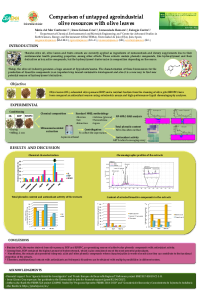
Olive leaves are a source of valuable compounds, including phenolic compounds and triterpenic acids, with applications in the phytopharmacy sector, among others. Nevertheless, there are untapped olive resources that can give new clues for the discovery of natural bioactive compounds. Therefore, in this study the antioxidant composition of olive mill leaves (OML), extracted olive pomace (EOP) and a new byproduct, the residual fraction from olive pit cleaning (RFOPC), was characterized and compared to olive leaves, which have been extensively studied as a source of bioactive compounds. The chemical characterization showed that all these byproducts contain a high amount of extractives; in all cases it was higher than 26%. This is interesting since the extractive fraction contains non-structural compounds, such as phenolic compounds and triterpenic acids. Then, ultrasound-assisted extraction was applied to recover phenolic compounds from this fraction using an aqueous-ethanolic solution. All the extracts showed antioxidant properties and the total phenolic content ranged from 69 (RFOPC) to 140 (EOP) g of gallic acid equivalents/kg dry weight. The profile obtained by liquid chromatography-mass spectrometry was different, suggesting some chemical differences in the phenolic composition. In fact, while olive leafy biomass and EOP contained hydroxytyrosol derivatives, RFOPC was a source of novel trilignols. Other bioactive compounds were found in the extracts, including triterpenic acids, which could give an extra value due to their cardioprotective properties.
Keywords
agro-industrial resources
exhausted olive pomace
multifunctional extracts
olive leaves
residual fraction from olive pit cleaning
Manuscript
Yukino-sciforum_039676_original_proceedings_IECBM_061120.pdf
Poster
sciforum_039676_slides_08_11_2020_IECBM_Contreras.pdf
Chromatographic analysis of iodoacetate encapsulated in liposomes and biochemical assessment of its toxic effect during course application
Inhibition of TNF-Alpha using Plant-Derived Small Molecules for Treatment of Inflammation-Mediated Diseases