Event submissions
Published

This submission belongs to the session PS. Poster Session of the event The 1st International Electronic Conference on Biomolecules
Published date
30 Nov, 2020
Citation
Shadma Wahab, An Experimental study exploring Box-Behnken Design for Optimal Extraction of Phenolics from Olea europaea leaves, in Proceedings of The 1st International Electronic Conference on Biomolecules, 1 December–13 December 2020, MDPI: Basel, Switzerland, doi: 10.3390/IECBM2020-08587
Share
Email
Facebook
Twitter
LinkedIn
An Experimental study exploring Box-Behnken Design for Optimal Extraction of Phenolics from Olea europaea leaves
'%3e%3cpath%20d='M12.6647%2010.9104C12.4176%2010.325%2012.0589%209.7933%2011.6088%209.34485C11.16%208.89511%2010.6283%208.53653%2010.0432%208.28891C10.038%208.28629%2010.0327%208.28498%2010.0275%208.28236C10.8437%207.69282%2011.3743%206.73252%2011.3743%205.64907C11.3743%203.85423%209.92005%202.40002%208.12522%202.40002C6.33038%202.40002%204.87618%203.85423%204.87618%205.64907C4.87618%206.73252%205.40677%207.69282%206.22296%208.28367C6.21772%208.28629%206.21248%208.2876%206.20724%208.29022C5.62031%208.53783%205.09365%208.89287%204.64167%209.34616C4.19192%209.79496%203.83334%2010.3266%203.58573%2010.9117C3.34247%2011.4846%203.21128%2012.0987%203.19925%2012.721C3.1989%2012.735%203.20135%2012.7489%203.20646%2012.7619C3.21157%2012.7749%203.21924%2012.7868%203.22901%2012.7968C3.23877%2012.8068%203.25045%2012.8148%203.26334%2012.8202C3.27623%2012.8256%203.29007%2012.8284%203.30406%2012.8284H4.09012C4.14776%2012.8284%204.19362%2012.7825%204.19493%2012.7262C4.22113%2011.7148%204.62726%2010.7676%205.34519%2010.0497C6.08802%209.30686%207.07452%208.89811%208.12522%208.89811C9.17592%208.89811%2010.1624%209.30686%2010.9052%2010.0497C11.6232%2010.7676%2012.0293%2011.7148%2012.0555%2012.7262C12.0568%2012.7839%2012.1027%2012.8284%2012.1603%2012.8284H12.9464C12.9604%2012.8284%2012.9742%2012.8256%2012.9871%2012.8202C13%2012.8148%2013.0117%2012.8068%2013.0214%2012.7968C13.0312%2012.7868%2013.0389%2012.7749%2013.044%2012.7619C13.0491%2012.7489%2013.0515%2012.735%2013.0512%2012.721C13.0381%2012.0947%2012.9084%2011.4856%2012.6647%2010.9104ZM8.12522%207.90243C7.52388%207.90243%206.95792%207.66793%206.53214%207.24215C6.10636%206.81636%205.87185%206.2504%205.87185%205.64907C5.87185%205.04773%206.10636%204.48177%206.53214%204.05599C6.95792%203.63021%207.52388%203.3957%208.12522%203.3957C8.72655%203.3957%209.29252%203.63021%209.7183%204.05599C10.1441%204.48177%2010.3786%205.04773%2010.3786%205.64907C10.3786%206.2504%2010.1441%206.81636%209.7183%207.24215C9.29252%207.66793%208.72655%207.90243%208.12522%207.90243Z'%20fill='%235D1EE1'/%3e%3c/g%3e%3c/svg%3e)
Shadma Wahab 1
1. king Khalid University
Abstract
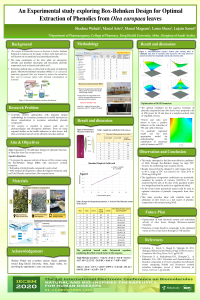
Olea europea is among the top potential plants of the Arabian Peninsula. It is commonly known as Zaytoun in Arabic. The therapeutic qualities of the olive tree are mostly associated with the leaves utilised in infusion or decoction. Olive leaves possessed wide area of pharmacological and medicinal attributes. Currently, process optimization for extraction parameters in herbal infusions to maximize antioxidant phenolic compounds has drawn consideration. There are many reported studies on the health influences of olive leaves; still, there is limited research on the efficient extraction method. This study is intended to examine the optimum microwave-assisted extraction conditions by using response surface methodology with Box–Behnken design for the better extraction output of total phenolic content from olive leaves. Results showed that the obtained % yield ranges from 16 to 48 %, while the range of TPC was found to be from 28.76 to 221.43 mg GAE/g DW. The significance of regression coefficients was statistically examined by analysis of variance (ANOVA). It was analyzed that the lack of fit value of the quadratic model was insignificant, but the model was significantly fitted. So the second-order polynomial model could be used to optimize the extraction of phenolic compounds from olive leaves. This study provides ideas with the scientific basis of utilization of olive leaves as a rich source of phenolic compounds to be extracted using MAE.
Keywords
Olea europea
Response surface methodology
Box–Behnken design
Microwave-assisted extraction
Total phenolic compounds
Manuscript
Biomedicine Abstract revised.pdf
Poster
Shadma Wahab.pdf
Inhibition of TNF-Alpha using Plant-Derived Small Molecules for Treatment of Inflammation-Mediated Diseases
Bactericidal effect of cinnamon leaf oil loaded onto chitosan microcapsules-modified biodegradable hydrogel-like films: an alternative for treating Pseudomonas aeruginosa infections