Event submissions
Published

This submission belongs to the session S1. The natural and bio-inspired drug universe of the event The 1st International Electronic Conference on Biomolecules
Published date
30 Nov, 2020
Citation
Catarina S. Miranda, Joana C. Antunes, Natália C. Homem, Helena P. Felgueiras, Bactericidal effect of cinnamon leaf oil loaded onto chitosan microcapsules-modified biodegradable hydrogel-like films: an alternative for treating Pseudomonas aeruginosa infections, in Proceedings of The 1st International Electronic Conference on Biomolecules, 1 December–13 December 2020, MDPI: Basel, Switzerland, doi: 10.3390/IECBM2020-08588
Share
Email
Facebook
Twitter
LinkedIn
Bactericidal effect of cinnamon leaf oil loaded onto chitosan microcapsules-modified biodegradable hydrogel-like films: an alternative for treating Pseudomonas aeruginosa infections
'%3e%3cpath%20d='M12.6647%2010.9104C12.4176%2010.325%2012.0589%209.7933%2011.6088%209.34485C11.16%208.89511%2010.6283%208.53653%2010.0432%208.28891C10.038%208.28629%2010.0327%208.28498%2010.0275%208.28236C10.8437%207.69282%2011.3743%206.73252%2011.3743%205.64907C11.3743%203.85423%209.92005%202.40002%208.12522%202.40002C6.33038%202.40002%204.87618%203.85423%204.87618%205.64907C4.87618%206.73252%205.40677%207.69282%206.22296%208.28367C6.21772%208.28629%206.21248%208.2876%206.20724%208.29022C5.62031%208.53783%205.09365%208.89287%204.64167%209.34616C4.19192%209.79496%203.83334%2010.3266%203.58573%2010.9117C3.34247%2011.4846%203.21128%2012.0987%203.19925%2012.721C3.1989%2012.735%203.20135%2012.7489%203.20646%2012.7619C3.21157%2012.7749%203.21924%2012.7868%203.22901%2012.7968C3.23877%2012.8068%203.25045%2012.8148%203.26334%2012.8202C3.27623%2012.8256%203.29007%2012.8284%203.30406%2012.8284H4.09012C4.14776%2012.8284%204.19362%2012.7825%204.19493%2012.7262C4.22113%2011.7148%204.62726%2010.7676%205.34519%2010.0497C6.08802%209.30686%207.07452%208.89811%208.12522%208.89811C9.17592%208.89811%2010.1624%209.30686%2010.9052%2010.0497C11.6232%2010.7676%2012.0293%2011.7148%2012.0555%2012.7262C12.0568%2012.7839%2012.1027%2012.8284%2012.1603%2012.8284H12.9464C12.9604%2012.8284%2012.9742%2012.8256%2012.9871%2012.8202C13%2012.8148%2013.0117%2012.8068%2013.0214%2012.7968C13.0312%2012.7868%2013.0389%2012.7749%2013.044%2012.7619C13.0491%2012.7489%2013.0515%2012.735%2013.0512%2012.721C13.0381%2012.0947%2012.9084%2011.4856%2012.6647%2010.9104ZM8.12522%207.90243C7.52388%207.90243%206.95792%207.66793%206.53214%207.24215C6.10636%206.81636%205.87185%206.2504%205.87185%205.64907C5.87185%205.04773%206.10636%204.48177%206.53214%204.05599C6.95792%203.63021%207.52388%203.3957%208.12522%203.3957C8.72655%203.3957%209.29252%203.63021%209.7183%204.05599C10.1441%204.48177%2010.3786%205.04773%2010.3786%205.64907C10.3786%206.2504%2010.1441%206.81636%209.7183%207.24215C9.29252%207.66793%208.72655%207.90243%208.12522%207.90243Z'%20fill='%235D1EE1'/%3e%3c/g%3e%3c/svg%3e)
Catarina S. Miranda 1

Joana C. Antunes 1

Natália C. Homem 1

Helena P. Felgueiras 1
1. Centre for Textile Science and Technology (2C2T), University of Minho
Abstract
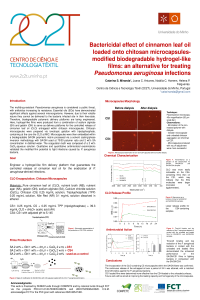
The multidrug-resistant Pseudomonas aeruginosa is considered a public threat, with antibiotics increasing its resistance. Essential oils (EOs) have demonstrated significant effects against several microorganisms. However, due to their volatile nature they cannot be delivered to the bacteria infected site in their free-state. Therefore, biodegradable polymeric delivery platforms are being engineered. Here, hydrogel-like films were produced from a combination of sodium alginate (SA) and gelatin (GN) to serve as delivery platforms for the controlled release of cinnamon leaf oil (CLO) entrapped within chitosan microcapsules. The minimum inhibitory concentration (MIC) of CLO was established at 39.3 mg/mL against P. aeruginosa. Chitosan microcapsules were prepared via ionotropic gelation with tripolyphosphate, containing at the core the CLO at MIC. Successful production was confirmed by fluorescent microscopy using Nile red as detection agent. The encapsulation efficiency and controlled release of the oil were monitored in basic and physiological pH for 24 h. Microcapsules were then embedded within a biodegradable SA/GN polymeric matrix processed via a solvent casting/phase inversion methodology with SA/GN used at 70/30 polymer ratio and 2 wt% SA concentration in distilled water. The coagulation bath was composed of a 2 wt% CaCl2 aqueous solution. The CLO-containing chitosan microcapsules homogeneous distribution was guaranteed by successive vortex and blending processes applied prior to casting. Flexible, highly hydrated films were obtained, with the presence of loaded chitosan capsules being confirmed by FTIR. Qualitative and quantitative antimicrobial examinations validated the modified film potential to fight infections caused by P. aeruginosa bacteria.
Keywords
Bio-based polymers
drug delivery platform
natural extracts
trigger-based release
bactericidal effects
Manuscript
Abstract_International Conference on Biomolecules.pdf
Poster
Poster_Electronic conference on Biomolecules.pdf
An Experimental study exploring Box-Behnken Design for Optimal Extraction of Phenolics from Olea europaea leaves
Propolis loaded sodium alginate/gelatin films cross-linked with Ca2+ for potential wound dressing and healing applications