Event submissions
Published

This submission belongs to the session S2. Antioxidants in Chronic Disease: From Dietary Prevention to Therapeutic Intervention of the event The 1st International E-Conference on Antioxidants in Health and Disease
Published date
30 Nov, 2020
Citation
Miruna S. Stan, Anca Dinischiotu, Evaluating the capacity of several antioxidants to attenuate the renal toxicity induced by methotrexate therapy, in Proceedings of The 1st International E-Conference on Antioxidants in Health and Disease, 1 December–15 December 2020, MDPI: Basel, Switzerland, doi: 10.3390/CAHD2020-08597
Share
Email
Facebook
Twitter
LinkedIn
Evaluating the capacity of several antioxidants to attenuate the renal toxicity induced by methotrexate therapy

Miruna S. Stan 1

Anca Dinischiotu 2
1. Departament of Biochemistry and Molecular Biology, Faculty of Biology, University of Bucharest, 91-95 Splaiul Independentei, 050095 Bucharest, Romania
2. Department of Biochemistry and Molecular Biology, Faculty of Biology, University of Bucharest, 91-95 Splaiul Independentei, 050095 Bucharest, Romania
Abstract
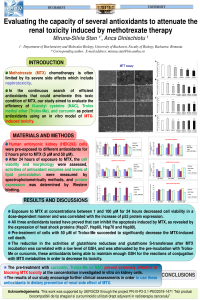
Methotrexate (MTX) chemotherapy is often limited by its severe side effects which include nephrotoxicity. In the continuous search of efficient antioxidants that could ameliorate MTX toxicity, our study aimed to evaluate the efficiency of N-acetyl cysteine (NAC), Trolox methyl ether (Trolox-Me), and curcumin as potent antioxidants using an in vitro model of MTX-induced toxicity.
Human embryonic kidney (HEK293) cells were pre-exposed to different antioxidants for 2 h before MTX treatment. After 24 hours of exposure to MTX, cell viability and morphology were assessed. Activities of antioxidant enzymes and levels of lipid peroxidation were measured by spectrophotometric methods, and protein expression was determined by Western blotting.
Exposure to MTX at concentrations between 1 and 100 μM for 6 and 24 h decreased cell viability in a dose-dependent manner and was correlated with the increase in p53 protein expression. All three antioxidants tested were able to inhibit MTX-induced apoptosis, as revealed by the expression of heat shock proteins (Hsp27, Hsp60, Hsp70, and Hsp90). Pre-treatment of cells with 50 μM of Trolox-Me succeeded to significantly decrease the MTX-induced cell death. The reduction in the activities of glutathione reductase and glutathione S-transferase after MTX treatment was correlated with a reduced level of GSH, and was attenuated by the pre-incubation with Trolox-Me or curcumin. These antioxidants were able to maintain enough GSH for the reactions of conjugation with MTX metabolites in order to decrease its toxicity.
In conclusion, the pre-treatment with curcumin, Trolox-Me, or NAC was significantly effective in blocking MTX toxicity at the concentration investigated in vitro on kidney cells. The results of our study encourage further clinical assessments in order to use these antioxidants in dietary prevention of renal side effects of MTX.
Keywords
methotrexate
HEK cells
antioxidants
nephrotoxicity
Manuscript
sciforum_038108_original_manuscript_Antioxidants2020-done.pdf
Poster
poster Antioxidants2020.pdf
Outcomes Assessment of Sustainable and Innovatively Simple Lifestyle Modification at the Workplace-Drinking Electrolyzed-Reduced Water (OASIS-ERW): A Randomized, Double-Blind, Placebo-Controlled Trial
Antioxidant activity of film forming systems based on melanins from 5,6-dihydroxyindole derivatives