Event submissions
Published

This submission belongs to the session B. Plant Nutrition, Plant Physiology and Metabolism of the event The 1st International Electronic Conference on Plant Science
Published date
30 Nov, 2020
Citation
Elena Ikkonen, Svetlana Chazhengina, Marija Gennad'evma Jurkevich, Nutrient and Water Use Efficiency at Leaf Level of Cucumber Plants under Contrasting Soil Nutrient and Lignosulfonate Level, in Proceedings of The 1st International Electronic Conference on Plant Science, 1 December–15 December 2020, MDPI: Basel, Switzerland, doi: 10.3390/IECPS2020-08611
Share
Email
Facebook
Twitter
LinkedIn
Nutrient and Water Use Efficiency at Leaf Level of Cucumber Plants under Contrasting Soil Nutrient and Lignosulfonate Level
'%3e%3cpath%20d='M12.6647%2010.9104C12.4176%2010.325%2012.0589%209.7933%2011.6088%209.34485C11.16%208.89511%2010.6283%208.53653%2010.0432%208.28891C10.038%208.28629%2010.0327%208.28498%2010.0275%208.28236C10.8437%207.69282%2011.3743%206.73252%2011.3743%205.64907C11.3743%203.85423%209.92005%202.40002%208.12522%202.40002C6.33038%202.40002%204.87618%203.85423%204.87618%205.64907C4.87618%206.73252%205.40677%207.69282%206.22296%208.28367C6.21772%208.28629%206.21248%208.2876%206.20724%208.29022C5.62031%208.53783%205.09365%208.89287%204.64167%209.34616C4.19192%209.79496%203.83334%2010.3266%203.58573%2010.9117C3.34247%2011.4846%203.21128%2012.0987%203.19925%2012.721C3.1989%2012.735%203.20135%2012.7489%203.20646%2012.7619C3.21157%2012.7749%203.21924%2012.7868%203.22901%2012.7968C3.23877%2012.8068%203.25045%2012.8148%203.26334%2012.8202C3.27623%2012.8256%203.29007%2012.8284%203.30406%2012.8284H4.09012C4.14776%2012.8284%204.19362%2012.7825%204.19493%2012.7262C4.22113%2011.7148%204.62726%2010.7676%205.34519%2010.0497C6.08802%209.30686%207.07452%208.89811%208.12522%208.89811C9.17592%208.89811%2010.1624%209.30686%2010.9052%2010.0497C11.6232%2010.7676%2012.0293%2011.7148%2012.0555%2012.7262C12.0568%2012.7839%2012.1027%2012.8284%2012.1603%2012.8284H12.9464C12.9604%2012.8284%2012.9742%2012.8256%2012.9871%2012.8202C13%2012.8148%2013.0117%2012.8068%2013.0214%2012.7968C13.0312%2012.7868%2013.0389%2012.7749%2013.044%2012.7619C13.0491%2012.7489%2013.0515%2012.735%2013.0512%2012.721C13.0381%2012.0947%2012.9084%2011.4856%2012.6647%2010.9104ZM8.12522%207.90243C7.52388%207.90243%206.95792%207.66793%206.53214%207.24215C6.10636%206.81636%205.87185%206.2504%205.87185%205.64907C5.87185%205.04773%206.10636%204.48177%206.53214%204.05599C6.95792%203.63021%207.52388%203.3957%208.12522%203.3957C8.72655%203.3957%209.29252%203.63021%209.7183%204.05599C10.1441%204.48177%2010.3786%205.04773%2010.3786%205.64907C10.3786%206.2504%2010.1441%206.81636%209.7183%207.24215C9.29252%207.66793%208.72655%207.90243%208.12522%207.90243Z'%20fill='%235D1EE1'/%3e%3c/g%3e%3c/svg%3e)
Elena Ikkonen 1
Svetlana Chazhengina 2
Marija Gennad'evma Jurkevich 1
1. 1Institute of Biology, Karelian Research Center RAS
2. Institute of Geology, Karelian Research Center RAS, Puskinskaja, 11, 185610 Petrozavodsk, Russia
Abstract
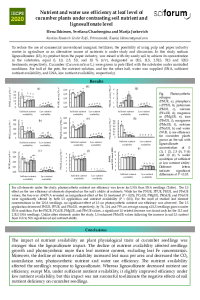
To reduce the use of commercial conventional inorganic fertilizers the possibility of using pulp and paper industry wastes in agriculture as an alternative source of nutrients is recently under study and discussion. This work aimed to evaluate the effect of sodium lignosulfonate application to soil on photosynthetic leaf nutrient- (N, P, K, Ca, Mg, Fe, and Mn) and water- use efficiency. A pot culture experiment was conducted with cucumber seedlings, using five lignosulfonate concentrations (0, 1, 2.5, 5, and 10 vol. %) in sandy soil under sufficient or low nutrient availability for plants. The impact of nutrient availability on plant physiological traits was stronger than the lignosulfonate impact. Under the condition of sufficient nutrient availability, the lignosulfonate application decreased N-, P-, K-, Ca-, Mg-, and Fe- use efficiency, increased Mn- use efficiency and did not change water- use efficiency. The decrease of nutrient- use efficiency was connected with both photosynthetic rate decrease and leaf nutrient content increase. The decline in soil nutrient availability caused a decrease in nutrient and water use efficiency. Under low nutrient availability, soil lignosulfonate tended to increase nutrient- and water- use efficiency, but it was not successful to eliminate the negative effects of soil nutrient deficiency on plant growth, photosynthetic processes, and efficiency of nutrient use.
Keywords
Cucumis sativus
pulp and paper industry wastes
sandy soil
macroelements
photosynthesis
Manuscript
sciforum_038049_original_Ikkonen_et_al-done.pdf
Poster
Poster Ikkonen et al.pdf
The Acclimation Mechanisms of Chlamydomonas reinhardtii against Nitrosative Stress: A Role of NADPH Oxidase (RBOL2) in the Regulation of Nitric Oxide-Mediated ER Stress and Glutathione Redox State
The Essential Oils of Thyme, Sage and Peppermint against Strawberry Anthracnose