Event submissions
Published

This submission belongs to the session S1. Dietary Antioxidants and Health Promotion: From Epidemiology to Policy Making of the event The 1st International E-Conference on Antioxidants in Health and Disease
Published date
01 Dec, 2020
Citation
Johura Ansary, Evaluation of the phenolic profile, mineral, and fatty acid content and antioxidant activity of Black cumin before and after an in vitro simulated gastrointestinal digestion., in Proceedings of The 1st International E-Conference on Antioxidants in Health and Disease, 1 December–15 December 2020, MDPI: Basel, Switzerland, doi: 10.3390/CAHD2020-08638
Share
Email
Facebook
Twitter
LinkedIn
Evaluation of the phenolic profile, mineral, and fatty acid content and antioxidant activity of Black cumin before and after an in vitro simulated gastrointestinal digestion.
'%3e%3cpath%20d='M12.6647%2010.9104C12.4176%2010.325%2012.0589%209.7933%2011.6088%209.34485C11.16%208.89511%2010.6283%208.53653%2010.0432%208.28891C10.038%208.28629%2010.0327%208.28498%2010.0275%208.28236C10.8437%207.69282%2011.3743%206.73252%2011.3743%205.64907C11.3743%203.85423%209.92005%202.40002%208.12522%202.40002C6.33038%202.40002%204.87618%203.85423%204.87618%205.64907C4.87618%206.73252%205.40677%207.69282%206.22296%208.28367C6.21772%208.28629%206.21248%208.2876%206.20724%208.29022C5.62031%208.53783%205.09365%208.89287%204.64167%209.34616C4.19192%209.79496%203.83334%2010.3266%203.58573%2010.9117C3.34247%2011.4846%203.21128%2012.0987%203.19925%2012.721C3.1989%2012.735%203.20135%2012.7489%203.20646%2012.7619C3.21157%2012.7749%203.21924%2012.7868%203.22901%2012.7968C3.23877%2012.8068%203.25045%2012.8148%203.26334%2012.8202C3.27623%2012.8256%203.29007%2012.8284%203.30406%2012.8284H4.09012C4.14776%2012.8284%204.19362%2012.7825%204.19493%2012.7262C4.22113%2011.7148%204.62726%2010.7676%205.34519%2010.0497C6.08802%209.30686%207.07452%208.89811%208.12522%208.89811C9.17592%208.89811%2010.1624%209.30686%2010.9052%2010.0497C11.6232%2010.7676%2012.0293%2011.7148%2012.0555%2012.7262C12.0568%2012.7839%2012.1027%2012.8284%2012.1603%2012.8284H12.9464C12.9604%2012.8284%2012.9742%2012.8256%2012.9871%2012.8202C13%2012.8148%2013.0117%2012.8068%2013.0214%2012.7968C13.0312%2012.7868%2013.0389%2012.7749%2013.044%2012.7619C13.0491%2012.7489%2013.0515%2012.735%2013.0512%2012.721C13.0381%2012.0947%2012.9084%2011.4856%2012.6647%2010.9104ZM8.12522%207.90243C7.52388%207.90243%206.95792%207.66793%206.53214%207.24215C6.10636%206.81636%205.87185%206.2504%205.87185%205.64907C5.87185%205.04773%206.10636%204.48177%206.53214%204.05599C6.95792%203.63021%207.52388%203.3957%208.12522%203.3957C8.72655%203.3957%209.29252%203.63021%209.7183%204.05599C10.1441%204.48177%2010.3786%205.04773%2010.3786%205.64907C10.3786%206.2504%2010.1441%206.81636%209.7183%207.24215C9.29252%207.66793%208.72655%207.90243%208.12522%207.90243Z'%20fill='%235D1EE1'/%3e%3c/g%3e%3c/svg%3e)
Johura Ansary 1
1. Università Politecnica delle Marche
Abstract
Black cumin (N. sativa; Ranunculaceae family) is well known for its numerous beneficial biological effects while its seed extracts exhibit anti-diabetic, anti-cancer, immunomodulatory, anti-microbial, anti-inflammatory, anti-hypertensive and antioxidant activities [1,2]. This study aimed to evaluate the phenolic and mineral contents, chemical composition and antioxidant activity of methanolic extracts from dried black cumin seed powder. Also, we have evaluated, after gastrointestinal digestion, the effect of phenolic components and their antioxidant activity by utilising an in vitro gastrointestinal digestion process. Black cumin showed high amounts of total phenolic and flavonoid contents (such as dihydroxybenzoic acid and ferulic acid) via HPLC analysis. Six mineral elements (Ca, Cu, Fe, K, Se, and Zn) were determined by using coupled plasma mass spectrometry. Twenty five (25) fatty acids (13 saturated, 7 unsaturated and 5 unsaturated omega fatty acids) were identified, by gas chromatography, with linoleic acid being the most abundant. In addition, black cumin methanolic extract presented higher antioxidant capacity measured by DPPH, FRAP and TEAC. Finally, dried black cumin powder was evaluated, after gastrointestinal digestion, with results indicating that phenolics, flavonoids and antioxidant capacity to be increased in the gastric fraction (1.81, 1.03 and 2.1-fold respectively) compared with the undigested methanolic extract. Moreover, a higher amount of total phenolic and flavonoid content as well as a higher total antioxidant capacity were found present in the gastric and elimination fraction than in the bio-accessible fraction (that represent the colon availability). Our results demonstrate a significant reduction in the quantity of phenolic (68%) and flavonoid (95.53%) compounds, after gastrointestinal digestion, in the bio-accessible fraction together with a decrease in total antioxidant activity suggesting that phenolic compounds are responsible for the observed antioxidant activity.
References
- doi=pjbs.2004.441.451
- doi:1016/S1875-5364(16)30088-7
Keywords
Black cumin
polyphenols
mineral content
fatty acid profile
antioxidant. and gastrointestinal digestion
Manuscript
Poster-Johura Ansary.pdf
Poster
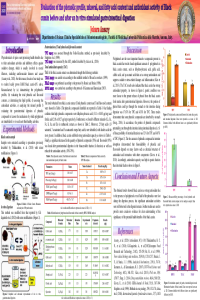
Poster-Johura Ansary.pdf
The preliminary effect of Manuka honey on cancer stem-like cells from colonspheres
Effects of some new antioxidants on apoptosis and ROS production in AFB1 treated chickens