Event submissions
Published

This submission belongs to the session A. Plant Protection, Response to stress and Climate Change of the event The 1st International Electronic Conference on Plant Science
Published date
01 Dec, 2020
Citation
Giovanna Marta Fusco, Emilia Dell’Aversana, Pasqualina Woodrow, Loredana F. Ciarmiello, Petronia Carillo, Remodeling of carbon and nitrogen metabolites in durum wheat: a simple response to complex stimuli, in Proceedings of The 1st International Electronic Conference on Plant Science, 1 December–15 December 2020, MDPI: Basel, Switzerland, doi: 10.3390/IECPS2020-08641
Share
Email
Facebook
Twitter
LinkedIn
Remodeling of carbon and nitrogen metabolites in durum wheat: a simple response to complex stimuli

Giovanna Marta Fusco 1
'%3e%3cpath%20d='M12.6647%2010.9104C12.4176%2010.325%2012.0589%209.7933%2011.6088%209.34485C11.16%208.89511%2010.6283%208.53653%2010.0432%208.28891C10.038%208.28629%2010.0327%208.28498%2010.0275%208.28236C10.8437%207.69282%2011.3743%206.73252%2011.3743%205.64907C11.3743%203.85423%209.92005%202.40002%208.12522%202.40002C6.33038%202.40002%204.87618%203.85423%204.87618%205.64907C4.87618%206.73252%205.40677%207.69282%206.22296%208.28367C6.21772%208.28629%206.21248%208.2876%206.20724%208.29022C5.62031%208.53783%205.09365%208.89287%204.64167%209.34616C4.19192%209.79496%203.83334%2010.3266%203.58573%2010.9117C3.34247%2011.4846%203.21128%2012.0987%203.19925%2012.721C3.1989%2012.735%203.20135%2012.7489%203.20646%2012.7619C3.21157%2012.7749%203.21924%2012.7868%203.22901%2012.7968C3.23877%2012.8068%203.25045%2012.8148%203.26334%2012.8202C3.27623%2012.8256%203.29007%2012.8284%203.30406%2012.8284H4.09012C4.14776%2012.8284%204.19362%2012.7825%204.19493%2012.7262C4.22113%2011.7148%204.62726%2010.7676%205.34519%2010.0497C6.08802%209.30686%207.07452%208.89811%208.12522%208.89811C9.17592%208.89811%2010.1624%209.30686%2010.9052%2010.0497C11.6232%2010.7676%2012.0293%2011.7148%2012.0555%2012.7262C12.0568%2012.7839%2012.1027%2012.8284%2012.1603%2012.8284H12.9464C12.9604%2012.8284%2012.9742%2012.8256%2012.9871%2012.8202C13%2012.8148%2013.0117%2012.8068%2013.0214%2012.7968C13.0312%2012.7868%2013.0389%2012.7749%2013.044%2012.7619C13.0491%2012.7489%2013.0515%2012.735%2013.0512%2012.721C13.0381%2012.0947%2012.9084%2011.4856%2012.6647%2010.9104ZM8.12522%207.90243C7.52388%207.90243%206.95792%207.66793%206.53214%207.24215C6.10636%206.81636%205.87185%206.2504%205.87185%205.64907C5.87185%205.04773%206.10636%204.48177%206.53214%204.05599C6.95792%203.63021%207.52388%203.3957%208.12522%203.3957C8.72655%203.3957%209.29252%203.63021%209.7183%204.05599C10.1441%204.48177%2010.3786%205.04773%2010.3786%205.64907C10.3786%206.2504%2010.1441%206.81636%209.7183%207.24215C9.29252%207.66793%208.72655%207.90243%208.12522%207.90243Z'%20fill='%235D1EE1'/%3e%3c/g%3e%3c/svg%3e)
Emilia Dell’Aversana 1

Pasqualina Woodrow 1

Loredana F. Ciarmiello 1

Petronia Carillo 2
1. Department of Environmental, Biological and Pharmaceutical Sciences and Technologies, University of Campania “Luigi Vanvitelli”, Via Vivaldi 43, 81100 Caserta, Italy
2. University of Campania "Luigi Vanvitelli"
Abstract
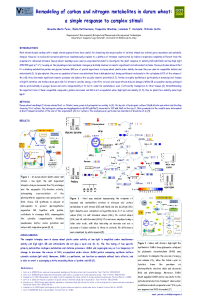
Plant stress studies dealing with a single stress approach have been useful for dissecting stress perception of defined stimuli and related gene expression and metabolic changes. However, in real-world scenarios plants are simultaneously exposed to a plethora of stresses counteracted by mean of tailored responses completely different from the responses to individual stresses. Durum wheat seedlings were used as experimental model to investigate the plant response to salinity (100 mM NaCl) and low/high light (350/900 μmol m–2 s–1) or low/high nitrogen (0.1/10mM KNO3, respectively), focusing on the physiological and metabolic changes potentially involved in osmotic adjustment and antioxidant defense. The data showed that durum wheat plants are able to fine-tune relatively few selected metabolites, in particular proline, amides, GABA, minor amino acids, hexoses and glycine betaine, which may be the key actors in osmotic adjustment, scavenging of ROS, biochemical pH-stat, assimilation of the excess of ammonium, and signaling under the combined stresses. To unravel, in particular, the reason of proline, glycine betaine and GABA accumulation and their possible mode of action, all possible roles for these metabolites under stress are considered, and mechanisms of action triggered by stresses suggested.
Keywords
combined stresses
tailored responses
salinity
high light
proline
glycine betaine
GABA
osmotic adjustment
pH stat
ROS scavenging
Manuscript
abstract.pdf
Poster
Poster Fusco et al. (Carillo).pdf
Beneficial microorganisms: the best partner to improve plant adaptative capacity
Plant Molecular Responses to Salt Stress