Event submissions
Published

This submission belongs to the session S3. Pathways for the discovery of new bio-inspired and natural drugs and their derivatives of the event The 1st International Electronic Conference on Biomolecules
Published date
01 Dec, 2020
Citation
Minerva C. García-Vargas, María del Mar Contreras, Eulogio Castro, Therapeutic bio-compounds from avocado residual biomass, in Proceedings of The 1st International Electronic Conference on Biomolecules, 1 December–13 December 2020, MDPI: Basel, Switzerland, doi: 10.3390/IECBM2020-08656
Share
Email
Facebook
Twitter
LinkedIn
Therapeutic bio-compounds from avocado residual biomass
'%3e%3cpath%20d='M12.6647%2010.9104C12.4176%2010.325%2012.0589%209.7933%2011.6088%209.34485C11.16%208.89511%2010.6283%208.53653%2010.0432%208.28891C10.038%208.28629%2010.0327%208.28498%2010.0275%208.28236C10.8437%207.69282%2011.3743%206.73252%2011.3743%205.64907C11.3743%203.85423%209.92005%202.40002%208.12522%202.40002C6.33038%202.40002%204.87618%203.85423%204.87618%205.64907C4.87618%206.73252%205.40677%207.69282%206.22296%208.28367C6.21772%208.28629%206.21248%208.2876%206.20724%208.29022C5.62031%208.53783%205.09365%208.89287%204.64167%209.34616C4.19192%209.79496%203.83334%2010.3266%203.58573%2010.9117C3.34247%2011.4846%203.21128%2012.0987%203.19925%2012.721C3.1989%2012.735%203.20135%2012.7489%203.20646%2012.7619C3.21157%2012.7749%203.21924%2012.7868%203.22901%2012.7968C3.23877%2012.8068%203.25045%2012.8148%203.26334%2012.8202C3.27623%2012.8256%203.29007%2012.8284%203.30406%2012.8284H4.09012C4.14776%2012.8284%204.19362%2012.7825%204.19493%2012.7262C4.22113%2011.7148%204.62726%2010.7676%205.34519%2010.0497C6.08802%209.30686%207.07452%208.89811%208.12522%208.89811C9.17592%208.89811%2010.1624%209.30686%2010.9052%2010.0497C11.6232%2010.7676%2012.0293%2011.7148%2012.0555%2012.7262C12.0568%2012.7839%2012.1027%2012.8284%2012.1603%2012.8284H12.9464C12.9604%2012.8284%2012.9742%2012.8256%2012.9871%2012.8202C13%2012.8148%2013.0117%2012.8068%2013.0214%2012.7968C13.0312%2012.7868%2013.0389%2012.7749%2013.044%2012.7619C13.0491%2012.7489%2013.0515%2012.735%2013.0512%2012.721C13.0381%2012.0947%2012.9084%2011.4856%2012.6647%2010.9104ZM8.12522%207.90243C7.52388%207.90243%206.95792%207.66793%206.53214%207.24215C6.10636%206.81636%205.87185%206.2504%205.87185%205.64907C5.87185%205.04773%206.10636%204.48177%206.53214%204.05599C6.95792%203.63021%207.52388%203.3957%208.12522%203.3957C8.72655%203.3957%209.29252%203.63021%209.7183%204.05599C10.1441%204.48177%2010.3786%205.04773%2010.3786%205.64907C10.3786%206.2504%2010.1441%206.81636%209.7183%207.24215C9.29252%207.66793%208.72655%207.90243%208.12522%207.90243Z'%20fill='%235D1EE1'/%3e%3c/g%3e%3c/svg%3e)
Minerva C. García-Vargas 1

María del Mar Contreras 2
Eulogio Castro 3
1. Tecnológico Nacional de México / Instituto Tecnológico de Zitácuaro, Mexico
2. Department of Chemical, Environmental and Materials Engineering and Centre for Advanced Studies in Earth Sciences, Energy and Environment (CEACTEMA), University of Jaén, Jaén, Spain.
3. Department of Chemical, Environmental and Materials Engineering and and Centre for Advanced Studies in Earth Sciences, Energy and Environment (CEACTEMA), University of Jaén, Jaén, Spain
Abstract
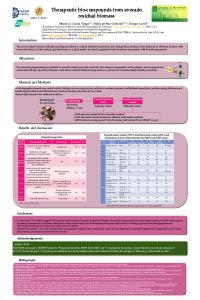
Since ancient times, plants have been used as preservatives, spices, flavorings and as natural remedies to prevent or treat diseases, thanks to the biological activity correlated with the bioactive compounds they contain. The avocado fruit (Persea americana), native to Mexico and Guatemala, has been traditionally used for its pleasant organoleptic characteristics, high nutritional value and health benefits, but its residual biomass (seed, skin and tree leaves) is also valuable in therapeutic terms. For this reason, the present investigation reviews the pharmacological potential of avocado waste. It can serve as a source of antioxidants, hypotensive, anti-analgesic, photoprotective, and anti-inflammatory agents, and to treat skin disorders. These properties are generally attributed to the phenolic composition. The content of phenolic compounds in avocado waste extracts varied between 16 and 307 g/kg dry weight, depending on the waste type and extraction conditions, among others. In particular, our results suggested that using water as solvent, high amount of phenolic compounds can be obtained from the peel (266 g/kg dry weight) and it was correlated with a major antioxidant activity. Thereby the peels can be applied to obtain antioxidants and water can be used as an environmentally friendly extraction solvent for food and pharmacological applications.
Keywords
Avocado peel
avocado seed
avocado leaf
bioactive compounds
Persea americana extracts
phenolic compounds
Manuscript
Layout-sciforum_039672_original_IECBM_Proceeding_Minerva_Contreras_2020.pdf
Poster
IECBM-poster-Minerva-Contreras-2020.pdf
Antiproliferative and apoptotic effects of polyphenol-rich crude methanol extract of Gracillaria edulis against human Rhabdomyosarcoma (RD) and breast adenocarcinoma (MCF-7) cell lines
Lentinan for integrative cancer treatment: an umbrella review