Event submissions
Published

This submission belongs to the session E. Transdermal and Topical Drug Delivery of the event The 1st International Electronic Conference on Pharmaceutics
Published date
01 Dec, 2020
Citation
Jesus Paterna-Paterna, Montserrat Miñarro-Carmona, Jose Ramon TIco-Grau, Antonio Boix-Montañes, Release of Ropinirole from Acrylate-Vinylacetate Transdermal Formulations: Modulation Based on Polymer-Drug Interactions, in Proceedings of The 1st International Electronic Conference on Pharmaceutics, 1 December–15 December 2020, MDPI: Basel, Switzerland, doi: 10.3390/IECP2020-08676
Share
Email
Facebook
Twitter
LinkedIn
Release of Ropinirole from Acrylate-Vinylacetate Transdermal Formulations: Modulation Based on Polymer-Drug Interactions
'%3e%3cpath%20d='M12.6647%2010.9104C12.4176%2010.325%2012.0589%209.7933%2011.6088%209.34485C11.16%208.89511%2010.6283%208.53653%2010.0432%208.28891C10.038%208.28629%2010.0327%208.28498%2010.0275%208.28236C10.8437%207.69282%2011.3743%206.73252%2011.3743%205.64907C11.3743%203.85423%209.92005%202.40002%208.12522%202.40002C6.33038%202.40002%204.87618%203.85423%204.87618%205.64907C4.87618%206.73252%205.40677%207.69282%206.22296%208.28367C6.21772%208.28629%206.21248%208.2876%206.20724%208.29022C5.62031%208.53783%205.09365%208.89287%204.64167%209.34616C4.19192%209.79496%203.83334%2010.3266%203.58573%2010.9117C3.34247%2011.4846%203.21128%2012.0987%203.19925%2012.721C3.1989%2012.735%203.20135%2012.7489%203.20646%2012.7619C3.21157%2012.7749%203.21924%2012.7868%203.22901%2012.7968C3.23877%2012.8068%203.25045%2012.8148%203.26334%2012.8202C3.27623%2012.8256%203.29007%2012.8284%203.30406%2012.8284H4.09012C4.14776%2012.8284%204.19362%2012.7825%204.19493%2012.7262C4.22113%2011.7148%204.62726%2010.7676%205.34519%2010.0497C6.08802%209.30686%207.07452%208.89811%208.12522%208.89811C9.17592%208.89811%2010.1624%209.30686%2010.9052%2010.0497C11.6232%2010.7676%2012.0293%2011.7148%2012.0555%2012.7262C12.0568%2012.7839%2012.1027%2012.8284%2012.1603%2012.8284H12.9464C12.9604%2012.8284%2012.9742%2012.8256%2012.9871%2012.8202C13%2012.8148%2013.0117%2012.8068%2013.0214%2012.7968C13.0312%2012.7868%2013.0389%2012.7749%2013.044%2012.7619C13.0491%2012.7489%2013.0515%2012.735%2013.0512%2012.721C13.0381%2012.0947%2012.9084%2011.4856%2012.6647%2010.9104ZM8.12522%207.90243C7.52388%207.90243%206.95792%207.66793%206.53214%207.24215C6.10636%206.81636%205.87185%206.2504%205.87185%205.64907C5.87185%205.04773%206.10636%204.48177%206.53214%204.05599C6.95792%203.63021%207.52388%203.3957%208.12522%203.3957C8.72655%203.3957%209.29252%203.63021%209.7183%204.05599C10.1441%204.48177%2010.3786%205.04773%2010.3786%205.64907C10.3786%206.2504%2010.1441%206.81636%209.7183%207.24215C9.29252%207.66793%208.72655%207.90243%208.12522%207.90243Z'%20fill='%235D1EE1'/%3e%3c/g%3e%3c/svg%3e)
Jesus Paterna-Paterna 1
Montserrat Miñarro-Carmona 2
Jose Ramon TIco-Grau 1
Antonio Boix-Montañes 1
1. University of Barcelona. Departament of Pharmacy and Pharmaceutical technology and Physico-chemistry
2. Departament de Farmacia i Tecnologia Farmaceutica, i Fisicoquimica, Unitat de Tecnologia Farmacèutica, , Universitat de Barcelona, 08007 Barcelona, Spain
Abstract
Optimization of transdermal formulations requires solving simultaneous challenges as the selection of release polymers. The interactions between the formulation components must be taken as a way to modulate its performance. Selection of acrylic polymers with different functionalizations for the transdermal formulation of a tertiary amine drug (ropinirole HCl) have been investigated. Aim of this work is to characterize the influence over drug release of certain experimental interactions. Solubility-crystalization and pharmacopoeial release tests have been used to evaluate the influence of drug loading and the pH of the release media. Area under the curve of dissolved amounts and percentage of release have been used as discriminant variables in mutual influence with the physical state of the drug. Elucidation of release mechanisms has been performed with data fitting of relevant modelystic equations. Fickian release and erosion contribution have been related with drug loading and the risk of burst effects. In conclusion, a rationale to select the best suitable polymer for ropinirole HCl has been demonstrated in terms of efficiency and extent of release.
Keywords
ropinirole
transdermal
acrylate-vinylacetate copolymer
Manuscript
sciforum-038857-done.pdf
Poster
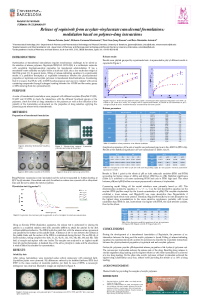
RopiniroleTransdermalRelease_Paterna_Poster.pdf
Design, Preparation and Evaluation of Taste-Masked Dexketoprofen of Orally Disintegrating Tablet By Using QbD Approach
Pharmacokinetic appraisal of carprofen delivery from intra-articular nanoparticles: A population modeling approach in rabbits