Event submissions
Published

This submission belongs to the session D. Advances in Pharmacokinetics and Drug Metabolism of the event The 1st International Electronic Conference on Pharmaceutics
Published date
01 Dec, 2020
Citation
Alexander Parra-Coca, Antonio Boix-Montañes, Ana-Cristina Calpena, Helena Colom, Pharmacokinetic appraisal of carprofen delivery from intra-articular nanoparticles: A population modeling approach in rabbits, in Proceedings of The 1st International Electronic Conference on Pharmaceutics, 1 December–15 December 2020, MDPI: Basel, Switzerland, doi: 10.3390/IECP2020-08677
Share
Email
Facebook
Twitter
LinkedIn
Pharmacokinetic appraisal of carprofen delivery from intra-articular nanoparticles: A population modeling approach in rabbits
'%3e%3cpath%20d='M12.6647%2010.9104C12.4176%2010.325%2012.0589%209.7933%2011.6088%209.34485C11.16%208.89511%2010.6283%208.53653%2010.0432%208.28891C10.038%208.28629%2010.0327%208.28498%2010.0275%208.28236C10.8437%207.69282%2011.3743%206.73252%2011.3743%205.64907C11.3743%203.85423%209.92005%202.40002%208.12522%202.40002C6.33038%202.40002%204.87618%203.85423%204.87618%205.64907C4.87618%206.73252%205.40677%207.69282%206.22296%208.28367C6.21772%208.28629%206.21248%208.2876%206.20724%208.29022C5.62031%208.53783%205.09365%208.89287%204.64167%209.34616C4.19192%209.79496%203.83334%2010.3266%203.58573%2010.9117C3.34247%2011.4846%203.21128%2012.0987%203.19925%2012.721C3.1989%2012.735%203.20135%2012.7489%203.20646%2012.7619C3.21157%2012.7749%203.21924%2012.7868%203.22901%2012.7968C3.23877%2012.8068%203.25045%2012.8148%203.26334%2012.8202C3.27623%2012.8256%203.29007%2012.8284%203.30406%2012.8284H4.09012C4.14776%2012.8284%204.19362%2012.7825%204.19493%2012.7262C4.22113%2011.7148%204.62726%2010.7676%205.34519%2010.0497C6.08802%209.30686%207.07452%208.89811%208.12522%208.89811C9.17592%208.89811%2010.1624%209.30686%2010.9052%2010.0497C11.6232%2010.7676%2012.0293%2011.7148%2012.0555%2012.7262C12.0568%2012.7839%2012.1027%2012.8284%2012.1603%2012.8284H12.9464C12.9604%2012.8284%2012.9742%2012.8256%2012.9871%2012.8202C13%2012.8148%2013.0117%2012.8068%2013.0214%2012.7968C13.0312%2012.7868%2013.0389%2012.7749%2013.044%2012.7619C13.0491%2012.7489%2013.0515%2012.735%2013.0512%2012.721C13.0381%2012.0947%2012.9084%2011.4856%2012.6647%2010.9104ZM8.12522%207.90243C7.52388%207.90243%206.95792%207.66793%206.53214%207.24215C6.10636%206.81636%205.87185%206.2504%205.87185%205.64907C5.87185%205.04773%206.10636%204.48177%206.53214%204.05599C6.95792%203.63021%207.52388%203.3957%208.12522%203.3957C8.72655%203.3957%209.29252%203.63021%209.7183%204.05599C10.1441%204.48177%2010.3786%205.04773%2010.3786%205.64907C10.3786%206.2504%2010.1441%206.81636%209.7183%207.24215C9.29252%207.66793%208.72655%207.90243%208.12522%207.90243Z'%20fill='%235D1EE1'/%3e%3c/g%3e%3c/svg%3e)
Alexander Parra-Coca 1
Antonio Boix-Montañes 2

Ana-Cristina Calpena 2

Helena Colom 2
1. Department of Veterinary Medicine and Zootechnic. Faculty of Agricultural Sciences. University of Applied and Environmental Sciences (U.D.C.A.), Bogotá, COLOMBIA
2. University of Barcelona. Departament of Pharmacy and Pharmaceutical technology and Physico-chemistry
Abstract
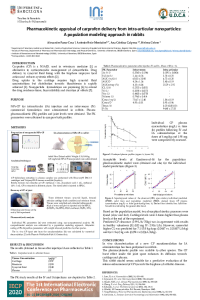
Osteoarthritis is frequently treated in veterinary with non-steroidal anti-inflammatory drugs such as carprofen (CP). The enhancement of its action over the articular cartilage can be achieved by increasing drug uptake into the cartilage, alongside its site of action, and anticipating its rapid distribution towards bloodstream. A pharmacokinetic study to evaluate carprofen nanoparticles (NP) after intraarticular administration (IA) in rabbits has been performed through a modeling allometric approach. The pharmacokinetic analysis of plasma profiles showed a rapid CP distribution outwards synovial chamber but mainly remaining in plasma (Vc = 0.14 L/5 Kg), according to its high protein-binding. The absorption data modeling showed the occurrence of two different release-absorption rate processes after nanoparticles administration in the synovial space, i.e., a fast rate process causing a burst effect and involving the 59.5% of the total CP absorbed amount and a slow rate process, involving the 40.5%. Interestingly, the CP burst effect inside the joint space enhances its diffusion towards cartilage resulting in CP accumulation about three times higher concentrations than in plasma. In line with these results, the normalised-by-dose AUC values after IA administration were 80% lower than those observed after the intravenous. Moreover, the slower slope of the concentration-time terminal phase after IA administration vs. IV suggested a flip-flop phenomenon (0.35 h-1 vs. 0.19 h-1). Of note, CP clearances are predictive of the PK profile of CP in healthy humans (0.14 L/h/5 Kg vs. 2.92 L/h/70 Kg) although an over-estimation has been detected for cats or dogs (10 times and 4 times respectively). This fact could probably be attributed to inter-species metabolic differences. In summary, despite the limited number of animals used, this study shows that the rabbit model could be suitable for a predictive evaluation of the release enhancement of CP-NP towards the biophase in arthritic diseases not due to sterical retention of the formulation.
Keywords
alometric
carprofen
intraarticular
nanoparticles
non-linear-mixed-effects modelling
pharmacokinetics
PLGA-P188
Manuscript
sciforum-038858-done.pdf
Poster
Poster_CarproPK Rabbit_PARRA.pdf
Release of Ropinirole from Acrylate-Vinylacetate Transdermal Formulations: Modulation Based on Polymer-Drug Interactions
NANOTECHNOLOGICAL STRATEGIES FOR ADMINISTRATION OF POORLY SOLUBLE NEUROACTIVE DRUGS