Event submissions
Published

This submission belongs to the session A. Formulation of Poorly Soluble Drugs of the event The 1st International Electronic Conference on Pharmaceutics
Published date
01 Dec, 2020
Citation
Esther Miralles Cardiel, Marcelle Silva-Abreu, Ana Cristina Calpena, Isidre Casals, Nanoparticles as carrier for improve therapeutic efficacy of pioglitazone in ocular inflammatory disorders: development and validation of a high throughput LC–MS/MS method for quantitation in ocular tissues., in Proceedings of The 1st International Electronic Conference on Pharmaceutics, 1 December–15 December 2020, MDPI: Basel, Switzerland, doi: 10.3390/IECP2020-08685
Share
Email
Facebook
Twitter
LinkedIn
Nanoparticles as carrier for improve therapeutic efficacy of pioglitazone in ocular inflammatory disorders: development and validation of a high throughput LC–MS/MS method for quantitation in ocular tissues.
'%3e%3cpath%20d='M12.6647%2010.9104C12.4176%2010.325%2012.0589%209.7933%2011.6088%209.34485C11.16%208.89511%2010.6283%208.53653%2010.0432%208.28891C10.038%208.28629%2010.0327%208.28498%2010.0275%208.28236C10.8437%207.69282%2011.3743%206.73252%2011.3743%205.64907C11.3743%203.85423%209.92005%202.40002%208.12522%202.40002C6.33038%202.40002%204.87618%203.85423%204.87618%205.64907C4.87618%206.73252%205.40677%207.69282%206.22296%208.28367C6.21772%208.28629%206.21248%208.2876%206.20724%208.29022C5.62031%208.53783%205.09365%208.89287%204.64167%209.34616C4.19192%209.79496%203.83334%2010.3266%203.58573%2010.9117C3.34247%2011.4846%203.21128%2012.0987%203.19925%2012.721C3.1989%2012.735%203.20135%2012.7489%203.20646%2012.7619C3.21157%2012.7749%203.21924%2012.7868%203.22901%2012.7968C3.23877%2012.8068%203.25045%2012.8148%203.26334%2012.8202C3.27623%2012.8256%203.29007%2012.8284%203.30406%2012.8284H4.09012C4.14776%2012.8284%204.19362%2012.7825%204.19493%2012.7262C4.22113%2011.7148%204.62726%2010.7676%205.34519%2010.0497C6.08802%209.30686%207.07452%208.89811%208.12522%208.89811C9.17592%208.89811%2010.1624%209.30686%2010.9052%2010.0497C11.6232%2010.7676%2012.0293%2011.7148%2012.0555%2012.7262C12.0568%2012.7839%2012.1027%2012.8284%2012.1603%2012.8284H12.9464C12.9604%2012.8284%2012.9742%2012.8256%2012.9871%2012.8202C13%2012.8148%2013.0117%2012.8068%2013.0214%2012.7968C13.0312%2012.7868%2013.0389%2012.7749%2013.044%2012.7619C13.0491%2012.7489%2013.0515%2012.735%2013.0512%2012.721C13.0381%2012.0947%2012.9084%2011.4856%2012.6647%2010.9104ZM8.12522%207.90243C7.52388%207.90243%206.95792%207.66793%206.53214%207.24215C6.10636%206.81636%205.87185%206.2504%205.87185%205.64907C5.87185%205.04773%206.10636%204.48177%206.53214%204.05599C6.95792%203.63021%207.52388%203.3957%208.12522%203.3957C8.72655%203.3957%209.29252%203.63021%209.7183%204.05599C10.1441%204.48177%2010.3786%205.04773%2010.3786%205.64907C10.3786%206.2504%2010.1441%206.81636%209.7183%207.24215C9.29252%207.66793%208.72655%207.90243%208.12522%207.90243Z'%20fill='%235D1EE1'/%3e%3c/g%3e%3c/svg%3e)
Esther Miralles Cardiel 1,2
Marcelle Silva-Abreu 3,4

Ana Cristina Calpena 3,4
Isidre Casals 1
1. CCiTS (Scientific and Technological Centres), University of Barcelona, Barcelona 08028, Spain.
2. Department of Analytical Chemistry, Faculty of Chemistry, University of Barcelona, Barcelona 08028, Spain.
3. Department of Pharmacy, Pharmaceutical Technology and Physical Chemistry, Faculty of Pharmacy and Food Sciences, University of Barcelona, Barcelona 08028, Spain.
4. Institute of Nanoscience and nanotechnology (IN2UB). Faculty of Pharmacy and Food Sciences, University of Barcelona, Barcelona 08028, Spain.
Abstract
Pioglitazone is an oral anti-hyperglycemic agent and it is used for the treatment of diabetes mellitus type 2. The anti-inflammatory activity has also been demonstrated in the literature. Pioglitazone belongs to Class II of Biopharmaceutical Classification System, i.e., low soluble and high permeable. Polymeric nanoparticles formulations play an important role in the improvement of the efficacy of ocular therapies. These systems are non-toxic and biodegradable, show appropriate physicochemical characteristics as well as prolonged release profile suitable for ocular delivery.
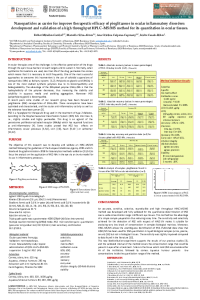
An accurate, sensitive, selective, reproducible and high throughput LC-MS/MS method was validated to quantitate pioglitazone in ocular swine tissues (cornea, sclera, lens, aqueous humour and vitreous humour). The chromatographic separation was achieved in 10 min on a Kinetex C18 column at 35°C, using a mobile phase composed of formic acid 0.1% in water and formic acid 0.1% in acetonitrile in gradient mode at a flow rate of 0.6 mL/min. The detection in the MRM mode for pioglitazone was 357.2/134.1 for quantitation (most sensitive), and 357.2/119.1 for confirmation. Linear response of pioglitazone was observed over the range of 5–100 ng/mL. Tissues were spiked with pioglitazone to obtain final extract levels in ng. The limit of quantitation was in 10 ng/ml in extract. The recovery of pioglitazone was in the range 70-120% % in all tissues and levels tested. The intra-day precision was < 3% and the inter-day precision was <7%. The obtained extracts demonstrated to be stable under various experimental conditions in all the studied matrices. The recovery of pioglitazone spiked at the levels of the validation study, in the form of a nanoparticle formulation of polylactic-co-glycolic acid-polyethyleneglycol (PLGA-PEG), was also found in the range 70-120 % with a precision <7%. This method can be applied to in vivo and ex vivo biodistribution studies related to the ocular administration of pioglitazone nanoparticles.
Keywords
pioglitazone
nanoparticles
PLGA-PEG
ocular
HPLC-MS
validation
Manuscript
sciforum-038925-done.pdf
Poster
Poster Esther_Miralles_Final.pdf
Development of anti-TNFRSF-conjugated nanoparticle and in vitro evaluation of its immunostimulatory effect.
Solid dispersions as a technological strategy to improve the bioperformance of antiparasitic drugs with limited solubility