Event submissions
Published

This submission belongs to the session E. Transdermal and Topical Drug Delivery of the event The 1st International Electronic Conference on Pharmaceutics
Published date
01 Dec, 2020
Citation
Cintia Alejandra Briones Nieva, Mercedes Villegas, Analía Irma Romero, Alicia Graciela Cid, Santiago Nicolás Campos, Elio Emilio Gonzo, Francisco Javier Arias Vallejo, José María Bermúdez, CIPROFLOXACIN RELEASE FROM POLYMERIC FILMS. MODELING AND PHARMACEUTICAL PARAMETERS DETERMINATION, in Proceedings of The 1st International Electronic Conference on Pharmaceutics, 1 December–15 December 2020, MDPI: Basel, Switzerland, doi: 10.3390/IECP2020-08693
Share
Email
Facebook
Twitter
LinkedIn
CIPROFLOXACIN RELEASE FROM POLYMERIC FILMS. MODELING AND PHARMACEUTICAL PARAMETERS DETERMINATION
'%3e%3cpath%20d='M12.6647%2010.9104C12.4176%2010.325%2012.0589%209.7933%2011.6088%209.34485C11.16%208.89511%2010.6283%208.53653%2010.0432%208.28891C10.038%208.28629%2010.0327%208.28498%2010.0275%208.28236C10.8437%207.69282%2011.3743%206.73252%2011.3743%205.64907C11.3743%203.85423%209.92005%202.40002%208.12522%202.40002C6.33038%202.40002%204.87618%203.85423%204.87618%205.64907C4.87618%206.73252%205.40677%207.69282%206.22296%208.28367C6.21772%208.28629%206.21248%208.2876%206.20724%208.29022C5.62031%208.53783%205.09365%208.89287%204.64167%209.34616C4.19192%209.79496%203.83334%2010.3266%203.58573%2010.9117C3.34247%2011.4846%203.21128%2012.0987%203.19925%2012.721C3.1989%2012.735%203.20135%2012.7489%203.20646%2012.7619C3.21157%2012.7749%203.21924%2012.7868%203.22901%2012.7968C3.23877%2012.8068%203.25045%2012.8148%203.26334%2012.8202C3.27623%2012.8256%203.29007%2012.8284%203.30406%2012.8284H4.09012C4.14776%2012.8284%204.19362%2012.7825%204.19493%2012.7262C4.22113%2011.7148%204.62726%2010.7676%205.34519%2010.0497C6.08802%209.30686%207.07452%208.89811%208.12522%208.89811C9.17592%208.89811%2010.1624%209.30686%2010.9052%2010.0497C11.6232%2010.7676%2012.0293%2011.7148%2012.0555%2012.7262C12.0568%2012.7839%2012.1027%2012.8284%2012.1603%2012.8284H12.9464C12.9604%2012.8284%2012.9742%2012.8256%2012.9871%2012.8202C13%2012.8148%2013.0117%2012.8068%2013.0214%2012.7968C13.0312%2012.7868%2013.0389%2012.7749%2013.044%2012.7619C13.0491%2012.7489%2013.0515%2012.735%2013.0512%2012.721C13.0381%2012.0947%2012.9084%2011.4856%2012.6647%2010.9104ZM8.12522%207.90243C7.52388%207.90243%206.95792%207.66793%206.53214%207.24215C6.10636%206.81636%205.87185%206.2504%205.87185%205.64907C5.87185%205.04773%206.10636%204.48177%206.53214%204.05599C6.95792%203.63021%207.52388%203.3957%208.12522%203.3957C8.72655%203.3957%209.29252%203.63021%209.7183%204.05599C10.1441%204.48177%2010.3786%205.04773%2010.3786%205.64907C10.3786%206.2504%2010.1441%206.81636%209.7183%207.24215C9.29252%207.66793%208.72655%207.90243%208.12522%207.90243Z'%20fill='%235D1EE1'/%3e%3c/g%3e%3c/svg%3e)
Cintia Alejandra Briones Nieva 1
Mercedes Villegas 1
Analía Irma Romero 1
Alicia Graciela Cid 1
Santiago Nicolás Campos 2
Elio Emilio Gonzo 2
Francisco Javier Arias Vallejo 3
José María Bermúdez 1
1. INIQUI (Instituto de Investigaciones para la Industria Química). UNSa (Universidad Nacional de Salta). CONICET (Consejo Nacional de Investigaciones Científicas y Técnicas). Facultad de Ingeniería de la UNSa. Salta (ARGENTINA)
2. INIQUI (Instituto de Investigaciones para la Industria Química). UNSa (Universidad Nacional de Salta). CONICET (Consejo Nacional de Investigaciones Científicas y Técnicas). Salta (ARGENTINA)
3. BIOFORGE (Grupo de Materiales Avanzados y Nanobiotecnología). Universidad de Valladolid. Valladolid (ESPAÑA)
Abstract
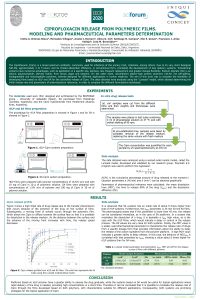
Ciprofloxacin (Cipro) is a broad-spectrum antibiotic used against both Gram (+) and Gram (-) bacteria. Its biological half-life is very short (4-5 hours) and its conventional administration forms present a limited absorption efficiency. For this reason, the aim of this work was to study other administration strategies based on topical films. Sodium alginate (SA), a naturally occurring polymer, and a recombinant elastin-like polymer (rELP) produced by advanced genetic engineering techniques were evaluated as potential carrier systems. The films were obtained by the casting technique, adding the Cipro by direct dispersion in the polymer solution - using 16.6% w/w rELP or 1.5% w/w SA. The in-vitro release assays were performed at 37°C in physiological solution and with orbital shaking at 90 rpm. Cipro concentration was determined by UV spectrophotometry at 276 nm. The release profiles were analyzed and adjusted using the Lumped model developed and validated by our research group. Pharmaceutical interest parameters were calculated and compared for both polymer-Cipro systems: the time required to reach 80% of the drug dissolved (t80%), the Dissolution Efficiency (DE) and the Mean Dissolution Time (MDT). The SA-Cipro platform released the 80% of the drug in 35 min, while this parameter was 209 min for the rELP-Cipro system. The MDT80% was 8.9 and 53 min for the SA-Cipro and rELP-Cipro, respectively, while the DE, evaluated at 200 min, was 66.6 and 58.8 for each platform, respectively. These parameters values demonstrate that the rELP films were able to modulate the drug release rate and for the SA ones, release can be considered immediate. Therefore, both systems are promising strategies for the topical application of Cipro.
Keywords
Ciprofloxacin
topical films
sodium alginate
recombinant elastin-like polymer
mathematical modeling
Manuscript
sciforum-040539-done.pdf
Poster
Poster IECP- Alg rELP cipro - 2020 Final.pdf
Biological studies on cyclodextrins
Key features of Solid Lipid Nanoparticles prepared with nanoclay and spring water ingredients with demonstrated wound healing activity: a pilot study