Event submissions
Published

This submission belongs to the session A. Plant Protection, Response to stress and Climate Change of the event The 1st International Electronic Conference on Plant Science
Published date
01 Dec, 2020
Citation
Francesca Alderotti, Cecilia Brunetti, Giovanni Marino, Barbara Moura, Mauro Centritto, Francesco Ferrini, Cristiana Giordano, Massimiliano Tattini, Antonella Gori, Coordination of morpho-physiological and metabolic traits of C. incanus to overcome heatwave-associated summer drought: a two-year on-site field study, in Proceedings of The 1st International Electronic Conference on Plant Science, 1 December–15 December 2020, MDPI: Basel, Switzerland, doi: 10.3390/IECPS2020-08721
Share
Email
Facebook
Twitter
LinkedIn
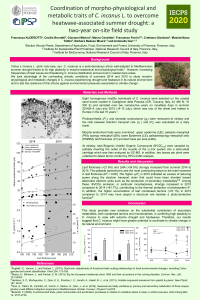
Coordination of morpho-physiological and metabolic traits of C. incanus to overcome heatwave-associated summer drought: a two-year on-site field study

Francesca Alderotti 1

Cecilia Brunetti 2
'%3e%3cpath%20d='M12.6647%2010.9104C12.4176%2010.325%2012.0589%209.7933%2011.6088%209.34485C11.16%208.89511%2010.6283%208.53653%2010.0432%208.28891C10.038%208.28629%2010.0327%208.28498%2010.0275%208.28236C10.8437%207.69282%2011.3743%206.73252%2011.3743%205.64907C11.3743%203.85423%209.92005%202.40002%208.12522%202.40002C6.33038%202.40002%204.87618%203.85423%204.87618%205.64907C4.87618%206.73252%205.40677%207.69282%206.22296%208.28367C6.21772%208.28629%206.21248%208.2876%206.20724%208.29022C5.62031%208.53783%205.09365%208.89287%204.64167%209.34616C4.19192%209.79496%203.83334%2010.3266%203.58573%2010.9117C3.34247%2011.4846%203.21128%2012.0987%203.19925%2012.721C3.1989%2012.735%203.20135%2012.7489%203.20646%2012.7619C3.21157%2012.7749%203.21924%2012.7868%203.22901%2012.7968C3.23877%2012.8068%203.25045%2012.8148%203.26334%2012.8202C3.27623%2012.8256%203.29007%2012.8284%203.30406%2012.8284H4.09012C4.14776%2012.8284%204.19362%2012.7825%204.19493%2012.7262C4.22113%2011.7148%204.62726%2010.7676%205.34519%2010.0497C6.08802%209.30686%207.07452%208.89811%208.12522%208.89811C9.17592%208.89811%2010.1624%209.30686%2010.9052%2010.0497C11.6232%2010.7676%2012.0293%2011.7148%2012.0555%2012.7262C12.0568%2012.7839%2012.1027%2012.8284%2012.1603%2012.8284H12.9464C12.9604%2012.8284%2012.9742%2012.8256%2012.9871%2012.8202C13%2012.8148%2013.0117%2012.8068%2013.0214%2012.7968C13.0312%2012.7868%2013.0389%2012.7749%2013.044%2012.7619C13.0491%2012.7489%2013.0515%2012.735%2013.0512%2012.721C13.0381%2012.0947%2012.9084%2011.4856%2012.6647%2010.9104ZM8.12522%207.90243C7.52388%207.90243%206.95792%207.66793%206.53214%207.24215C6.10636%206.81636%205.87185%206.2504%205.87185%205.64907C5.87185%205.04773%206.10636%204.48177%206.53214%204.05599C6.95792%203.63021%207.52388%203.3957%208.12522%203.3957C8.72655%203.3957%209.29252%203.63021%209.7183%204.05599C10.1441%204.48177%2010.3786%205.04773%2010.3786%205.64907C10.3786%206.2504%2010.1441%206.81636%209.7183%207.24215C9.29252%207.66793%208.72655%207.90243%208.12522%207.90243Z'%20fill='%235D1EE1'/%3e%3c/g%3e%3c/svg%3e)
Giovanni Marino 2
Barbara Moura 3

Mauro Centritto 2

Francesco Ferrini 4
Cristiana Giordano 5
Massimiliano Tattini 2

Antonella Gori 6
1. 1University of Florence, Department of Agriculture, Food, Environment and Forest, Section Woody
Plants, Italy.
2. Institute for Sustainable Plant Protection, CNR, Sesto Fiorentino, Italy.
3. Institute of Research on Terrestrial Ecosystems (IRET), National Research Council (CNR)
4. University of Florence, Department of Agriculture, Food, Environment and Forest, Section Woody
Plants, Italy.
5. Institute for Bioeconomy, Italian National Research Council, Italy.
6. University of Florence, Department of Agriculture, Food, Environment and Forest, Section Woody Plants, Italy.
Abstract
The shrub Cistus incanus L. is well adapted to Mediterranean conditions thanks to its morpho-anatomical, physiological and biochemical traits. However, its distribution and survival in coastal dunes will be likely threatened by ongoing runaway climate change. We investigated how the harsh climatic conditions generated by the 2015 summer heat wave triggered specific anatomical, physiological and biochemical responses of this species in its natural environment. These adjustments were compared to those measured in summer 2014. The drier and hotter conditions of summer 2015 determined an increment in leaf lamina thickness, due to a greater palisade parenchyma, thus leading to an increase in the whole leaf mass per area. These morphoanatomical adjustments enhanced leaf resistance against dehydration, optimized carbon assimilation, and delayed leaf senescence.
In addition, the activation of secondary metabolic pathways, in particular the biosynthesis of tannins and monoterpenes, helped prevent oxidative stress through the consumption of excess reducing power, thus contributing to the maintenance of physiological performances even under hotter and drier conditions. In conclusion, our study offers new evidence on the integration of morphophysiological and metabolic adjustments of this species growing in its natural habitat to cope with ongoing climate change.
Keywords
drought
Flavonols
heat wave
leaf morpho-anatomical traits
Mediterranean maquis
Monoterpenes
Photosynthesis
Tannins.
Manuscript
1IECPS_Alderotti_F_Abstract.pdf
Poster
1IECPS_Alderotti_F_Poster.pdf
Grapes Enrichment with Zinc for Vinification: Mineral Analysis with Atomic Absorption Spectrophotometry, XRF and Tissue Analysis
Extracts of non-microcystin-producing cyanobacteria affect the plant cytoskeleton and cell cycle