Event submissions
Published

This submission belongs to the session E. Plant Outreach and Educational Resources of the event The 1st International Electronic Conference on Plant Science
Published date
01 Dec, 2020
Citation
Laura Bentley, Savia Palate, Pamela Anahi Ribone, Elizabeth M Tennyson, 2050: A New World—Observations from a Policy-Making Board Game for Climate Change Engagement, in Proceedings of The 1st International Electronic Conference on Plant Science, 1 December–15 December 2020, MDPI: Basel, Switzerland, doi: 10.3390/IECPS2020-08763
Share
Email
Facebook
Twitter
LinkedIn
2050: A New World—Observations from a Policy-Making Board Game for Climate Change Engagement
'%3e%3cpath%20d='M12.6647%2010.9104C12.4176%2010.325%2012.0589%209.7933%2011.6088%209.34485C11.16%208.89511%2010.6283%208.53653%2010.0432%208.28891C10.038%208.28629%2010.0327%208.28498%2010.0275%208.28236C10.8437%207.69282%2011.3743%206.73252%2011.3743%205.64907C11.3743%203.85423%209.92005%202.40002%208.12522%202.40002C6.33038%202.40002%204.87618%203.85423%204.87618%205.64907C4.87618%206.73252%205.40677%207.69282%206.22296%208.28367C6.21772%208.28629%206.21248%208.2876%206.20724%208.29022C5.62031%208.53783%205.09365%208.89287%204.64167%209.34616C4.19192%209.79496%203.83334%2010.3266%203.58573%2010.9117C3.34247%2011.4846%203.21128%2012.0987%203.19925%2012.721C3.1989%2012.735%203.20135%2012.7489%203.20646%2012.7619C3.21157%2012.7749%203.21924%2012.7868%203.22901%2012.7968C3.23877%2012.8068%203.25045%2012.8148%203.26334%2012.8202C3.27623%2012.8256%203.29007%2012.8284%203.30406%2012.8284H4.09012C4.14776%2012.8284%204.19362%2012.7825%204.19493%2012.7262C4.22113%2011.7148%204.62726%2010.7676%205.34519%2010.0497C6.08802%209.30686%207.07452%208.89811%208.12522%208.89811C9.17592%208.89811%2010.1624%209.30686%2010.9052%2010.0497C11.6232%2010.7676%2012.0293%2011.7148%2012.0555%2012.7262C12.0568%2012.7839%2012.1027%2012.8284%2012.1603%2012.8284H12.9464C12.9604%2012.8284%2012.9742%2012.8256%2012.9871%2012.8202C13%2012.8148%2013.0117%2012.8068%2013.0214%2012.7968C13.0312%2012.7868%2013.0389%2012.7749%2013.044%2012.7619C13.0491%2012.7489%2013.0515%2012.735%2013.0512%2012.721C13.0381%2012.0947%2012.9084%2011.4856%2012.6647%2010.9104ZM8.12522%207.90243C7.52388%207.90243%206.95792%207.66793%206.53214%207.24215C6.10636%206.81636%205.87185%206.2504%205.87185%205.64907C5.87185%205.04773%206.10636%204.48177%206.53214%204.05599C6.95792%203.63021%207.52388%203.3957%208.12522%203.3957C8.72655%203.3957%209.29252%203.63021%209.7183%204.05599C10.1441%204.48177%2010.3786%205.04773%2010.3786%205.64907C10.3786%206.2504%2010.1441%206.81636%209.7183%207.24215C9.29252%207.66793%208.72655%207.90243%208.12522%207.90243Z'%20fill='%235D1EE1'/%3e%3c/g%3e%3c/svg%3e)
Laura Bentley 1
Savia Palate 2
Pamela Anahi Ribone 3
Elizabeth M Tennyson 4
1. Forest Ecology and conservation, Plant Sciences Department, University of Cambridge
2. University of Cambridge
3. The Sainsbury Laboratory Cambridge University
4. Cavendish Laboratory, 19 JJ Thomson Avenue, University of Cambridge, Cambridge CB3 0HE, UK
Abstract
This project focuses on the development and impact of 2050 - A New World: a policy-making boardgame that makes players balance city development with climate change mitigation, to make the best future they can. They must make tough decisions with limited resources and consider what they are willing to change for a sustainable, resilient life. The game is intended to encourage creative thinking about sustainability, and emphasise the difficult trade offs and feedbacks involved in combating climate change.
Each round, players must create policies that move their assigned city towards its international commitments on sustainability and prevent environmental collapse, by reallocating or improving resources from five systems: energy, food, nature, shelter, and water. Throughout the game, progressively worsening climate events interact with your resource state, in a way that reflects the real-world risks to each city. The diversity of circumstances between cities helps to communicate the impacts of climate change in a global context, which players explore through debate. Social variables, such as inequality, population density, food security and aversion to some technological solutions, are all embedded within the game play.
In 2019, the game was played by three cohorts of people, from a wide range of age groups, backgrounds, and interests, hosted by the Cambridge Festival of Ideas. We found the compressed time frame of policy enactment and consequence provided a new perspective on real life decisions for the players. We observed that a dynamic environment developed, facilitating debate around topics that are associated with complex societal perceptions, such as deforestation, diet, and the use of transgenic crops. The game encourages the players to face tough choices creatively, and their policies, successes and failures reflect the values they brought to the table. We discuss the insights gained from this process in the context of sustainability and science communication.
Keywords
climate change
policy
resources
global
education
outreach
Manuscript
sciforum_036492_original_Article_IECPS_2050_anewworld_engagement-DONE.pdf
Poster
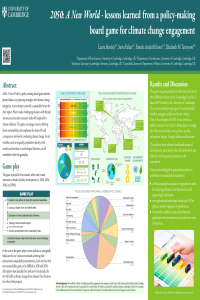
IECPS_Poster_2050_anewworld_engagement.pdf
Polycyclic Aromatic Hydrocarbons in Commercial Herbal Teas
Reactive Oxygen Species in Host-Plant Are Required for an Early Defense Response Against Attack of Stagonospora nodorum Berk. Necrotrophic Effectors SnTox