Event submissions
Published

This submission belongs to the session B. Plant Nutrition, Plant Physiology and Metabolism of the event The 1st International Electronic Conference on Plant Science
Published date
01 Dec, 2020
Citation
Anjali A. Kulkarni, Anuja Kamble, Flavonoids from Argyreia nervosa (Burm.f) Bojer: A Ready Arsenal against Pests as Well as Diabetes, in Proceedings of The 1st International Electronic Conference on Plant Science, 1 December–15 December 2020, MDPI: Basel, Switzerland, doi: 10.3390/IECPS2020-08773
Share
Email
Facebook
Twitter
LinkedIn
Flavonoids from Argyreia nervosa (Burm.f) Bojer: A Ready Arsenal against Pests as Well as Diabetes
'%3e%3cpath%20d='M12.6647%2010.9104C12.4176%2010.325%2012.0589%209.7933%2011.6088%209.34485C11.16%208.89511%2010.6283%208.53653%2010.0432%208.28891C10.038%208.28629%2010.0327%208.28498%2010.0275%208.28236C10.8437%207.69282%2011.3743%206.73252%2011.3743%205.64907C11.3743%203.85423%209.92005%202.40002%208.12522%202.40002C6.33038%202.40002%204.87618%203.85423%204.87618%205.64907C4.87618%206.73252%205.40677%207.69282%206.22296%208.28367C6.21772%208.28629%206.21248%208.2876%206.20724%208.29022C5.62031%208.53783%205.09365%208.89287%204.64167%209.34616C4.19192%209.79496%203.83334%2010.3266%203.58573%2010.9117C3.34247%2011.4846%203.21128%2012.0987%203.19925%2012.721C3.1989%2012.735%203.20135%2012.7489%203.20646%2012.7619C3.21157%2012.7749%203.21924%2012.7868%203.22901%2012.7968C3.23877%2012.8068%203.25045%2012.8148%203.26334%2012.8202C3.27623%2012.8256%203.29007%2012.8284%203.30406%2012.8284H4.09012C4.14776%2012.8284%204.19362%2012.7825%204.19493%2012.7262C4.22113%2011.7148%204.62726%2010.7676%205.34519%2010.0497C6.08802%209.30686%207.07452%208.89811%208.12522%208.89811C9.17592%208.89811%2010.1624%209.30686%2010.9052%2010.0497C11.6232%2010.7676%2012.0293%2011.7148%2012.0555%2012.7262C12.0568%2012.7839%2012.1027%2012.8284%2012.1603%2012.8284H12.9464C12.9604%2012.8284%2012.9742%2012.8256%2012.9871%2012.8202C13%2012.8148%2013.0117%2012.8068%2013.0214%2012.7968C13.0312%2012.7868%2013.0389%2012.7749%2013.044%2012.7619C13.0491%2012.7489%2013.0515%2012.735%2013.0512%2012.721C13.0381%2012.0947%2012.9084%2011.4856%2012.6647%2010.9104ZM8.12522%207.90243C7.52388%207.90243%206.95792%207.66793%206.53214%207.24215C6.10636%206.81636%205.87185%206.2504%205.87185%205.64907C5.87185%205.04773%206.10636%204.48177%206.53214%204.05599C6.95792%203.63021%207.52388%203.3957%208.12522%203.3957C8.72655%203.3957%209.29252%203.63021%209.7183%204.05599C10.1441%204.48177%2010.3786%205.04773%2010.3786%205.64907C10.3786%206.2504%2010.1441%206.81636%209.7183%207.24215C9.29252%207.66793%208.72655%207.90243%208.12522%207.90243Z'%20fill='%235D1EE1'/%3e%3c/g%3e%3c/svg%3e)
Anjali A. Kulkarni 1
Anuja Kamble 2
1. Department of Botany, Savitribai Phule Pune University (Formerly University of Pune), Ganeshkhind Road, Pune 411007, Maharashtra, India.
2. Department of Botany, Savitribai Phule Pune University
Abstract
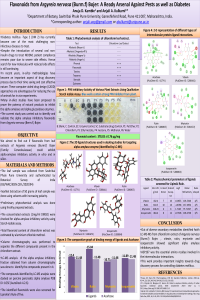
Diabetes mellitus -Type 2 (DM 2) has currently become one of the most challenging non-infectious diseases to treat. Enzymes such as alpha-amylase and alpha-glucosidase involved in carbohydrate metabolism are useful targets to treat the disease. Plants produce an immense variety of flavonoids with diverse biological activities. They are involved in interactions with other plants, animals and microbes. They can act as anti-microbial toxins or as anti- or pro-oxidants.
We aimed to find out if flavonoids from leaf extracts of Argyreia nervosa (Burm.f) Bojer (Family: Convolvulaceae) could exhibit alpha-amylase inhibitory activity in vitro and in silico. The leaf flavonoids were extracted in chloroform by routine protocols and their profiling was carried out using LC-MS technique. The chloroform extract was also tested for its inhibitory activity against porcine pancreatic alpha-amylase enzyme in vitro, where it showed excellent inhibition.
The molecular docking study was done only for flavonoids from LC-MS compound list using AutoDock 4.2.6. The compounds were docked against porcine pancreatic alpha-amylase (PDB ID: 1OSE). This structure already contained a bound molecule of ‘Acarbose’ (a prescribed drug, an amylase inhibitor and positive control in our in vitro experiments). Out of these, top 4 flavonoids, Vitexin (Apigenin 8-C Glucoside, a flavone), Rutin (a flavonol), Myricetin (a flavonol) and Isoquercetin (a flavonol), showed the highest binding energies of -12.4 kcal/mol, -15.04 kcal/mol, -10.71 kcal/mol and -11.89 kcal/mol respectively. ‘Acarbose’ had binding energy of -11.48 kcal/mol. Thus all the 4 secondary metabolites showed comparable or higher binding energies than Acarbose. The ligands interacting with the amino acid residues ASP 197, GLU 233, TRP 97 of Amylase protein seemed to show an excellent inhibitory effect among the 15 secondary metabolites studied. This is also proven by our experimental data which will be discussed in detail.
Keywords
Argyreia nervosa
Diabetes
Flavonoids
Amylase inhibition
Manuscript
sciforum_036343-done.pdf
Poster
Flavonoids from Argyreia nervosa-Poster-Kamble-Kulkarni-India.pdf
Effects of Metformin on Antioxidative Response of Lactuca sativa Plants
Qualitative Screening of Phytocompounds and Spectrophotometric Investigations of two Pumpkin Species