Event submissions
Published

This submission belongs to the session E. Transdermal and Topical Drug Delivery of the event The 1st International Electronic Conference on Pharmaceutics
Published date
01 Dec, 2020
Citation
Noelia Nieto González, Antonella Obinu, Elisabetta Gavini, Paolo Giunchedi, Giovanna Rassu, Cellulose acetate phthalate-chitosan based nanoparticles for transdermal delivery of captopril in pediatric patients, in Proceedings of The 1st International Electronic Conference on Pharmaceutics, 1 December–15 December 2020, MDPI: Basel, Switzerland, doi: 10.3390/IECP2020-08786
Share
Email
Facebook
Twitter
LinkedIn
Cellulose acetate phthalate-chitosan based nanoparticles for transdermal delivery of captopril in pediatric patients
'%3e%3cpath%20d='M12.6647%2010.9104C12.4176%2010.325%2012.0589%209.7933%2011.6088%209.34485C11.16%208.89511%2010.6283%208.53653%2010.0432%208.28891C10.038%208.28629%2010.0327%208.28498%2010.0275%208.28236C10.8437%207.69282%2011.3743%206.73252%2011.3743%205.64907C11.3743%203.85423%209.92005%202.40002%208.12522%202.40002C6.33038%202.40002%204.87618%203.85423%204.87618%205.64907C4.87618%206.73252%205.40677%207.69282%206.22296%208.28367C6.21772%208.28629%206.21248%208.2876%206.20724%208.29022C5.62031%208.53783%205.09365%208.89287%204.64167%209.34616C4.19192%209.79496%203.83334%2010.3266%203.58573%2010.9117C3.34247%2011.4846%203.21128%2012.0987%203.19925%2012.721C3.1989%2012.735%203.20135%2012.7489%203.20646%2012.7619C3.21157%2012.7749%203.21924%2012.7868%203.22901%2012.7968C3.23877%2012.8068%203.25045%2012.8148%203.26334%2012.8202C3.27623%2012.8256%203.29007%2012.8284%203.30406%2012.8284H4.09012C4.14776%2012.8284%204.19362%2012.7825%204.19493%2012.7262C4.22113%2011.7148%204.62726%2010.7676%205.34519%2010.0497C6.08802%209.30686%207.07452%208.89811%208.12522%208.89811C9.17592%208.89811%2010.1624%209.30686%2010.9052%2010.0497C11.6232%2010.7676%2012.0293%2011.7148%2012.0555%2012.7262C12.0568%2012.7839%2012.1027%2012.8284%2012.1603%2012.8284H12.9464C12.9604%2012.8284%2012.9742%2012.8256%2012.9871%2012.8202C13%2012.8148%2013.0117%2012.8068%2013.0214%2012.7968C13.0312%2012.7868%2013.0389%2012.7749%2013.044%2012.7619C13.0491%2012.7489%2013.0515%2012.735%2013.0512%2012.721C13.0381%2012.0947%2012.9084%2011.4856%2012.6647%2010.9104ZM8.12522%207.90243C7.52388%207.90243%206.95792%207.66793%206.53214%207.24215C6.10636%206.81636%205.87185%206.2504%205.87185%205.64907C5.87185%205.04773%206.10636%204.48177%206.53214%204.05599C6.95792%203.63021%207.52388%203.3957%208.12522%203.3957C8.72655%203.3957%209.29252%203.63021%209.7183%204.05599C10.1441%204.48177%2010.3786%205.04773%2010.3786%205.64907C10.3786%206.2504%2010.1441%206.81636%209.7183%207.24215C9.29252%207.66793%208.72655%207.90243%208.12522%207.90243Z'%20fill='%235D1EE1'/%3e%3c/g%3e%3c/svg%3e)
Noelia Nieto González 1
Antonella Obinu 1

Elisabetta Gavini 1
Paolo Giunchedi 1

Giovanna Rassu 1
1. Department of Chemistry and Pharmacy, University of Sassari, Sassari, Italy.
Abstract
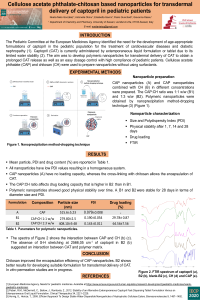
The Pediatric Committee at the European Medicines Agency identified the needs of the development of age-appropriate formulation of captopril in pediatric population for the treatment of cardiovascular diseases and diabetic nephropathy. Captopril (CAT) is currently administered by extemporaneous liquid formulation or tablet due to its limited water stability. Therefore, polymeric nanoparticles were developed for transdermal delivery of CAT for obtaining a prolonged CAT release as well as an easy dosage control with high compliance of pediatric patients. Cellulose acetate phthalate (CAP) and chitosan (CH) were chosen to prepare nanoparticles by nanoprecipitation method-dropping technique without using surfactants. CAP nanoparticles and CAP nanoparticles combined with CH in different concentrations (1:1 w/w and 1:3 w/w) were produced both unloaded and loaded with CAT. Nanoparticles were characterized in terms of size, drug loading efficiency and physical stability during the time (1-28 days). Chemical stability of drug in the dispersion was investigated. Results show that CAP nanoparticles have no drug loading capacity, whereas CH allows the encapsulation of CAT; highest drug loading is obtained when 1:3 CAP:CH w/w ratio was used (64.6±7.6%). The particle preparation at 60°C enhances the interaction of CAT with the polymer matrix. The size of loaded CAP nanoparticles is 515.6±5.2 nm, whereas that of CAP-CH nanoparticles is 279.8±2.5 nm (1:1 w/w ratio) and 408.1±9.5 nm (1:1 w/w ratio) with a PDI values around 0.2, resulting in a homogeneous system. Good physical stability of all formulations during the time is observed. At the moment, CAT appears stable in the dispersions. In conclusion, CAP-CH nanoparticles prepared using a 1:3 w/w ratio show good properties for developing suitable formulation for transdermal delivery of CAT.
Keywords
Captopril
Pediatric patients
Cellulose acetate phthalate
Chitosan
Nanoparticles
Manuscript
poster IECP 2020.pdf
Poster
poster IECP 2020.pdf
INCLUSION COMPLEXES OF NEW IBUPROFEN THIAZOLIDIN-4-ONES WITH β-CYCLODEXTRIN
Time course study of oxyresveratrol inclusion complexes in aqueous solutions