Event submissions
Published

This submission belongs to the session B. Cyclodextrins in Pharmaceutics of the event The 1st International Electronic Conference on Pharmaceutics
Published date
01 Dec, 2020
Citation
Silvia Navarro-Orcajada, Adrián Matencio, Francisco García-Carmona, José Manuel López-Nicolás, Cyclodextrin inclusion complexes with caffeoylquinic acids as bioactive compounds, in Proceedings of The 1st International Electronic Conference on Pharmaceutics, 1 December–15 December 2020, MDPI: Basel, Switzerland, doi: 10.3390/IECP2020-08788
Share
Email
Facebook
Twitter
LinkedIn
Cyclodextrin inclusion complexes with caffeoylquinic acids as bioactive compounds
'%3e%3cpath%20d='M12.6647%2010.9104C12.4176%2010.325%2012.0589%209.7933%2011.6088%209.34485C11.16%208.89511%2010.6283%208.53653%2010.0432%208.28891C10.038%208.28629%2010.0327%208.28498%2010.0275%208.28236C10.8437%207.69282%2011.3743%206.73252%2011.3743%205.64907C11.3743%203.85423%209.92005%202.40002%208.12522%202.40002C6.33038%202.40002%204.87618%203.85423%204.87618%205.64907C4.87618%206.73252%205.40677%207.69282%206.22296%208.28367C6.21772%208.28629%206.21248%208.2876%206.20724%208.29022C5.62031%208.53783%205.09365%208.89287%204.64167%209.34616C4.19192%209.79496%203.83334%2010.3266%203.58573%2010.9117C3.34247%2011.4846%203.21128%2012.0987%203.19925%2012.721C3.1989%2012.735%203.20135%2012.7489%203.20646%2012.7619C3.21157%2012.7749%203.21924%2012.7868%203.22901%2012.7968C3.23877%2012.8068%203.25045%2012.8148%203.26334%2012.8202C3.27623%2012.8256%203.29007%2012.8284%203.30406%2012.8284H4.09012C4.14776%2012.8284%204.19362%2012.7825%204.19493%2012.7262C4.22113%2011.7148%204.62726%2010.7676%205.34519%2010.0497C6.08802%209.30686%207.07452%208.89811%208.12522%208.89811C9.17592%208.89811%2010.1624%209.30686%2010.9052%2010.0497C11.6232%2010.7676%2012.0293%2011.7148%2012.0555%2012.7262C12.0568%2012.7839%2012.1027%2012.8284%2012.1603%2012.8284H12.9464C12.9604%2012.8284%2012.9742%2012.8256%2012.9871%2012.8202C13%2012.8148%2013.0117%2012.8068%2013.0214%2012.7968C13.0312%2012.7868%2013.0389%2012.7749%2013.044%2012.7619C13.0491%2012.7489%2013.0515%2012.735%2013.0512%2012.721C13.0381%2012.0947%2012.9084%2011.4856%2012.6647%2010.9104ZM8.12522%207.90243C7.52388%207.90243%206.95792%207.66793%206.53214%207.24215C6.10636%206.81636%205.87185%206.2504%205.87185%205.64907C5.87185%205.04773%206.10636%204.48177%206.53214%204.05599C6.95792%203.63021%207.52388%203.3957%208.12522%203.3957C8.72655%203.3957%209.29252%203.63021%209.7183%204.05599C10.1441%204.48177%2010.3786%205.04773%2010.3786%205.64907C10.3786%206.2504%2010.1441%206.81636%209.7183%207.24215C9.29252%207.66793%208.72655%207.90243%208.12522%207.90243Z'%20fill='%235D1EE1'/%3e%3c/g%3e%3c/svg%3e)
Silvia Navarro-Orcajada 1

Adrián Matencio 2
Francisco García-Carmona 1

José Manuel López-Nicolás 1
1. Universidad de Murcia
2. Università di Torino
Abstract
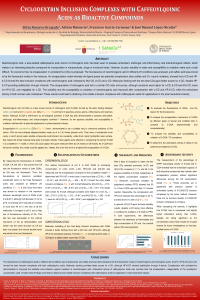
Neochlorogenic acid, a less-studied caffeoylquinic acid, isomer of chlorogenic acid, has been seen to possess antioxidant, antifungal, anti-inflammatory and anticarcinogenic effects, which makes it an interesting bioactive compound for incorporation in drugs, nutraceuticals or functional foods. However, its poor solubility in water and susceptibility to oxidation make such a task difficult. To overcome that, its encapsulation in cyclodextrins (CDs) is proposed. The fluorescence of neochlorogenic acid in different pH conditions was analyzed, and caffeic acid was proved to be the fluorescent moiety in the molecule. An encapsulation model whereby the ligand poses two potential complexation sites (caffeic and D-(-)-quinic moieties), showed that α-CD and HP-β-CD formed the best inclusion complexes with neochlorogenic acid, followed by M-β-CD, β-CD and γ-CD. Molecular docking with the two best CDs gave better scores for α-CD, despite HP-β-CD providing stabilization through H-bonds. The encapsulation of chlorogenic acid led to a similar CD order and scores, although constants were higher for α-CD, β-CD and M-β-CD, lower for HP-β-CD, and negligible for γ-CD. The solubility and the susceptibility to oxidation of neochlorogenic acid improved after complexation with α-CD and HP-β-CD, while the antioxidant activity of both isomers was maintained. These results could lead to obtaining more stable inclusion complexes with caffeoylquinic acids for applications in the pharmaceutical industry.
Keywords
Neochlorogenic acid
Caffeoylquinic acids
Cyclodextrins
Encapsulation
Fluorescence
Manuscript
Abstract IECP2020 (S).pdf
Poster
Poster Silvia.pdf
Time course study of oxyresveratrol inclusion complexes in aqueous solutions
In vitro and in vivo ophthalmic bioadhesion and ocular safety characterization of cyclodextrin based solution