Event submissions
Published

This submission belongs to the session E. Transdermal and Topical Drug Delivery of the event The 1st International Electronic Conference on Pharmaceutics
Published date
01 Dec, 2020
Citation
Rubén Varela-Fernández, Xurxo García-Otero, Victoria Díaz-Tomé, Miguel González-Barcia, Isabel Lema, Francisco J. Otero-Espinar, Design, preparation, and characterization of lactoferrin-loaded sulfobutylether-β-cyclodextrin/chitosan nanoparticles as a therapeutic alternative for keratoconus treatment, in Proceedings of The 1st International Electronic Conference on Pharmaceutics, 1 December–15 December 2020, MDPI: Basel, Switzerland, doi: 10.3390/IECP2020-08793
Share
Email
Facebook
Twitter
LinkedIn
Design, preparation, and characterization of lactoferrin-loaded sulfobutylether-β-cyclodextrin/chitosan nanoparticles as a therapeutic alternative for keratoconus treatment
'%3e%3cpath%20d='M12.6647%2010.9104C12.4176%2010.325%2012.0589%209.7933%2011.6088%209.34485C11.16%208.89511%2010.6283%208.53653%2010.0432%208.28891C10.038%208.28629%2010.0327%208.28498%2010.0275%208.28236C10.8437%207.69282%2011.3743%206.73252%2011.3743%205.64907C11.3743%203.85423%209.92005%202.40002%208.12522%202.40002C6.33038%202.40002%204.87618%203.85423%204.87618%205.64907C4.87618%206.73252%205.40677%207.69282%206.22296%208.28367C6.21772%208.28629%206.21248%208.2876%206.20724%208.29022C5.62031%208.53783%205.09365%208.89287%204.64167%209.34616C4.19192%209.79496%203.83334%2010.3266%203.58573%2010.9117C3.34247%2011.4846%203.21128%2012.0987%203.19925%2012.721C3.1989%2012.735%203.20135%2012.7489%203.20646%2012.7619C3.21157%2012.7749%203.21924%2012.7868%203.22901%2012.7968C3.23877%2012.8068%203.25045%2012.8148%203.26334%2012.8202C3.27623%2012.8256%203.29007%2012.8284%203.30406%2012.8284H4.09012C4.14776%2012.8284%204.19362%2012.7825%204.19493%2012.7262C4.22113%2011.7148%204.62726%2010.7676%205.34519%2010.0497C6.08802%209.30686%207.07452%208.89811%208.12522%208.89811C9.17592%208.89811%2010.1624%209.30686%2010.9052%2010.0497C11.6232%2010.7676%2012.0293%2011.7148%2012.0555%2012.7262C12.0568%2012.7839%2012.1027%2012.8284%2012.1603%2012.8284H12.9464C12.9604%2012.8284%2012.9742%2012.8256%2012.9871%2012.8202C13%2012.8148%2013.0117%2012.8068%2013.0214%2012.7968C13.0312%2012.7868%2013.0389%2012.7749%2013.044%2012.7619C13.0491%2012.7489%2013.0515%2012.735%2013.0512%2012.721C13.0381%2012.0947%2012.9084%2011.4856%2012.6647%2010.9104ZM8.12522%207.90243C7.52388%207.90243%206.95792%207.66793%206.53214%207.24215C6.10636%206.81636%205.87185%206.2504%205.87185%205.64907C5.87185%205.04773%206.10636%204.48177%206.53214%204.05599C6.95792%203.63021%207.52388%203.3957%208.12522%203.3957C8.72655%203.3957%209.29252%203.63021%209.7183%204.05599C10.1441%204.48177%2010.3786%205.04773%2010.3786%205.64907C10.3786%206.2504%2010.1441%206.81636%209.7183%207.24215C9.29252%207.66793%208.72655%207.90243%208.12522%207.90243Z'%20fill='%235D1EE1'/%3e%3c/g%3e%3c/svg%3e)
Rubén Varela-Fernández 1

Xurxo García-Otero 1
Victoria Díaz-Tomé 1
Miguel González-Barcia 1
Isabel Lema 1

Francisco J. Otero-Espinar 1
1. University of Santiago de Compostela
Abstract
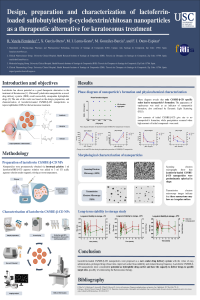
Introduction and Objectives: Keratoconus is a progressive bilateral degenerative corneal ectasia that affects young adults, causing great visual disability, with a great impact on life quality and social health, worsening over time (1). There is no available medical or pharmacological treatment to prevent the development or decrease its progression. Lactoferrin was observed to promote in vivo and in vitro corneal epithelial wound healing (2). The aim of this work was based on the design, preparation, and characterization of lactoferrin-loaded CS/SBE-b-CD nanoparticles intended for topical ophthalmic administration as a pharmacological alternative for keratoconus treatment.
Methods: Lactoferrin-loaded SBE-β-CD/CS nanoparticles were prepared by ion gelation. Different proportions were tested in order to select the formulation with better characteristics. Evaluation and characterization were carried out in terms of size, surface potential, morphology, production yield (PY), encapsulation efficacy (EE), and loading capacity (LC). Additional experimental data may be included.
Results and discussion: Lactoferrin-loaded SBE-β-CD/CS nanoparticles were prepared, and physicochemical properties successfully evaluated. Proposed nanocarriers show potential as a pharmacological alternative for keratoconus treatment, with the virtue of easy administration, prolonged drug release time, improved ocular bioavailability and reduced dosing frequency.
Conclusions: It is proposed a chitosan-based formulation as a biodegradable mucoadhesive nanocarrier for the controlled delivery of lactoferrin, supported by a preclinical consistent base as the first pharmacological treatment for keratoconus as an alternative to the current invasive clinical methods.
References
[1] Kymes SM, Walline JJ, Zadnik K, Sterling J, Gordon MO, Collaborative Longitudinal Evaluation of Keratoconus Study Group. Changes in the quality-of-life of people with keratoconus. Am J Ophthalmol. 2008 Apr;145(4):611–7.
[2] Pattamatta U, Willcox M, Stapleton F, Cole N, Garrett Q. Bovine lactoferrin stimulates human corneal epithelial alkali wound healing in vitro. Invest Ophthalmol Vis Sci. 2009 Apr;50(4):1636–43.
Keywords
nanoparticles
drug delivery system
controlled released
lactoferrrin
keratoconus
cyclodextrin
sulfobutylether cyclodextrin
topical-ophthalmic administration
Manuscript
Poster IECP Novembrer 2020.pdf
Poster
Poster IECP Noviembre 2020.pdf
Polyelectrolyte complex Nanoparticles for cancer therapy
Peptide nanoparticle-mediated combinatorial delivery of cancer-related siRNAs for synergistic anti-proliferative activity in triple-negative breast cancer cells