Event submissions
Published

This submission belongs to the session A. Formulation of Poorly Soluble Drugs of the event The 1st International Electronic Conference on Pharmaceutics
Published date
01 Dec, 2020
Citation
Asmita Poudel, George Gachumi, Zafer Dallal Bashi, Ildiko Badea, Anas El-Aneed, Development and characterization of liposomal formulation containing phytosterols and tocopherols for reducing low-density lipoprotein cholesterol., in Proceedings of The 1st International Electronic Conference on Pharmaceutics, 1 December–15 December 2020, MDPI: Basel, Switzerland, doi: 10.3390/IECP2020-08796
Share
Email
Facebook
Twitter
LinkedIn
Development and characterization of liposomal formulation containing phytosterols and tocopherols for reducing low-density lipoprotein cholesterol.
'%3e%3cpath%20d='M12.6647%2010.9104C12.4176%2010.325%2012.0589%209.7933%2011.6088%209.34485C11.16%208.89511%2010.6283%208.53653%2010.0432%208.28891C10.038%208.28629%2010.0327%208.28498%2010.0275%208.28236C10.8437%207.69282%2011.3743%206.73252%2011.3743%205.64907C11.3743%203.85423%209.92005%202.40002%208.12522%202.40002C6.33038%202.40002%204.87618%203.85423%204.87618%205.64907C4.87618%206.73252%205.40677%207.69282%206.22296%208.28367C6.21772%208.28629%206.21248%208.2876%206.20724%208.29022C5.62031%208.53783%205.09365%208.89287%204.64167%209.34616C4.19192%209.79496%203.83334%2010.3266%203.58573%2010.9117C3.34247%2011.4846%203.21128%2012.0987%203.19925%2012.721C3.1989%2012.735%203.20135%2012.7489%203.20646%2012.7619C3.21157%2012.7749%203.21924%2012.7868%203.22901%2012.7968C3.23877%2012.8068%203.25045%2012.8148%203.26334%2012.8202C3.27623%2012.8256%203.29007%2012.8284%203.30406%2012.8284H4.09012C4.14776%2012.8284%204.19362%2012.7825%204.19493%2012.7262C4.22113%2011.7148%204.62726%2010.7676%205.34519%2010.0497C6.08802%209.30686%207.07452%208.89811%208.12522%208.89811C9.17592%208.89811%2010.1624%209.30686%2010.9052%2010.0497C11.6232%2010.7676%2012.0293%2011.7148%2012.0555%2012.7262C12.0568%2012.7839%2012.1027%2012.8284%2012.1603%2012.8284H12.9464C12.9604%2012.8284%2012.9742%2012.8256%2012.9871%2012.8202C13%2012.8148%2013.0117%2012.8068%2013.0214%2012.7968C13.0312%2012.7868%2013.0389%2012.7749%2013.044%2012.7619C13.0491%2012.7489%2013.0515%2012.735%2013.0512%2012.721C13.0381%2012.0947%2012.9084%2011.4856%2012.6647%2010.9104ZM8.12522%207.90243C7.52388%207.90243%206.95792%207.66793%206.53214%207.24215C6.10636%206.81636%205.87185%206.2504%205.87185%205.64907C5.87185%205.04773%206.10636%204.48177%206.53214%204.05599C6.95792%203.63021%207.52388%203.3957%208.12522%203.3957C8.72655%203.3957%209.29252%203.63021%209.7183%204.05599C10.1441%204.48177%2010.3786%205.04773%2010.3786%205.64907C10.3786%206.2504%2010.1441%206.81636%209.7183%207.24215C9.29252%207.66793%208.72655%207.90243%208.12522%207.90243Z'%20fill='%235D1EE1'/%3e%3c/g%3e%3c/svg%3e)
Asmita Poudel 1
George Gachumi 1
Zafer Dallal Bashi 1

Ildiko Badea 1
Anas El-Aneed 1
1. Drug Discovery and Development Research Group, College of Pharmacy and Nutrition, University of Saskatchewan, Saskatoon, SK, Canada
Abstract
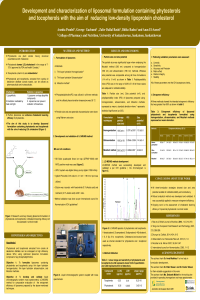
Purpose: Phytosterols are plant sterols with structural resemblance to cholesterol. United States Food and Drug Administration (FDA) and Health Canada have approved phytosterols as a cholesterol-lowering agent due to their ability to significantly reduce low-density lipoprotein cholesterol (LDL-C) in the range of 7-12%. However, phytosterols (lipophilic) have the potential to impart higher efficacy in the reduction of LDL-C if formulated in a delivery system that increases its bioavailability. In this work, we aim to develop and characterize a liposomal formulation containing phytosterols and tocopherols; the aim is to enhance cholesterol-lowering ability of phytosterols. We also aim to test the efficacy of brassicasterol (phytosterol unique to canola seeds) which has not yet been approved by the FDA. To prevent oxidation of phytosterols during formulation development and storage, tocopherols (vitamin E) are also added as antioxidants.
Methods: Liposomes containing phytosterols and tocopherols were prepared using phosphatidylcholine as the lipid carrier and formulated using three different approaches -i) thin layer hydration homogenization, ii) thin layer hydration ultra-sonication, and iii) Mozafari method. Liquid chromatography-tandem mass spectrometry (LC-MS/MS) was developed and validated for quantifying liposomal phytosterols and tocopherols.
Results: Liposomal vesicles prepared via homogenization and ultrasonication methods were significantly lower in size (<200 nm) in comparison to those produced by the Mozafari method (>200 nm). All three methods showed comparable zeta potential values (-9 to -14 mV), which is adequate for the physical stability of the vesicles. A new validated LC-MS/MS method with a total run time of seven minutes was applied to quantify four phytosterols (brassicasterol, campesterol, stigmasterol, and β-sitosterol) and three tocopherols (alpha, gamma, and delta) simultaneously. The run time of seven minutes is the shortest among reported methods to date. The liposomal formulation prepared by all three methods showed entrapment efficiency >89% for both phytosterols and tocopherols.
Conclusion: Liposomes containing phytosterols and tocopherols were successfully developed and characterized with the aim of enhancing the efficacy of phytosterols. In vivo studies will be conducted using hamster animal model to compare the efficacy of liposomal phytosterols to marketed phytosterols containing products.
Keywords
Liposomes
Phytosterols
Tocopherols
Cholesterol
Liquid Chromatography-Tandem Mass Spectrometry
Manuscript
1st International conference on pharmaceutics_2020_Poudel_A.pdf
Poster
1st International conference on pharmaceutics_2020_Poudel_A.pdf
Synthesis and characterization of a novel nanomicellar system Pluronic-PEI suitable for gene and drug co-delivery in cancer therapy
Crystallization from the Gas Phase: Morphology Control, Co-Crystal and Salt Formation