Event submissions
Published

This submission belongs to the session A. Plant Protection, Response to stress and Climate Change of the event The 1st International Electronic Conference on Plant Science
Published date
02 Dec, 2020
Citation
Álvaro Rodríguez González, Alejandra J. Porteous-Álvarez, Mario Del Val, Pedro A. Casquero, Baltasar Escriche, Susceptibility of Xylotrechus arvicola (Coleoptera: Cerambycidae) to Five Cry Toxins , in Proceedings of The 1st International Electronic Conference on Plant Science, 1 December–15 December 2020, MDPI: Basel, Switzerland, doi: 10.3390/IECPS2020-08821
Share
Email
Facebook
Twitter
LinkedIn
Susceptibility of Xylotrechus arvicola (Coleoptera: Cerambycidae) to Five Cry Toxins
'%3e%3cpath%20d='M12.6647%2010.9104C12.4176%2010.325%2012.0589%209.7933%2011.6088%209.34485C11.16%208.89511%2010.6283%208.53653%2010.0432%208.28891C10.038%208.28629%2010.0327%208.28498%2010.0275%208.28236C10.8437%207.69282%2011.3743%206.73252%2011.3743%205.64907C11.3743%203.85423%209.92005%202.40002%208.12522%202.40002C6.33038%202.40002%204.87618%203.85423%204.87618%205.64907C4.87618%206.73252%205.40677%207.69282%206.22296%208.28367C6.21772%208.28629%206.21248%208.2876%206.20724%208.29022C5.62031%208.53783%205.09365%208.89287%204.64167%209.34616C4.19192%209.79496%203.83334%2010.3266%203.58573%2010.9117C3.34247%2011.4846%203.21128%2012.0987%203.19925%2012.721C3.1989%2012.735%203.20135%2012.7489%203.20646%2012.7619C3.21157%2012.7749%203.21924%2012.7868%203.22901%2012.7968C3.23877%2012.8068%203.25045%2012.8148%203.26334%2012.8202C3.27623%2012.8256%203.29007%2012.8284%203.30406%2012.8284H4.09012C4.14776%2012.8284%204.19362%2012.7825%204.19493%2012.7262C4.22113%2011.7148%204.62726%2010.7676%205.34519%2010.0497C6.08802%209.30686%207.07452%208.89811%208.12522%208.89811C9.17592%208.89811%2010.1624%209.30686%2010.9052%2010.0497C11.6232%2010.7676%2012.0293%2011.7148%2012.0555%2012.7262C12.0568%2012.7839%2012.1027%2012.8284%2012.1603%2012.8284H12.9464C12.9604%2012.8284%2012.9742%2012.8256%2012.9871%2012.8202C13%2012.8148%2013.0117%2012.8068%2013.0214%2012.7968C13.0312%2012.7868%2013.0389%2012.7749%2013.044%2012.7619C13.0491%2012.7489%2013.0515%2012.735%2013.0512%2012.721C13.0381%2012.0947%2012.9084%2011.4856%2012.6647%2010.9104ZM8.12522%207.90243C7.52388%207.90243%206.95792%207.66793%206.53214%207.24215C6.10636%206.81636%205.87185%206.2504%205.87185%205.64907C5.87185%205.04773%206.10636%204.48177%206.53214%204.05599C6.95792%203.63021%207.52388%203.3957%208.12522%203.3957C8.72655%203.3957%209.29252%203.63021%209.7183%204.05599C10.1441%204.48177%2010.3786%205.04773%2010.3786%205.64907C10.3786%206.2504%2010.1441%206.81636%209.7183%207.24215C9.29252%207.66793%208.72655%207.90243%208.12522%207.90243Z'%20fill='%235D1EE1'/%3e%3c/g%3e%3c/svg%3e)
Álvaro Rodríguez González 1
Alejandra J. Porteous-Álvarez 1
Mario Del Val 1

Pedro A. Casquero 1

Baltasar Escriche 2
1. Escuela de Ingeniería Agraria y Forestal. Universidad de León
2. ERI de Biotecnología y Biomedicina (BIOTECMED). Departamento de Genetica. Universitat de València
Abstract
The beetle Xylotrechus arvicola is an important pest in vineyards (Vitis vinifera) in the main Iberian wine-producing regions of Iberian Peninsula. X. arvicola larvae bore into the grapevine wood and make galleries, which cause structural damages to the plant and a decrease in the quality and quantity of its production. Under laboratory conditions and over artificial diet used for the larval rearing of this cerambycid pest, the susceptibility of X. arvicola larvae against five coleopteran toxic Cry proteins (Cry1B, Cry1I, Cry3A, Cry7A and Cry23/37) was evaluated. After 30 days of evaluation, Cry proteins have demonstrated larvicidal activity on X. arvicola, with mortalities over 50%, being the proteins Cry1Ba and Cry7Ab, with mortalities greatest than 83%, which showed greatest larval activity. Cry proteins can be applied for the biological control of X. arvicola larvae, due to that these activated Cry proteins had the ability to be inserted into the evaluated stages of this insect, and subsequently cause their death to a greater or lesser intensity. The results can help in designing new combinations of Cry proteins applications as biopesticides over its grapevine hosts in the vineyards by the time when these larvae hatch from egg layings to increase its protection.
Keywords
Vineyards
Insect pest
Xylophagous polyphagous
Bacterium
Cristal proteins.
Manuscript
sciforum-036262-done.pdf
Poster
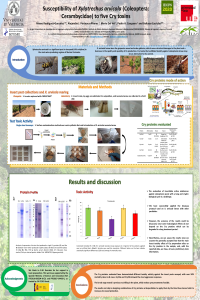
IECPS 2020_Presentation_Xyl._CRY.pdf
Genetic Variability for Mesocotyl Length in Maize
Phytochemical adaptions of Fast-growing Willow to Field-scale Municipal Wastewater Irrigation