Event submissions
Published

This submission belongs to the session D. Phytochemistry and Bioremediation of the event The 1st International Electronic Conference on Plant Science
Published date
02 Dec, 2020
Citation
Eszter Sas, Nicholas James Beresford Brereton, Adrien Frémont, Mathieu Sarrazin, Julien Lamontagne, Ahmed Jerbi, Simon Barnabé, Michel Labrecque, Frédéric Emmanuel Pitre, Phytochemical adaptions of Fast-growing Willow to Field-scale Municipal Wastewater Irrigation, in Proceedings of The 1st International Electronic Conference on Plant Science, 1 December–15 December 2020, MDPI: Basel, Switzerland, doi: 10.3390/IECPS2020-08823
Share
Email
Facebook
Twitter
LinkedIn
Phytochemical adaptions of Fast-growing Willow to Field-scale Municipal Wastewater Irrigation
'%3e%3cpath%20d='M12.6647%2010.9104C12.4176%2010.325%2012.0589%209.7933%2011.6088%209.34485C11.16%208.89511%2010.6283%208.53653%2010.0432%208.28891C10.038%208.28629%2010.0327%208.28498%2010.0275%208.28236C10.8437%207.69282%2011.3743%206.73252%2011.3743%205.64907C11.3743%203.85423%209.92005%202.40002%208.12522%202.40002C6.33038%202.40002%204.87618%203.85423%204.87618%205.64907C4.87618%206.73252%205.40677%207.69282%206.22296%208.28367C6.21772%208.28629%206.21248%208.2876%206.20724%208.29022C5.62031%208.53783%205.09365%208.89287%204.64167%209.34616C4.19192%209.79496%203.83334%2010.3266%203.58573%2010.9117C3.34247%2011.4846%203.21128%2012.0987%203.19925%2012.721C3.1989%2012.735%203.20135%2012.7489%203.20646%2012.7619C3.21157%2012.7749%203.21924%2012.7868%203.22901%2012.7968C3.23877%2012.8068%203.25045%2012.8148%203.26334%2012.8202C3.27623%2012.8256%203.29007%2012.8284%203.30406%2012.8284H4.09012C4.14776%2012.8284%204.19362%2012.7825%204.19493%2012.7262C4.22113%2011.7148%204.62726%2010.7676%205.34519%2010.0497C6.08802%209.30686%207.07452%208.89811%208.12522%208.89811C9.17592%208.89811%2010.1624%209.30686%2010.9052%2010.0497C11.6232%2010.7676%2012.0293%2011.7148%2012.0555%2012.7262C12.0568%2012.7839%2012.1027%2012.8284%2012.1603%2012.8284H12.9464C12.9604%2012.8284%2012.9742%2012.8256%2012.9871%2012.8202C13%2012.8148%2013.0117%2012.8068%2013.0214%2012.7968C13.0312%2012.7868%2013.0389%2012.7749%2013.044%2012.7619C13.0491%2012.7489%2013.0515%2012.735%2013.0512%2012.721C13.0381%2012.0947%2012.9084%2011.4856%2012.6647%2010.9104ZM8.12522%207.90243C7.52388%207.90243%206.95792%207.66793%206.53214%207.24215C6.10636%206.81636%205.87185%206.2504%205.87185%205.64907C5.87185%205.04773%206.10636%204.48177%206.53214%204.05599C6.95792%203.63021%207.52388%203.3957%208.12522%203.3957C8.72655%203.3957%209.29252%203.63021%209.7183%204.05599C10.1441%204.48177%2010.3786%205.04773%2010.3786%205.64907C10.3786%206.2504%2010.1441%206.81636%209.7183%207.24215C9.29252%207.66793%208.72655%207.90243%208.12522%207.90243Z'%20fill='%235D1EE1'/%3e%3c/g%3e%3c/svg%3e)
Eszter Sas 1
Nicholas James Beresford Brereton 1
Adrien Frémont 1
Mathieu Sarrazin 2
Julien Lamontagne 1

Ahmed Jerbi 1

Simon Barnabé 3
Michel Labrecque 1,4
Frédéric Emmanuel Pitre 1,4
1. University of Montreal, Institut de Recherche en Biologie Végétale (IRBV)
2. Collège de Maisonneuve, Centre d'Études des Procédés Chimiques du Québec (CÉPROCQ)
3. Université du Québec à Trois-Rivières (UQTR)
4. Montreal Botanical Garden
Abstract
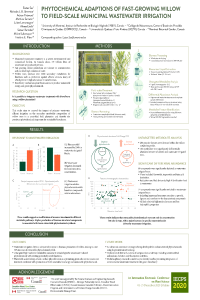
Treatment of municipal wastewater has a high economic and environmental burden to communities around the world. Fast-growing Salix miyabeana (willow) trees can potentially be used to environmentally treat high volumes of primary municipal wastewater while also generating sustainable biomass and phytochemicals for green biorefinery. However, the biochemical mechanisms underlying wastewater tolerance in willow and the impact of wastewater treatment on their extractable phytochemicals are as yet unexplored.
A one-hectare Salix miyabeana ‘SX67’ plantation was established in Southern Québec (Canada) and three replicated blocks compared trees left unirrigated with those irrigated with primary effluent wastewater at rates of around 29 ML ha-1 yr-1. In addition to assessing sustainable biomass yields, methanol extracted phytochemical composition of harvested stems were compared using untargeted LC-MS/MS with an annotation pipeline including a Salicaceae metabolite library, MS/MS fragment clustering and global plant metabolite libraries.
Biomass production was substantially improved by wastewater treatment, increasing the yield by 200% compared to unirrigated controls. The phytochemical profile was also altered: out of 214 detected compounds, 119 significantly varied in concentration between treatments. One hundred were significantly reduced in abundance due to wastewater irrigation whereas nineteen compounds were significantly induced, potentially including isoflavonoid, lactone and phenolic based macrocompounds.
These findings reveal the phytochemical toolkit used by willow trees to tolerate abiotic stress and provide an insight into novel mechanisms underpinning plant tolerance. The identified compounds will serve to target functional studies and provide a detailed profile of valuable green bioproducts available from wastewater treated trees which could potentially help improve the economic feasibility of this clean technology, particularly once increased biomass yields are considered.
Keywords
wastewater treatment
phytoremediation
willow
phytochemistry
secondary metabolites
bioproducts
sustainable biomass
Manuscript
abstract.pdf
Poster
Sas_IECPS 2020_Poster.pdf
Susceptibility of Xylotrechus arvicola (Coleoptera: Cerambycidae) to Five Cry Toxins
Inhibitory Potential of Essential Oils on Malassezia strains by Various Plants