Event submissions
EventsThe 1st International Electronic Conference on Animals—Global Sustainability and Animals: Science, Ethics and Policy
Published

This submission belongs to the session C. Sustainable animal welfare, ethics, policies and politics of the event The 1st International Electronic Conference on Animals—Global Sustainability and Animals: Science, Ethics and Policy
Published date
02 Dec, 2020
Citation
Paula Elizabeth Baker, Jessica Elizabeth Stokes, Claire Alexandra Weeks, Enabling behaviour change in laying hen farmers using Motivational Interviewing (MI), in Proceedings of The 1st International Electronic Conference on Animals—Global Sustainability and Animals: Science, Ethics and Policy, 5 December–20 December 2020, MDPI: Basel, Switzerland, doi: 10.3390/IECA2020-08830
Share
Email
Facebook
Twitter
LinkedIn
Enabling behaviour change in laying hen farmers using Motivational Interviewing (MI)
'%3e%3cpath%20d='M12.6647%2010.9104C12.4176%2010.325%2012.0589%209.7933%2011.6088%209.34485C11.16%208.89511%2010.6283%208.53653%2010.0432%208.28891C10.038%208.28629%2010.0327%208.28498%2010.0275%208.28236C10.8437%207.69282%2011.3743%206.73252%2011.3743%205.64907C11.3743%203.85423%209.92005%202.40002%208.12522%202.40002C6.33038%202.40002%204.87618%203.85423%204.87618%205.64907C4.87618%206.73252%205.40677%207.69282%206.22296%208.28367C6.21772%208.28629%206.21248%208.2876%206.20724%208.29022C5.62031%208.53783%205.09365%208.89287%204.64167%209.34616C4.19192%209.79496%203.83334%2010.3266%203.58573%2010.9117C3.34247%2011.4846%203.21128%2012.0987%203.19925%2012.721C3.1989%2012.735%203.20135%2012.7489%203.20646%2012.7619C3.21157%2012.7749%203.21924%2012.7868%203.22901%2012.7968C3.23877%2012.8068%203.25045%2012.8148%203.26334%2012.8202C3.27623%2012.8256%203.29007%2012.8284%203.30406%2012.8284H4.09012C4.14776%2012.8284%204.19362%2012.7825%204.19493%2012.7262C4.22113%2011.7148%204.62726%2010.7676%205.34519%2010.0497C6.08802%209.30686%207.07452%208.89811%208.12522%208.89811C9.17592%208.89811%2010.1624%209.30686%2010.9052%2010.0497C11.6232%2010.7676%2012.0293%2011.7148%2012.0555%2012.7262C12.0568%2012.7839%2012.1027%2012.8284%2012.1603%2012.8284H12.9464C12.9604%2012.8284%2012.9742%2012.8256%2012.9871%2012.8202C13%2012.8148%2013.0117%2012.8068%2013.0214%2012.7968C13.0312%2012.7868%2013.0389%2012.7749%2013.044%2012.7619C13.0491%2012.7489%2013.0515%2012.735%2013.0512%2012.721C13.0381%2012.0947%2012.9084%2011.4856%2012.6647%2010.9104ZM8.12522%207.90243C7.52388%207.90243%206.95792%207.66793%206.53214%207.24215C6.10636%206.81636%205.87185%206.2504%205.87185%205.64907C5.87185%205.04773%206.10636%204.48177%206.53214%204.05599C6.95792%203.63021%207.52388%203.3957%208.12522%203.3957C8.72655%203.3957%209.29252%203.63021%209.7183%204.05599C10.1441%204.48177%2010.3786%205.04773%2010.3786%205.64907C10.3786%206.2504%2010.1441%206.81636%209.7183%207.24215C9.29252%207.66793%208.72655%207.90243%208.12522%207.90243Z'%20fill='%235D1EE1'/%3e%3c/g%3e%3c/svg%3e)
Paula Elizabeth Baker 1

Jessica Elizabeth Stokes 2

Claire Alexandra Weeks 3
1. Project research officer for the Laying Hen Welfare Forum (British Egg Industry Council)
2. Lecturer in Farm Animal Welfare Science and Policy Royal Agricultural University
3. Senior Research Fellow University of Bristol
Abstract
Laying hens with poor feather cover eat more feed, are less productive and have higher levels of morbidity and mortality. This welfare and sustainability issue is complex and requires a proactive, multi-pronged approach. The aim of this UK study was to test a support approach for commercial implementation and uptake of evidence-based strategies aimed at reducing injurious pecking (IP) in 29 flocks of free range (FR), aviary and enriched cages (EC). This was accomplished by using Motivational Interviewing (MI) to facilitate farmer ownership over maintaining feather cover by co-developing bespoke Feather Cover Action Plans (FCAP). Recruitment included farmers with initial ranges of attitudes from not regarding IP as a priority, to engaged first adopters. The MI approach resulted in 80% of farmers making changes to their management and resource provision, with 90% of farmers of (FR) and half of those using (EC) making changes. Up to 9 actions were implemented from their FCAP (average 3 on FR farms) and 67% of all planned changes had been achieved on average 9 months later. While some changes were inexpensive and durable, such as providing rope or plastic objects, others were capital investments like verandas, planting trees, renewing and strategically placing artificial shelters, frequently replenishing lucerne, removing capped litter plus adding pecking rings in enriched cages. Reflecting on the value of their FCAP, farmers recognised that being part of the project not only raised their awareness of IP and the importance of maintaining good feather cover but also motivated them to make changes. They recognised the value of the facilitator and noted that successful outcomes gave incentive to make further progress. Half the farmers felt their FCAP had been successful in reducing IP within their flocks. This approach therefore has potential to improve both the sustainability of egg production and hen welfare.
Keywords
Injurious pecking
feather cover
motivational interviewing
feather cover action plan (FCAP)
Manuscript
Baker et al 2020 Enabling behaviour change in laying hen farmers using Motivational Interviewing.pdf
Poster
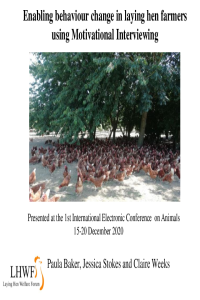
Baker er al, 2020 Presentation - 1st International Electronic Conference on Animals Article sciforum-041558.pdf
Identification and validation of operational welfare indicators appropriate for small-scale goat farming in Chile
Is an animal welfare label enough?
Role of farm animal welfare voluntary labelling schemes in the development of sustainable livestock production