Event submissions
Published

This submission belongs to the session A. Plant Protection, Response to stress and Climate Change of the event The 1st International Electronic Conference on Plant Science
Published date
02 Dec, 2020
Citation
Marzena Sujkowska-Rybkowska, Arleta Kochańska-Jeziorska, Comparative analysis of remodelling of the apoplast in Lotus corniculatus L. symbiotic nodules under trace metal contamination, in Proceedings of The 1st International Electronic Conference on Plant Science, 1 December–15 December 2020, MDPI: Basel, Switzerland, doi: 10.3390/IECPS2020-08840
Share
Email
Facebook
Twitter
LinkedIn
Comparative analysis of remodelling of the apoplast in Lotus corniculatus L. symbiotic nodules under trace metal contamination

Marzena Sujkowska-Rybkowska 1
'%3e%3cpath%20d='M12.6647%2010.9104C12.4176%2010.325%2012.0589%209.7933%2011.6088%209.34485C11.16%208.89511%2010.6283%208.53653%2010.0432%208.28891C10.038%208.28629%2010.0327%208.28498%2010.0275%208.28236C10.8437%207.69282%2011.3743%206.73252%2011.3743%205.64907C11.3743%203.85423%209.92005%202.40002%208.12522%202.40002C6.33038%202.40002%204.87618%203.85423%204.87618%205.64907C4.87618%206.73252%205.40677%207.69282%206.22296%208.28367C6.21772%208.28629%206.21248%208.2876%206.20724%208.29022C5.62031%208.53783%205.09365%208.89287%204.64167%209.34616C4.19192%209.79496%203.83334%2010.3266%203.58573%2010.9117C3.34247%2011.4846%203.21128%2012.0987%203.19925%2012.721C3.1989%2012.735%203.20135%2012.7489%203.20646%2012.7619C3.21157%2012.7749%203.21924%2012.7868%203.22901%2012.7968C3.23877%2012.8068%203.25045%2012.8148%203.26334%2012.8202C3.27623%2012.8256%203.29007%2012.8284%203.30406%2012.8284H4.09012C4.14776%2012.8284%204.19362%2012.7825%204.19493%2012.7262C4.22113%2011.7148%204.62726%2010.7676%205.34519%2010.0497C6.08802%209.30686%207.07452%208.89811%208.12522%208.89811C9.17592%208.89811%2010.1624%209.30686%2010.9052%2010.0497C11.6232%2010.7676%2012.0293%2011.7148%2012.0555%2012.7262C12.0568%2012.7839%2012.1027%2012.8284%2012.1603%2012.8284H12.9464C12.9604%2012.8284%2012.9742%2012.8256%2012.9871%2012.8202C13%2012.8148%2013.0117%2012.8068%2013.0214%2012.7968C13.0312%2012.7868%2013.0389%2012.7749%2013.044%2012.7619C13.0491%2012.7489%2013.0515%2012.735%2013.0512%2012.721C13.0381%2012.0947%2012.9084%2011.4856%2012.6647%2010.9104ZM8.12522%207.90243C7.52388%207.90243%206.95792%207.66793%206.53214%207.24215C6.10636%206.81636%205.87185%206.2504%205.87185%205.64907C5.87185%205.04773%206.10636%204.48177%206.53214%204.05599C6.95792%203.63021%207.52388%203.3957%208.12522%203.3957C8.72655%203.3957%209.29252%203.63021%209.7183%204.05599C10.1441%204.48177%2010.3786%205.04773%2010.3786%205.64907C10.3786%206.2504%2010.1441%206.81636%209.7183%207.24215C9.29252%207.66793%208.72655%207.90243%208.12522%207.90243Z'%20fill='%235D1EE1'/%3e%3c/g%3e%3c/svg%3e)
Arleta Kochańska-Jeziorska 2
1. Department of Botany, Institute of Biology, Warsaw University of Life Sciences‐SGGW, Nowoursynowska159, Building 37, 02‐776 Warsaw, Poland
2. Department of Biochemistry and Microbiology, Institute of Biology, Warsaw University of Life Sciences‐SGGW, Nowoursynowska 159, Building 37, 02‐776 Warsaw, Poland
Abstract
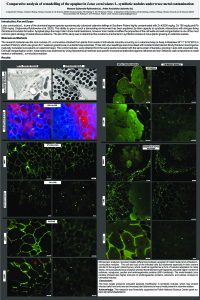
The metal-tolerant legume Lotus corniculatus L. and it's metal-tolerant rhizobial symbiont has been identified in calamine tailing highly contaminated with trace elements including Zn, Pb and Cd. The cell wall reorganization is one of the most common plant strategy of trace metal avoidance. The aim of this study is to determine this avoidance mechanism in symbiotic nodules to tolerate toxic metals present in calamine wastes. Cell wall reorganisation under metal stress was examined by using histochemical methods and specific monoclonal antibodies against cellulose and non-cellulosic wall components in metal treated or untreated L. corniculatus nodules.
Microscopic analysis showed wall thickening of infected cells and higher content of cellulose, xyloglucan, pectins, arabinogalactan proteins, extensins, and callose in metal treated Lotus nodules.
The toxic metals presence activated apoplast modification in symbiotic nodules, which may protect infected cells from toxic ions and increase plant tolerance to heavy metal present in calamine wastes.
Keywords
toxic metals
legume
cellulosic
Manuscript
abstract.pdf
Poster
poster Ist Conference Sujkowska 2020(1).pdf
In silico identification of MYB and bHLH families reveals candidate transcription factors for secondary metabolic pathways in Cannabis sativa L.
Differences in development in vitro of Cannabis sativa L. (variety K290) under the influence of various mineral components of nutrients, vitamins and plant growth regulators