Event submissions
Published

This submission belongs to the session B. Plant Nutrition, Plant Physiology and Metabolism of the event The 1st International Electronic Conference on Plant Science
Published date
02 Dec, 2020
Citation
Mariola Dreger, Milena Szalata, Małgorzata Górska-Paukszta, Grażyna Mańkowska, Karolina Wielgus, Effect of auxin transport inhibitors on shoot organogenesis of hemp (Cannabis sativa L.) epicotyl explants, in Proceedings of The 1st International Electronic Conference on Plant Science, 1 December–15 December 2020, MDPI: Basel, Switzerland, doi: 10.3390/IECPS2020-08843
Share
Email
Facebook
Twitter
LinkedIn
Effect of auxin transport inhibitors on shoot organogenesis of hemp (Cannabis sativa L.) epicotyl explants
'%3e%3cpath%20d='M12.6647%2010.9104C12.4176%2010.325%2012.0589%209.7933%2011.6088%209.34485C11.16%208.89511%2010.6283%208.53653%2010.0432%208.28891C10.038%208.28629%2010.0327%208.28498%2010.0275%208.28236C10.8437%207.69282%2011.3743%206.73252%2011.3743%205.64907C11.3743%203.85423%209.92005%202.40002%208.12522%202.40002C6.33038%202.40002%204.87618%203.85423%204.87618%205.64907C4.87618%206.73252%205.40677%207.69282%206.22296%208.28367C6.21772%208.28629%206.21248%208.2876%206.20724%208.29022C5.62031%208.53783%205.09365%208.89287%204.64167%209.34616C4.19192%209.79496%203.83334%2010.3266%203.58573%2010.9117C3.34247%2011.4846%203.21128%2012.0987%203.19925%2012.721C3.1989%2012.735%203.20135%2012.7489%203.20646%2012.7619C3.21157%2012.7749%203.21924%2012.7868%203.22901%2012.7968C3.23877%2012.8068%203.25045%2012.8148%203.26334%2012.8202C3.27623%2012.8256%203.29007%2012.8284%203.30406%2012.8284H4.09012C4.14776%2012.8284%204.19362%2012.7825%204.19493%2012.7262C4.22113%2011.7148%204.62726%2010.7676%205.34519%2010.0497C6.08802%209.30686%207.07452%208.89811%208.12522%208.89811C9.17592%208.89811%2010.1624%209.30686%2010.9052%2010.0497C11.6232%2010.7676%2012.0293%2011.7148%2012.0555%2012.7262C12.0568%2012.7839%2012.1027%2012.8284%2012.1603%2012.8284H12.9464C12.9604%2012.8284%2012.9742%2012.8256%2012.9871%2012.8202C13%2012.8148%2013.0117%2012.8068%2013.0214%2012.7968C13.0312%2012.7868%2013.0389%2012.7749%2013.044%2012.7619C13.0491%2012.7489%2013.0515%2012.735%2013.0512%2012.721C13.0381%2012.0947%2012.9084%2011.4856%2012.6647%2010.9104ZM8.12522%207.90243C7.52388%207.90243%206.95792%207.66793%206.53214%207.24215C6.10636%206.81636%205.87185%206.2504%205.87185%205.64907C5.87185%205.04773%206.10636%204.48177%206.53214%204.05599C6.95792%203.63021%207.52388%203.3957%208.12522%203.3957C8.72655%203.3957%209.29252%203.63021%209.7183%204.05599C10.1441%204.48177%2010.3786%205.04773%2010.3786%205.64907C10.3786%206.2504%2010.1441%206.81636%209.7183%207.24215C9.29252%207.66793%208.72655%207.90243%208.12522%207.90243Z'%20fill='%235D1EE1'/%3e%3c/g%3e%3c/svg%3e)
Mariola Dreger 1
Milena Szalata 2
Małgorzata Górska-Paukszta 2
Grażyna Mańkowska 2
Karolina Wielgus 2
1. Institute of Natural Fibres & Medicinal Plants National Research Institute, Department of Biotechnology, Wojska Polskiego 71b, 60-630 Poznan, Poland
2. Institute of Natural Fibres & Medicinal Plants, Department of Biotechnology, Wojska Polskiego 71b, 60-630 Poznan, Poland
Abstract
Industrial hemp (Cannabis sativa L.) is economically valuable crop used in a production of nutraceutical supplements, functional food, pharmaceuticals, cosmetics etc. However, the large scale propagation of this plant has been so far limited by the challenges regarding low regeneration rate and variety-/genotype-dependent response of the explants. Previously, it was shown that elevated endogenous auxin levels are inhibitory for the shoot organogenesis and the use of auxin transport inhibitor may improve shoot regeneration in some recalcitrant species. This study explored the effect of auxin transport inhibitor such as 1-N-naphthylphthalamic acid (NPA) and 2,3,5-triiodobenzoic acid (TIBA) application on shoot induction in hemp. Epicotyls isolated from 7-day-old seedlings were used as explants. Explants were cultured on shoot regeneration media composed of Murashige and Skoog basal medium enriched with meta-topolin (mT) and tidiazuron TDZ (control), as well as media supplemented with combination of TDZ or mT with auxin transport inhibitors NPA (0.0-20 mg L-1) and TIBA (0.05-0.5 mM). Shoot regeneration proceeded at 25°C± 2°C with a 16 h photoperiod under a photosynthetic flux of 80 µmol m2 s-1. After three weeks of culture the following data were recorded: percentage of survival explants, percentage of explants producing axillary shoots, and their mean number per explant and percentage of callusing and malformed explants. The use of medium supplemented with NPA at concentration 10 mg L-1 for both hormonal treatments resulted in the higher number of shoots per explant as compared with control (4.3 vs. 3.4 for TDZ and 3.7 vs. 2.8 for mT). The regeneration rate for TIBA treatment was lower than in the control medium. Moreover, inhibition of growth and necrosis of explants was observed. The results of this study demonstrated the promotional effect of NPA on shoot organogenesis in hemp in vitro cultures. Further studies on various plant material (different genotypes/cultivars) and the effects of auxin transport inhibitors are recommended in order to establish the optimal protocol.
Funded by Polish Ministry of Agriculture and Rural Development, resolution of the Council of Ministers no: 171/2017
Keywords
Cannabis sativa L.
in vitro cultures
micropropagation
polar auxin inhibitors
Manuscript
abstract.pdf
Poster
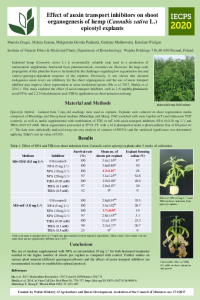
Effectofauxin_posterMD-skonwertowany.pdf
Between eco-philosophy and conventional agriculture the role of fungicides from the perspective of climate change
Partial Rootzone Drying Irrigation Modulates Transpiration of Olive Trees