Event submissions
Published

This submission belongs to the session C. Plant Cell and Developmental Biology of the event The 1st International Electronic Conference on Plant Science
Published date
02 Dec, 2020
Citation
Jyoti Devi, Shashi Bhushan, Arnebia euchroma leaf induced in vitro adventitious roots: an alternate source of naphthoquinones, in Proceedings of The 1st International Electronic Conference on Plant Science, 1 December–15 December 2020, MDPI: Basel, Switzerland, doi: 10.3390/IECPS2020-08846
Share
Email
Facebook
Twitter
LinkedIn
Arnebia euchroma leaf induced in vitro adventitious roots: an alternate source of naphthoquinones
'%3e%3cpath%20d='M12.6647%2010.9104C12.4176%2010.325%2012.0589%209.7933%2011.6088%209.34485C11.16%208.89511%2010.6283%208.53653%2010.0432%208.28891C10.038%208.28629%2010.0327%208.28498%2010.0275%208.28236C10.8437%207.69282%2011.3743%206.73252%2011.3743%205.64907C11.3743%203.85423%209.92005%202.40002%208.12522%202.40002C6.33038%202.40002%204.87618%203.85423%204.87618%205.64907C4.87618%206.73252%205.40677%207.69282%206.22296%208.28367C6.21772%208.28629%206.21248%208.2876%206.20724%208.29022C5.62031%208.53783%205.09365%208.89287%204.64167%209.34616C4.19192%209.79496%203.83334%2010.3266%203.58573%2010.9117C3.34247%2011.4846%203.21128%2012.0987%203.19925%2012.721C3.1989%2012.735%203.20135%2012.7489%203.20646%2012.7619C3.21157%2012.7749%203.21924%2012.7868%203.22901%2012.7968C3.23877%2012.8068%203.25045%2012.8148%203.26334%2012.8202C3.27623%2012.8256%203.29007%2012.8284%203.30406%2012.8284H4.09012C4.14776%2012.8284%204.19362%2012.7825%204.19493%2012.7262C4.22113%2011.7148%204.62726%2010.7676%205.34519%2010.0497C6.08802%209.30686%207.07452%208.89811%208.12522%208.89811C9.17592%208.89811%2010.1624%209.30686%2010.9052%2010.0497C11.6232%2010.7676%2012.0293%2011.7148%2012.0555%2012.7262C12.0568%2012.7839%2012.1027%2012.8284%2012.1603%2012.8284H12.9464C12.9604%2012.8284%2012.9742%2012.8256%2012.9871%2012.8202C13%2012.8148%2013.0117%2012.8068%2013.0214%2012.7968C13.0312%2012.7868%2013.0389%2012.7749%2013.044%2012.7619C13.0491%2012.7489%2013.0515%2012.735%2013.0512%2012.721C13.0381%2012.0947%2012.9084%2011.4856%2012.6647%2010.9104ZM8.12522%207.90243C7.52388%207.90243%206.95792%207.66793%206.53214%207.24215C6.10636%206.81636%205.87185%206.2504%205.87185%205.64907C5.87185%205.04773%206.10636%204.48177%206.53214%204.05599C6.95792%203.63021%207.52388%203.3957%208.12522%203.3957C8.72655%203.3957%209.29252%203.63021%209.7183%204.05599C10.1441%204.48177%2010.3786%205.04773%2010.3786%205.64907C10.3786%206.2504%2010.1441%206.81636%209.7183%207.24215C9.29252%207.66793%208.72655%207.90243%208.12522%207.90243Z'%20fill='%235D1EE1'/%3e%3c/g%3e%3c/svg%3e)
Jyoti Devi 1

Shashi Bhushan 1
1. 1 Biotechnology Division, CSIR-Institute of Himalayan Bioresource Technology, Palampur, H.P.-176061, India.
2 Academy of Scientific and Innovative Research (AcSIR), Ghaziabad-201002, India.
Abstract
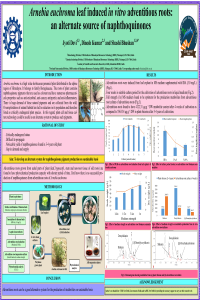
Arnebia euchroma is a high value herbaceous perennial plant distributed in the alpine region of Himalayas. It belongs to family Boraginaceae. Its root contains naphthoquinone pigments that are used as colourant and have numerous pharmaceuticals properties such as anti-microbial, anti-cancer, antipyretic and anti‐inflammatory. There is huge demand of these natural pigments and are collected from the wild. Overexploitation of natural habitat has led to reduction in its population and therefore listed as critically endangered plant species. In this regard, plant cell and tissue culture technology could be useful as an alternate system to produce such pigments. In this study, adventitious root cultures were induced from leaf explant of Arnebia euchroma on Murashige and Skoog (MS) medium augmented with different auxin. Among different auxins tested, IBA resulted in highest root numbers (12.0±4.99) and length (1.10±0.23 cm). Growth kinetics of adventitious roots showed significant accumulation of fresh weight (85.62±6.30 g/L) and dry weight (12.00±0.00) after four weeks of cultivation under dark condition. Out of different strength of medium used, full-strength leads to highest fresh weight (52.50± 3.37 g/L) and dry weight (8.25 ± 0.75 g/L) production. The phytochemical analysis after four weeks of cultivation showed 4122.31 µg.g⁻¹ DW naphthoquinone content in these adventitious roots as compared to 3-5 years old parent plant rhizome (5563.34 µg.g⁻¹ DW). Hence, these adventitious roots can be used as an alternate source to meet the growing demand for such bioactives.
Keywords
Arnebia euchroma
naphthoquinone
adventitious roots
auxin
media
Manuscript
Abstract.pdf
Poster
Jyoti Devi CSIR-IHBT.pdf
Optimization of non-psychotropic Cannabis sativa L. extraction and evaluation of anti-inflammatory activity on microglial cells
Role of Class III Peroxidases in Stem Lignification of Zinnia elegans Jacq.