Event submissions
Published

This submission belongs to the session A. Plant Protection, Response to stress and Climate Change of the event The 1st International Electronic Conference on Plant Science
Published date
02 Dec, 2020
Citation
Lihuén Iraí González-Dominici, Alejandro Jiménez-Gómez, Zaki Saati-Santamaría, Paula García-Fraile, Analysis of the potential of a Pseudomonas bacterial strain to promote Brassica napus plant growth and study of its inoculation effect on root bacterial associated communities, in Proceedings of The 1st International Electronic Conference on Plant Science, 1 December–15 December 2020, MDPI: Basel, Switzerland, doi: 10.3390/IECPS2020-08848
Share
Email
Facebook
Twitter
LinkedIn
Analysis of the potential of a Pseudomonas bacterial strain to promote Brassica napus plant growth and study of its inoculation effect on root bacterial associated communities
'%3e%3cpath%20d='M12.6647%2010.9104C12.4176%2010.325%2012.0589%209.7933%2011.6088%209.34485C11.16%208.89511%2010.6283%208.53653%2010.0432%208.28891C10.038%208.28629%2010.0327%208.28498%2010.0275%208.28236C10.8437%207.69282%2011.3743%206.73252%2011.3743%205.64907C11.3743%203.85423%209.92005%202.40002%208.12522%202.40002C6.33038%202.40002%204.87618%203.85423%204.87618%205.64907C4.87618%206.73252%205.40677%207.69282%206.22296%208.28367C6.21772%208.28629%206.21248%208.2876%206.20724%208.29022C5.62031%208.53783%205.09365%208.89287%204.64167%209.34616C4.19192%209.79496%203.83334%2010.3266%203.58573%2010.9117C3.34247%2011.4846%203.21128%2012.0987%203.19925%2012.721C3.1989%2012.735%203.20135%2012.7489%203.20646%2012.7619C3.21157%2012.7749%203.21924%2012.7868%203.22901%2012.7968C3.23877%2012.8068%203.25045%2012.8148%203.26334%2012.8202C3.27623%2012.8256%203.29007%2012.8284%203.30406%2012.8284H4.09012C4.14776%2012.8284%204.19362%2012.7825%204.19493%2012.7262C4.22113%2011.7148%204.62726%2010.7676%205.34519%2010.0497C6.08802%209.30686%207.07452%208.89811%208.12522%208.89811C9.17592%208.89811%2010.1624%209.30686%2010.9052%2010.0497C11.6232%2010.7676%2012.0293%2011.7148%2012.0555%2012.7262C12.0568%2012.7839%2012.1027%2012.8284%2012.1603%2012.8284H12.9464C12.9604%2012.8284%2012.9742%2012.8256%2012.9871%2012.8202C13%2012.8148%2013.0117%2012.8068%2013.0214%2012.7968C13.0312%2012.7868%2013.0389%2012.7749%2013.044%2012.7619C13.0491%2012.7489%2013.0515%2012.735%2013.0512%2012.721C13.0381%2012.0947%2012.9084%2011.4856%2012.6647%2010.9104ZM8.12522%207.90243C7.52388%207.90243%206.95792%207.66793%206.53214%207.24215C6.10636%206.81636%205.87185%206.2504%205.87185%205.64907C5.87185%205.04773%206.10636%204.48177%206.53214%204.05599C6.95792%203.63021%207.52388%203.3957%208.12522%203.3957C8.72655%203.3957%209.29252%203.63021%209.7183%204.05599C10.1441%204.48177%2010.3786%205.04773%2010.3786%205.64907C10.3786%206.2504%2010.1441%206.81636%209.7183%207.24215C9.29252%207.66793%208.72655%207.90243%208.12522%207.90243Z'%20fill='%235D1EE1'/%3e%3c/g%3e%3c/svg%3e)
Lihuén Iraí González-Dominici 1,2
Alejandro Jiménez-Gómez 1,2
Zaki Saati-Santamaría 1,2
Paula García-Fraile 3,4,5
1. Microbiology and Genetics Department. University of Salamanca. Spain
2. Spanish-Portuguese Institute for Agricultural Research (CIALE), Villamayor, Salamanca, Spain
3. Microbiology and Genetics Department. University of Salamanca, Spain.
4. Spanish-Portuguese Institute for Agricultural Research (CIALE), Villamayor, Salamanca, Spain.
5. Associated R&D Unit, USAL-CSIC (IRNASA), Salamanca, Spain.
Abstract
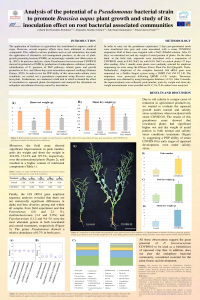
Because of their plant-growth-promoting (PGP) properties, microbes play crucial roles in plant development, making them potential candidates for substituting chemical fertilizers, especially when the soil conditions are not the most appropriate to obtain maximum crop yields. This is the case of strain Pseudomonas brassicacearum CDVBN10, a bacterial endophyte isolated from rapeseed (Brassica napus) roots. Previous in vitro, in planta and in silico experiments have demonstrated that strain CDVBN10 have interesting PGP potential. This endophyte synthetizes cellulose, produces siderophores, solubilizes P, promotes plant height and root length in rapeseed seedlings, and carries genes implicated in several PGP pathways. Based on these data, we conducted greenhouse experiments using this strain as biofertilizer under normal and salinity stress conditions, finding significant improvements in those inoculated plants, compared to the negative control. To prove its biofertilizer potential under field conditions, we carried out a field trial in which plants inoculated with CDVBN10 showed a 216%, 174.3% and 197.8% increase in number of pods, seed weight and aerial part weight, respectively. Along-read (SMRT; PacBio) 16S rRNA gene amplicon sequencing was performed in root samples from this field trials to study possible shifts on the rapeseed root microbiome due to the inoculation with CDVBN10. Interestingly, despite the great plant improvements, there were no significant differences in root bacterial communities of inoculated plants; thus, other potential beneficial members of the plant microbiome had not been displaced. According to the results, the strain P. brassicacearum CDVBN10 is suggested as a promising bacterial biofertilizer with great performance on B. napus crops.
Keywords
Plant-growth-promoting
Pseudomonas brassicacearum CDVBN10
Brassica napus
salinity stress
biofertilizer
microbiome
Manuscript
Abstract_e-Conference_LIGD_ZSS_PGF.pdf
Poster
Poster_Gonzalez-Dominici.pdf
Role of Class III Peroxidases in Stem Lignification of Zinnia elegans Jacq.
Title Effect of WGA on 24-Epibrassinolide-Induced Resistance of Wheat Plants and Cell Walls Reinforcement under the Influence of Cadmium Acetate