Event submissions
Published

This submission belongs to the session B. Plant Nutrition, Plant Physiology and Metabolism of the event The 1st International Electronic Conference on Plant Science
Published date
02 Dec, 2020
Citation
Huy Le, Nhung Hong Nguyen, Dong Thi Ta, Thao Nhu Le, Thao Phuong Bui, Ngoc Thu Le, Cuong Xuan Nguyen, Hardy Rolletschek, Gary Stacey, Minviluz G Stacey, Ngoc Bich Pham, Phat Do, Ha Hoang Chu, CRISPR/Cas9-mediated knockout of galactinol synthase-encoding genes reduces raffinose family oligosaccharide levels in soybean seeds, in Proceedings of The 1st International Electronic Conference on Plant Science, 1 December–15 December 2020, MDPI: Basel, Switzerland, doi: 10.3390/IECPS2020-08852
Share
Email
Facebook
Twitter
LinkedIn
CRISPR/Cas9-mediated knockout of galactinol synthase-encoding genes reduces raffinose family oligosaccharide levels in soybean seeds
'%3e%3cpath%20d='M12.6647%2010.9104C12.4176%2010.325%2012.0589%209.7933%2011.6088%209.34485C11.16%208.89511%2010.6283%208.53653%2010.0432%208.28891C10.038%208.28629%2010.0327%208.28498%2010.0275%208.28236C10.8437%207.69282%2011.3743%206.73252%2011.3743%205.64907C11.3743%203.85423%209.92005%202.40002%208.12522%202.40002C6.33038%202.40002%204.87618%203.85423%204.87618%205.64907C4.87618%206.73252%205.40677%207.69282%206.22296%208.28367C6.21772%208.28629%206.21248%208.2876%206.20724%208.29022C5.62031%208.53783%205.09365%208.89287%204.64167%209.34616C4.19192%209.79496%203.83334%2010.3266%203.58573%2010.9117C3.34247%2011.4846%203.21128%2012.0987%203.19925%2012.721C3.1989%2012.735%203.20135%2012.7489%203.20646%2012.7619C3.21157%2012.7749%203.21924%2012.7868%203.22901%2012.7968C3.23877%2012.8068%203.25045%2012.8148%203.26334%2012.8202C3.27623%2012.8256%203.29007%2012.8284%203.30406%2012.8284H4.09012C4.14776%2012.8284%204.19362%2012.7825%204.19493%2012.7262C4.22113%2011.7148%204.62726%2010.7676%205.34519%2010.0497C6.08802%209.30686%207.07452%208.89811%208.12522%208.89811C9.17592%208.89811%2010.1624%209.30686%2010.9052%2010.0497C11.6232%2010.7676%2012.0293%2011.7148%2012.0555%2012.7262C12.0568%2012.7839%2012.1027%2012.8284%2012.1603%2012.8284H12.9464C12.9604%2012.8284%2012.9742%2012.8256%2012.9871%2012.8202C13%2012.8148%2013.0117%2012.8068%2013.0214%2012.7968C13.0312%2012.7868%2013.0389%2012.7749%2013.044%2012.7619C13.0491%2012.7489%2013.0515%2012.735%2013.0512%2012.721C13.0381%2012.0947%2012.9084%2011.4856%2012.6647%2010.9104ZM8.12522%207.90243C7.52388%207.90243%206.95792%207.66793%206.53214%207.24215C6.10636%206.81636%205.87185%206.2504%205.87185%205.64907C5.87185%205.04773%206.10636%204.48177%206.53214%204.05599C6.95792%203.63021%207.52388%203.3957%208.12522%203.3957C8.72655%203.3957%209.29252%203.63021%209.7183%204.05599C10.1441%204.48177%2010.3786%205.04773%2010.3786%205.64907C10.3786%206.2504%2010.1441%206.81636%209.7183%207.24215C9.29252%207.66793%208.72655%207.90243%208.12522%207.90243Z'%20fill='%235D1EE1'/%3e%3c/g%3e%3c/svg%3e)
Huy Le 1
Nhung Hong Nguyen 2
Dong Thi Ta 2
Thao Nhu Le 2
Thao Phuong Bui 2
Ngoc Thu Le 2
Cuong Xuan Nguyen 3
Hardy Rolletschek 4
Gary Stacey 3
Minviluz G Stacey 3
Ngoc Bich Pham 2
Phat Do 2
Ha Hoang Chu 2
1. Institute of Biotechnology, Vietnam Academy of Science and Technology
2. Institute of Biotechnology, Vietnam Academy of Science and Technology
3. Division of Plant Science, University of Missouri-Columbia
4. Leibniz Institute of Plant Genetics and Crop Plant Research (IPK)
Gatersleben, Germany
Abstract
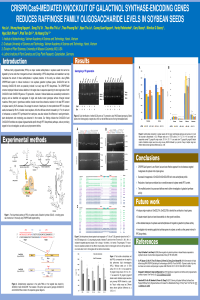
Raffinose family oligosaccharides (RFOs) are major soluble carbohydrates in soybean seeds that cannot be digested by human and other monogastric animals. Hence, a major goal is to reduce RFO levels to improve the nutritional quality of soybean. In this study, we utilized a dual gRNAs CRISPR/Cas9 system to induce knockouts in two soybean galactinol synthase genes, GmGOLS1A and its homeolog GmGOLS1B. Genotyping of T0 plants showed that the construct design was efficient in inducing various deletions in the target sites or sequences spanning the two target sites of both GmGOLS1A and GmGOLS1B genes. A subset of induced alleles was successfully transferred to progeny and, at the T2 generation, we identified null segregants of single and double mutant genotypes without off-target induced mutations. The seed carbohydrate analysis of double mutant lines showed a reduction in the total RFO content of soybean seed from 64.7 mg/g dry weight to 41.95 mg/g dry weight, a 35.2% decrease. On average the stachyose content, the most predominant RFO in soybean seeds, decreased by 35.4% in double mutant soybean, while the raffinose content increased by 41.7%. A slight decrease in verbascose content was also observed in mutant lines. Aside from changes in soluble carbohydrate content, some mutant lines also exhibited increased protein and fat contents. Otherwise, no difference in seed germination, plant development and morphology was observed in the mutants. Our findings indicate that GmGOLS1A and GmGOLS1B contribute to soybean oligosaccharides profile through RFO biosynthesis pathways, and are promising targets for future investigation, as well as crop improvement efforts. Our results also demonstrate the potential in using elite soybean cultivar for transformation and targeted genome editing.
Keywords
CRISPR/Cas9
GmGOLS1A
GmGOLS1B
raffinose family oligosaccharides
soybean
Manuscript
sciforum-038742-abstract.pdf
Poster
sciforum-038742.pdf
Contribution of Glutathione and Ascorbate to Realization of the Protective Effect of Nitric Oxide on Wheat Plants under Drought
Transcriptome Analysis of Cocos nucifera L. Seedlings Having Contrasting Water-Use Efficiency (WUE) under Water-Deficit Stress: Molecular Insights and Genetic Markers for Drought Tolerance