Event submissions
Published

This submission belongs to the session A. Plant Protection, Response to stress and Climate Change of the event The 1st International Electronic Conference on Plant Science
Published date
02 Dec, 2020
Citation
Panagiota Ntasiou, George Tziros, George Karaoglanidis, Novel copper nanoparticles for the control of olive foliar and fruit diseases, in Proceedings of The 1st International Electronic Conference on Plant Science, 1 December–15 December 2020, MDPI: Basel, Switzerland, doi: 10.3390/IECPS2020-08854
Share
Email
Facebook
Twitter
LinkedIn
Novel copper nanoparticles for the control of olive foliar and fruit diseases
'%3e%3cpath%20d='M12.6647%2010.9104C12.4176%2010.325%2012.0589%209.7933%2011.6088%209.34485C11.16%208.89511%2010.6283%208.53653%2010.0432%208.28891C10.038%208.28629%2010.0327%208.28498%2010.0275%208.28236C10.8437%207.69282%2011.3743%206.73252%2011.3743%205.64907C11.3743%203.85423%209.92005%202.40002%208.12522%202.40002C6.33038%202.40002%204.87618%203.85423%204.87618%205.64907C4.87618%206.73252%205.40677%207.69282%206.22296%208.28367C6.21772%208.28629%206.21248%208.2876%206.20724%208.29022C5.62031%208.53783%205.09365%208.89287%204.64167%209.34616C4.19192%209.79496%203.83334%2010.3266%203.58573%2010.9117C3.34247%2011.4846%203.21128%2012.0987%203.19925%2012.721C3.1989%2012.735%203.20135%2012.7489%203.20646%2012.7619C3.21157%2012.7749%203.21924%2012.7868%203.22901%2012.7968C3.23877%2012.8068%203.25045%2012.8148%203.26334%2012.8202C3.27623%2012.8256%203.29007%2012.8284%203.30406%2012.8284H4.09012C4.14776%2012.8284%204.19362%2012.7825%204.19493%2012.7262C4.22113%2011.7148%204.62726%2010.7676%205.34519%2010.0497C6.08802%209.30686%207.07452%208.89811%208.12522%208.89811C9.17592%208.89811%2010.1624%209.30686%2010.9052%2010.0497C11.6232%2010.7676%2012.0293%2011.7148%2012.0555%2012.7262C12.0568%2012.7839%2012.1027%2012.8284%2012.1603%2012.8284H12.9464C12.9604%2012.8284%2012.9742%2012.8256%2012.9871%2012.8202C13%2012.8148%2013.0117%2012.8068%2013.0214%2012.7968C13.0312%2012.7868%2013.0389%2012.7749%2013.044%2012.7619C13.0491%2012.7489%2013.0515%2012.735%2013.0512%2012.721C13.0381%2012.0947%2012.9084%2011.4856%2012.6647%2010.9104ZM8.12522%207.90243C7.52388%207.90243%206.95792%207.66793%206.53214%207.24215C6.10636%206.81636%205.87185%206.2504%205.87185%205.64907C5.87185%205.04773%206.10636%204.48177%206.53214%204.05599C6.95792%203.63021%207.52388%203.3957%208.12522%203.3957C8.72655%203.3957%209.29252%203.63021%209.7183%204.05599C10.1441%204.48177%2010.3786%205.04773%2010.3786%205.64907C10.3786%206.2504%2010.1441%206.81636%209.7183%207.24215C9.29252%207.66793%208.72655%207.90243%208.12522%207.90243Z'%20fill='%235D1EE1'/%3e%3c/g%3e%3c/svg%3e)
Panagiota Ntasiou 1
George Tziros 1

George Karaoglanidis 1
1. Aristotle University of Thessaloniki, Faculty of Agriculture, Forestry and Natural Environment, School of Agriculture Laboratory of Plant Pathology, POB 269, 54124, Thessaloniki, Greece.
Abstract
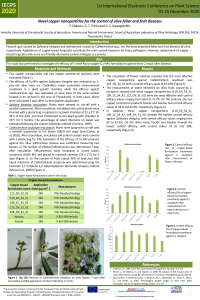
Peacock spot caused by Spilocaea oleagina and anthracnose caused by Colletotrichum spp., are the most important foliar and fruit diseases of olive. Applications of copper-based fungicides are the main control measures for these pathogens. However, replacement of copper –based products by more eco-friendly alternatives is a priority. In this study we investigated the efficacy of 5 novel Nano-copper (Cu-NPs) formulations against the 2 major olive diseases. Two commercial copper-based formulations were included as reference treatments. The efficacy of Cu-NPs against Spilocaea oleagina was evaluated in one-year-old olive trees (cv. Chondrolia Chalkidikis) under controlled environmental conditions in plant growth chamber, while the efficacy against Colletotrichum spp. was evaluated under field conditions on the same cultivar. Results showed that the most effective Cu-NPs against Colletotrichum spp. was 110_CN_S4_X1 that provided a mean control efficacy value of 61.03%, while the 2 commercial formulations of conventional cooper products provided significantly lower control efficacy values of 35.06 and 45.45%. Similarly 3 of the Cu-NPs tested (110_CN_S4_X1, 109_CC_S4_X2, 108_CN_S1_X1) were found to be highly effective against Spilocaea oleagina with control efficacy values ranging from 60 to 67.5%. The results of this study are expected to contribute in the optimization of olive diseases control and reduce the yield losses caused, using a new generation of biocides.
This research has been co‐financed by the European Union and Greek national funds through the Operational Program Competitiveness, Entrepreneurship and Innovation, under the call RESEARCH – CREATE – INNOVATE (project code: T1EDK- 01492)
Keywords
peacock spot
anthracnose
olive
nanoparticiples
Manuscript
Ntasiou_ NPs olive disease Poster (IECPS 2020).pdf
Poster
IECPS 2020.pdf
Transcriptome Analysis of Cocos nucifera L. Seedlings Having Contrasting Water-Use Efficiency (WUE) under Water-Deficit Stress: Molecular Insights and Genetic Markers for Drought Tolerance
Tomato Fruit Development in the Responses to Different Irrigation Practices: Developmental Study of Pericarp Cell Layers