Event submissions
Published

This submission belongs to the session A. Plant Protection, Response to stress and Climate Change of the event The 1st International Electronic Conference on Plant Science
Published date
02 Dec, 2020
Citation
Stefanos Gabriel Testempasis, Nathalie Nefeli Kamou, George Karaoglanidis, Urania Menkissoglu-Spiroudi, “Black Aspergilli” in vineyards of conventional and organic farming: Investigating the population structure and mycotoxigenic capacity of Aspergillus species section Nigri., in Proceedings of The 1st International Electronic Conference on Plant Science, 1 December–15 December 2020, MDPI: Basel, Switzerland, doi: 10.3390/IECPS2020-08856
Share
Email
Facebook
Twitter
LinkedIn
“Black Aspergilli” in vineyards of conventional and organic farming: Investigating the population structure and mycotoxigenic capacity of Aspergillus species section Nigri.
'%3e%3cpath%20d='M12.6647%2010.9104C12.4176%2010.325%2012.0589%209.7933%2011.6088%209.34485C11.16%208.89511%2010.6283%208.53653%2010.0432%208.28891C10.038%208.28629%2010.0327%208.28498%2010.0275%208.28236C10.8437%207.69282%2011.3743%206.73252%2011.3743%205.64907C11.3743%203.85423%209.92005%202.40002%208.12522%202.40002C6.33038%202.40002%204.87618%203.85423%204.87618%205.64907C4.87618%206.73252%205.40677%207.69282%206.22296%208.28367C6.21772%208.28629%206.21248%208.2876%206.20724%208.29022C5.62031%208.53783%205.09365%208.89287%204.64167%209.34616C4.19192%209.79496%203.83334%2010.3266%203.58573%2010.9117C3.34247%2011.4846%203.21128%2012.0987%203.19925%2012.721C3.1989%2012.735%203.20135%2012.7489%203.20646%2012.7619C3.21157%2012.7749%203.21924%2012.7868%203.22901%2012.7968C3.23877%2012.8068%203.25045%2012.8148%203.26334%2012.8202C3.27623%2012.8256%203.29007%2012.8284%203.30406%2012.8284H4.09012C4.14776%2012.8284%204.19362%2012.7825%204.19493%2012.7262C4.22113%2011.7148%204.62726%2010.7676%205.34519%2010.0497C6.08802%209.30686%207.07452%208.89811%208.12522%208.89811C9.17592%208.89811%2010.1624%209.30686%2010.9052%2010.0497C11.6232%2010.7676%2012.0293%2011.7148%2012.0555%2012.7262C12.0568%2012.7839%2012.1027%2012.8284%2012.1603%2012.8284H12.9464C12.9604%2012.8284%2012.9742%2012.8256%2012.9871%2012.8202C13%2012.8148%2013.0117%2012.8068%2013.0214%2012.7968C13.0312%2012.7868%2013.0389%2012.7749%2013.044%2012.7619C13.0491%2012.7489%2013.0515%2012.735%2013.0512%2012.721C13.0381%2012.0947%2012.9084%2011.4856%2012.6647%2010.9104ZM8.12522%207.90243C7.52388%207.90243%206.95792%207.66793%206.53214%207.24215C6.10636%206.81636%205.87185%206.2504%205.87185%205.64907C5.87185%205.04773%206.10636%204.48177%206.53214%204.05599C6.95792%203.63021%207.52388%203.3957%208.12522%203.3957C8.72655%203.3957%209.29252%203.63021%209.7183%204.05599C10.1441%204.48177%2010.3786%205.04773%2010.3786%205.64907C10.3786%206.2504%2010.1441%206.81636%209.7183%207.24215C9.29252%207.66793%208.72655%207.90243%208.12522%207.90243Z'%20fill='%235D1EE1'/%3e%3c/g%3e%3c/svg%3e)
Stefanos Gabriel Testempasis 1
Nathalie Nefeli Kamou 2

George Karaoglanidis 1
Urania Menkissoglu-Spiroudi 3
1. Faculty of Agriculture, Forestry and Natural Environment, Laboratory of Plant Pathology, Aristotle University of Thessaloniki
2. Faculty of Agriculture, Forestry and Natural Environment, Pesticide Science laboratory, Aristotle University of Thessaloniki
3. 2Faculty of Agriculture, Forestry and Natural Environment, Pesticide Science laboratory, Aristotle University of Thessaloniki
Abstract
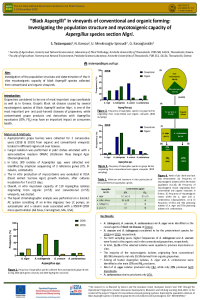
Grapevines considered to be one of most important crops worldwide as well as in Greece. Grape’s Black rot disease caused by several mycotoxigenic species of Black Aspergilli section Nigri, is one of the most important pre- as well as post-harvest diseases of grapevines, while contaminated grape products and derivatives with Aspergillus mycotoxins may have an important impact on consumers health. Overall the aim of this project is the investigation of the population structure and the determination of the in vitro mycotoxigenic capacity of black Aspergilli species collected from conventional and organic growing systems. In detailed, asymptomatic grape berries were collected for two consecutive years (2018 & 2019) from organic and conventional grapevines originated from different regions all over the Greece. In total, 300 isolates of Aspergillus spp. were selected and identified by amplicon sequencing of three reference genes. More specifically, A. tubingiensis, A. uvarum, A. carbonarious and A. niger were identified as the casual agents of Black rot disease in Greece, while A. uvarum and A. tubingiensis considered to be the predominant species for 2018 and 2019, respectively. In addition, for both sampling years, higher frequencies of A. tubingiensis and A. uvarum were found in the organic and in the conventional grapevines, respectively. In vitro mycotoxin production (OTA, FB2, FB3 and FB4) was evaluated in two selective media, while the analysis and the quantification were performed with LC/Q-TOF MS system. The analysis revealed significant high mycotoxin production, especially to the isolates originated from the conventional vineyards. In addition, A. carbonarious identified as the main OTA (0.02 to 16 μg/g) producer, while A. niger was the main producer of FB2(5 to 35 μg/g), FB4 and FB6.
Keywords
Black Aspergilli
Grapevines
Growing systems
Mycotoxins
in vitro
LC/Q-TOF MS
Manuscript
Mipd2020_Abstract_ST_Final.pdf
Poster
POSTER_ST_GK_OM.pdf
Tomato Fruit Development in the Responses to Different Irrigation Practices: Developmental Study of Pericarp Cell Layers
Determination of total phenolics and flavonoids content and evaluation of antioxidant activity of Tomborissa comorensis fruit.