Event submissions
Published

This submission belongs to the session B. Plant Nutrition, Plant Physiology and Metabolism of the event The 1st International Electronic Conference on Plant Science
Published date
02 Dec, 2020
Citation
Pia Starič, Ita Junkar, Katarina Vogel Mikuš, Miran Mozetič, Exploring the Effects of Cold Plasma on Wheat Seed Surface, Germination and Growth, in Proceedings of The 1st International Electronic Conference on Plant Science, 1 December–15 December 2020, MDPI: Basel, Switzerland, doi: 10.3390/IECPS2020-08860
Share
Email
Facebook
Twitter
LinkedIn
Exploring the Effects of Cold Plasma on Wheat Seed Surface, Germination and Growth
'%3e%3cpath%20d='M12.6647%2010.9104C12.4176%2010.325%2012.0589%209.7933%2011.6088%209.34485C11.16%208.89511%2010.6283%208.53653%2010.0432%208.28891C10.038%208.28629%2010.0327%208.28498%2010.0275%208.28236C10.8437%207.69282%2011.3743%206.73252%2011.3743%205.64907C11.3743%203.85423%209.92005%202.40002%208.12522%202.40002C6.33038%202.40002%204.87618%203.85423%204.87618%205.64907C4.87618%206.73252%205.40677%207.69282%206.22296%208.28367C6.21772%208.28629%206.21248%208.2876%206.20724%208.29022C5.62031%208.53783%205.09365%208.89287%204.64167%209.34616C4.19192%209.79496%203.83334%2010.3266%203.58573%2010.9117C3.34247%2011.4846%203.21128%2012.0987%203.19925%2012.721C3.1989%2012.735%203.20135%2012.7489%203.20646%2012.7619C3.21157%2012.7749%203.21924%2012.7868%203.22901%2012.7968C3.23877%2012.8068%203.25045%2012.8148%203.26334%2012.8202C3.27623%2012.8256%203.29007%2012.8284%203.30406%2012.8284H4.09012C4.14776%2012.8284%204.19362%2012.7825%204.19493%2012.7262C4.22113%2011.7148%204.62726%2010.7676%205.34519%2010.0497C6.08802%209.30686%207.07452%208.89811%208.12522%208.89811C9.17592%208.89811%2010.1624%209.30686%2010.9052%2010.0497C11.6232%2010.7676%2012.0293%2011.7148%2012.0555%2012.7262C12.0568%2012.7839%2012.1027%2012.8284%2012.1603%2012.8284H12.9464C12.9604%2012.8284%2012.9742%2012.8256%2012.9871%2012.8202C13%2012.8148%2013.0117%2012.8068%2013.0214%2012.7968C13.0312%2012.7868%2013.0389%2012.7749%2013.044%2012.7619C13.0491%2012.7489%2013.0515%2012.735%2013.0512%2012.721C13.0381%2012.0947%2012.9084%2011.4856%2012.6647%2010.9104ZM8.12522%207.90243C7.52388%207.90243%206.95792%207.66793%206.53214%207.24215C6.10636%206.81636%205.87185%206.2504%205.87185%205.64907C5.87185%205.04773%206.10636%204.48177%206.53214%204.05599C6.95792%203.63021%207.52388%203.3957%208.12522%203.3957C8.72655%203.3957%209.29252%203.63021%209.7183%204.05599C10.1441%204.48177%2010.3786%205.04773%2010.3786%205.64907C10.3786%206.2504%2010.1441%206.81636%209.7183%207.24215C9.29252%207.66793%208.72655%207.90243%208.12522%207.90243Z'%20fill='%235D1EE1'/%3e%3c/g%3e%3c/svg%3e)
Pia Starič 1

Ita Junkar 1

Katarina Vogel Mikuš 1,2
Miran Mozetič 1
1. Jožef Stefan Institute
2. University of Ljubljana, Biotechnical Faculty
Abstract
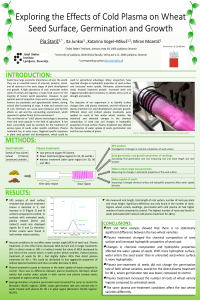
Seeds have large economic importance all over the world. They are an essential source of minerals, proteins, starch, and oil reserves in the early stages of plant development and growth. A high abundance of such molecules makes seeds of cereals and legumes a major food source for the majority of human world population. However, to gain optimal yield of important crops and to avoid pests, many farmers use pesticides and agrochemicals before, during, or/and after harvesting of crops. Wide and common use of such chemicals can cause pest resistance and harmful effects on soil and the surrounding environment, which represents a global threat to the environment.
The non-thermal or “cold” plasma technology is becoming more and more popular in the field of agriculture. It has been successfully used by scientists for the treatment of various types of seeds under specific conditions. Plasma treatment has, in some cases, triggered specific responses in plant seed growth and development, which could be used to agricultural advantage. Many researchers have reported changes in hydrophilic properties of seed surface and increased water uptake. Moreover, plasma-treated seeds showed improved growth, increased yield and triggered possible plant resistance to abiotic stress such as drought and salinity.
The objective of our experiment is to identify surface changes after cold plasma treatment, and the influence of plasma treatment on seed development and early growth. Different direct and indirect plasma treatments were applied on seeds of two winter wheat varieties. We examined and detected changes in the chemical composition of seed coat and changes in hydrophilic properties of seed surface. Plasma treatment also affected the dynamics of water uptake of seeds, germination rate and the root number of plants.
Keywords
cold plasma
seeds
wheat
surface modifications
XPS
water contact angle
germination
root
Manuscript
Staric_Pia_Plants_2020.pdf
Poster
Staric_Pia_Plants_2020.pdf
Isolation and genetic characterization of bacteria associated with Philaenus spumarius for the control of Xylella fastidiosa
Widespread holm oak dieback in Mediterranean forests: the roles of carbon stress and hydraulic failure under recurrent drought events