Event submissions
Published

This submission belongs to the session B. Plant Nutrition, Plant Physiology and Metabolism of the event The 1st International Electronic Conference on Plant Science
Published date
03 Dec, 2020
Citation
Sara Granado Rodríguez, Luis Felipe Pérez-Romero, Javier Matías, Nieves Aparicio, Luis Bolaños, María Reguera, Studying the effects of environmental conditions on the quality of quinoa seeds, in Proceedings of The 1st International Electronic Conference on Plant Science, 1 December–15 December 2020, MDPI: Basel, Switzerland, doi: 10.3390/IECPS2020-08866
Share
Email
Facebook
Twitter
LinkedIn
Studying the effects of environmental conditions on the quality of quinoa seeds
'%3e%3cpath%20d='M12.6647%2010.9104C12.4176%2010.325%2012.0589%209.7933%2011.6088%209.34485C11.16%208.89511%2010.6283%208.53653%2010.0432%208.28891C10.038%208.28629%2010.0327%208.28498%2010.0275%208.28236C10.8437%207.69282%2011.3743%206.73252%2011.3743%205.64907C11.3743%203.85423%209.92005%202.40002%208.12522%202.40002C6.33038%202.40002%204.87618%203.85423%204.87618%205.64907C4.87618%206.73252%205.40677%207.69282%206.22296%208.28367C6.21772%208.28629%206.21248%208.2876%206.20724%208.29022C5.62031%208.53783%205.09365%208.89287%204.64167%209.34616C4.19192%209.79496%203.83334%2010.3266%203.58573%2010.9117C3.34247%2011.4846%203.21128%2012.0987%203.19925%2012.721C3.1989%2012.735%203.20135%2012.7489%203.20646%2012.7619C3.21157%2012.7749%203.21924%2012.7868%203.22901%2012.7968C3.23877%2012.8068%203.25045%2012.8148%203.26334%2012.8202C3.27623%2012.8256%203.29007%2012.8284%203.30406%2012.8284H4.09012C4.14776%2012.8284%204.19362%2012.7825%204.19493%2012.7262C4.22113%2011.7148%204.62726%2010.7676%205.34519%2010.0497C6.08802%209.30686%207.07452%208.89811%208.12522%208.89811C9.17592%208.89811%2010.1624%209.30686%2010.9052%2010.0497C11.6232%2010.7676%2012.0293%2011.7148%2012.0555%2012.7262C12.0568%2012.7839%2012.1027%2012.8284%2012.1603%2012.8284H12.9464C12.9604%2012.8284%2012.9742%2012.8256%2012.9871%2012.8202C13%2012.8148%2013.0117%2012.8068%2013.0214%2012.7968C13.0312%2012.7868%2013.0389%2012.7749%2013.044%2012.7619C13.0491%2012.7489%2013.0515%2012.735%2013.0512%2012.721C13.0381%2012.0947%2012.9084%2011.4856%2012.6647%2010.9104ZM8.12522%207.90243C7.52388%207.90243%206.95792%207.66793%206.53214%207.24215C6.10636%206.81636%205.87185%206.2504%205.87185%205.64907C5.87185%205.04773%206.10636%204.48177%206.53214%204.05599C6.95792%203.63021%207.52388%203.3957%208.12522%203.3957C8.72655%203.3957%209.29252%203.63021%209.7183%204.05599C10.1441%204.48177%2010.3786%205.04773%2010.3786%205.64907C10.3786%206.2504%2010.1441%206.81636%209.7183%207.24215C9.29252%207.66793%208.72655%207.90243%208.12522%207.90243Z'%20fill='%235D1EE1'/%3e%3c/g%3e%3c/svg%3e)
Sara Granado Rodríguez 1
Luis Felipe Pérez-Romero 2
Javier Matías 3
Nieves Aparicio 4
Luis Bolaños 1

María Reguera 1
1. Universidad Autónoma de Madrid
2. Universidad de Huelva
3. Centro de Investigaciones Científicas y Tecnológicas de Extremadura
4. Instituto Tecnológico Agrario de Castilla y León
Abstract
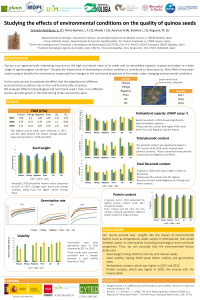
Quinoa is an Andean crop which has gained worldwide attention in the last few decades. This is in part due to the high nutritional value of its seeds (that present high protein content, a balanced amino acid composition and no gluten), and because of its remarkable capacity to grow and adapt to a wide range of agroecological conditions. Despite the importance of developing nutritious varieties to contribute to food security, little efforts have been made trying to identify the molecular pathways responsible for changes in the nutritional properties of the seeds under changing environmental conditions. In this study we aim to evaluate the effect that the adaptation to different environmental conditions has on the nutritional profile of quinoa seeds. For this purpose, we analyzed different physiological and nutritional seed´s traits in six different quinoa varieties grown in the field during three consecutive years (2017, 2018 and 2019). We found that there were differences between cultivars in most of the nutritional parameters analyzed and that the annuity was a determinant factor in every parameter tested, being 2018 the year with lower yields, germinative rates and antioxidant capacity but with higher seed weights and protein contents.
Keywords
quinoa
nutriotional quality
agronomy
food science
Manuscript
abstract.pdf
Poster
Granado Quinoa2 2020.pdf
Biocontrol Activity of Actinomycetes Strains against Fungal and Bacterial Pathogens of Solanum lycopersicum L. and Daucus carota L.: In Vitro and In Planta Antagonistic Activity
Influence of severe drought on leaf response in ABA contrasting tomato genotypes (wild type and flacca mutant)