Event submissions
Published

This submission belongs to the session A. Plant Protection, Response to stress and Climate Change of the event The 1st International Electronic Conference on Plant Science
Published date
03 Dec, 2020
Citation
Leila Bendifallah, Rima Tabli, Halima Khelladi, Latifa Hamoudi-Belarbi, Safia Hamoudi, Biological Activity of the Mentha spicata L. and Salvia officinalis L. (Lamiaceae) Essential Oils on Sytophilus granarius L. and Tribolium confusum Jac. Du Val. Infested Stored Wheat, in Proceedings of The 1st International Electronic Conference on Plant Science, 1 December–15 December 2020, MDPI: Basel, Switzerland, doi: 10.3390/IECPS2020-08873
Share
Email
Facebook
Twitter
LinkedIn
Biological Activity of the Mentha spicata L. and Salvia officinalis L. (Lamiaceae) Essential Oils on Sytophilus granarius L. and Tribolium confusum Jac. Du Val. Infested Stored Wheat
'%3e%3cpath%20d='M12.6647%2010.9104C12.4176%2010.325%2012.0589%209.7933%2011.6088%209.34485C11.16%208.89511%2010.6283%208.53653%2010.0432%208.28891C10.038%208.28629%2010.0327%208.28498%2010.0275%208.28236C10.8437%207.69282%2011.3743%206.73252%2011.3743%205.64907C11.3743%203.85423%209.92005%202.40002%208.12522%202.40002C6.33038%202.40002%204.87618%203.85423%204.87618%205.64907C4.87618%206.73252%205.40677%207.69282%206.22296%208.28367C6.21772%208.28629%206.21248%208.2876%206.20724%208.29022C5.62031%208.53783%205.09365%208.89287%204.64167%209.34616C4.19192%209.79496%203.83334%2010.3266%203.58573%2010.9117C3.34247%2011.4846%203.21128%2012.0987%203.19925%2012.721C3.1989%2012.735%203.20135%2012.7489%203.20646%2012.7619C3.21157%2012.7749%203.21924%2012.7868%203.22901%2012.7968C3.23877%2012.8068%203.25045%2012.8148%203.26334%2012.8202C3.27623%2012.8256%203.29007%2012.8284%203.30406%2012.8284H4.09012C4.14776%2012.8284%204.19362%2012.7825%204.19493%2012.7262C4.22113%2011.7148%204.62726%2010.7676%205.34519%2010.0497C6.08802%209.30686%207.07452%208.89811%208.12522%208.89811C9.17592%208.89811%2010.1624%209.30686%2010.9052%2010.0497C11.6232%2010.7676%2012.0293%2011.7148%2012.0555%2012.7262C12.0568%2012.7839%2012.1027%2012.8284%2012.1603%2012.8284H12.9464C12.9604%2012.8284%2012.9742%2012.8256%2012.9871%2012.8202C13%2012.8148%2013.0117%2012.8068%2013.0214%2012.7968C13.0312%2012.7868%2013.0389%2012.7749%2013.044%2012.7619C13.0491%2012.7489%2013.0515%2012.735%2013.0512%2012.721C13.0381%2012.0947%2012.9084%2011.4856%2012.6647%2010.9104ZM8.12522%207.90243C7.52388%207.90243%206.95792%207.66793%206.53214%207.24215C6.10636%206.81636%205.87185%206.2504%205.87185%205.64907C5.87185%205.04773%206.10636%204.48177%206.53214%204.05599C6.95792%203.63021%207.52388%203.3957%208.12522%203.3957C8.72655%203.3957%209.29252%203.63021%209.7183%204.05599C10.1441%204.48177%2010.3786%205.04773%2010.3786%205.64907C10.3786%206.2504%2010.1441%206.81636%209.7183%207.24215C9.29252%207.66793%208.72655%207.90243%208.12522%207.90243Z'%20fill='%235D1EE1'/%3e%3c/g%3e%3c/svg%3e)
Leila Bendifallah 1
Rima Tabli 2
Halima Khelladi 2
Latifa Hamoudi-Belarbi 3
Safia Hamoudi 4
1. Laboratory of Soft Technologies, Valorization, Physico-chemistry of Biological Materials and Biodiversity. Faculty of Sciences, M’hamed Bougara University of Boumerdes, Avenue de l’Indépendance, 35000, Boumerdes, Algeria. Email: Leila.bendifallah@gmail.co
2. Laboratory of Soft Technologies, Valorization, Physico-chemistry of Biological Materials and Biodiversity. Faculty of Sciences, M’hamed Bougara University of Boumerdes, Avenue de l’Indépendance, 35000 Boumerdes, Algeria
3. Laboratory of Valorisation and Bio-Engineering of Natural Resources, Department of Nature and Life Sciences, Faculty of Sciences, University of Algiers, 16000 Algiers, Algeria
4. Safia Hamoudi, Department of Soil Sciences and Agri‐Food Engineering, Université Laval, Centre in Green Chemistry & Catalysis, Québec, G1V 0A6, Canada
Abstract
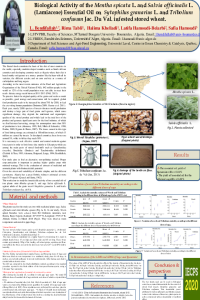
This work is part of the development and enhancement of natural substances and the search for effective, non-polluting and beneficial control methods for human health and for the environment against insect pests of stored cereals. For this purpose, the essential oil extracted by hydro-distillation using Clevenger of aromatic plants Mentha spicata L. and Salvia officinalis L. of the Lamiaceae family, have been tested for a possible effect bio-insecticides, by the method of direct contact against two different species of insect pests of stored cereals belonging to the order Coleoptera: wheat weevil Sytophilus granarius Linnaeus, 1758 (Curculionidae) and confused flour beetle Tribolium confusum Jacquelin du Val, 1863 (Tenebrionidae). This method involves the use of three solutions of essential oils (1ml, 2ml, 10ml of essential oil). 1ml of each solution was applied uniformly to a filter paper disc placed in a petri dish. A batch of adult insect individuals was introduced into each petri dish which was immediately closed and placed in their respective oven. Evaluation of the effectiveness of the product tested: this involves counting the dead individuals daily in the first hours after launching the tests. The test results show that the aerial part of Sage and Spearmint have a toxic effect on adults of Weevil (more than 60% mortality for Spearmint and more than 90% for Sage) and Tribolium (with more than 70% mortality for spearmint and more than 90% for sage). The dose (D3) is the most effective concentration. The insecticidal activity of the essential oil of Spearmint and Sage officinale more effective with respect to both species. In conclusion, these two aromatic and medicinal plants are naturally occurring substances that act as insecticides to control the stored cereals insect pest species.
Keywords
Biopesticides
Mentha spicata
Salvia officinalis
insect pests
stored cereals
Manuscript
sciforum_036708_original_Bendifallah_et_al_IECPS2020_Final-done.pdf
Poster
Poster L. Bendifallah et al 2020 IECPS..pdf
Promising bacteria for glyphosate degradation
Understanding fungal communities of olive tree leaves for application to climate change adaptation