Event submissions
Published

This submission belongs to the session A. Plant Protection, Response to stress and Climate Change of the event The 1st International Electronic Conference on Plant Science
Published date
03 Dec, 2020
Citation
Dalila Pasquini, Cecilia Brunetti, Francesco Ferrini, Roslyn Gleadow, Identifying allelopathic compounds emitted by Pittosporum undulatum in Eucalypt forests, in Proceedings of The 1st International Electronic Conference on Plant Science, 1 December–15 December 2020, MDPI: Basel, Switzerland, doi: 10.3390/IECPS2020-08884
Share
Email
Facebook
Twitter
LinkedIn
Identifying allelopathic compounds emitted by Pittosporum undulatum in Eucalypt forests
'%3e%3cpath%20d='M12.6647%2010.9104C12.4176%2010.325%2012.0589%209.7933%2011.6088%209.34485C11.16%208.89511%2010.6283%208.53653%2010.0432%208.28891C10.038%208.28629%2010.0327%208.28498%2010.0275%208.28236C10.8437%207.69282%2011.3743%206.73252%2011.3743%205.64907C11.3743%203.85423%209.92005%202.40002%208.12522%202.40002C6.33038%202.40002%204.87618%203.85423%204.87618%205.64907C4.87618%206.73252%205.40677%207.69282%206.22296%208.28367C6.21772%208.28629%206.21248%208.2876%206.20724%208.29022C5.62031%208.53783%205.09365%208.89287%204.64167%209.34616C4.19192%209.79496%203.83334%2010.3266%203.58573%2010.9117C3.34247%2011.4846%203.21128%2012.0987%203.19925%2012.721C3.1989%2012.735%203.20135%2012.7489%203.20646%2012.7619C3.21157%2012.7749%203.21924%2012.7868%203.22901%2012.7968C3.23877%2012.8068%203.25045%2012.8148%203.26334%2012.8202C3.27623%2012.8256%203.29007%2012.8284%203.30406%2012.8284H4.09012C4.14776%2012.8284%204.19362%2012.7825%204.19493%2012.7262C4.22113%2011.7148%204.62726%2010.7676%205.34519%2010.0497C6.08802%209.30686%207.07452%208.89811%208.12522%208.89811C9.17592%208.89811%2010.1624%209.30686%2010.9052%2010.0497C11.6232%2010.7676%2012.0293%2011.7148%2012.0555%2012.7262C12.0568%2012.7839%2012.1027%2012.8284%2012.1603%2012.8284H12.9464C12.9604%2012.8284%2012.9742%2012.8256%2012.9871%2012.8202C13%2012.8148%2013.0117%2012.8068%2013.0214%2012.7968C13.0312%2012.7868%2013.0389%2012.7749%2013.044%2012.7619C13.0491%2012.7489%2013.0515%2012.735%2013.0512%2012.721C13.0381%2012.0947%2012.9084%2011.4856%2012.6647%2010.9104ZM8.12522%207.90243C7.52388%207.90243%206.95792%207.66793%206.53214%207.24215C6.10636%206.81636%205.87185%206.2504%205.87185%205.64907C5.87185%205.04773%206.10636%204.48177%206.53214%204.05599C6.95792%203.63021%207.52388%203.3957%208.12522%203.3957C8.72655%203.3957%209.29252%203.63021%209.7183%204.05599C10.1441%204.48177%2010.3786%205.04773%2010.3786%205.64907C10.3786%206.2504%2010.1441%206.81636%209.7183%207.24215C9.29252%207.66793%208.72655%207.90243%208.12522%207.90243Z'%20fill='%235D1EE1'/%3e%3c/g%3e%3c/svg%3e)
Dalila Pasquini 1

Cecilia Brunetti 1,2

Francesco Ferrini 1

Roslyn Gleadow 3
1. Department of Agriculture, Food, Environment and Forestry - University of Florence, Florence, Italy
2. Institute for Sustainable Plant Protection (IPSP), National Research Council of Italy (CNR), Sesto Fiorentino, Italy
3. School of Biological Science - Monash University, Melbourne, Victoria, Australia
Abstract
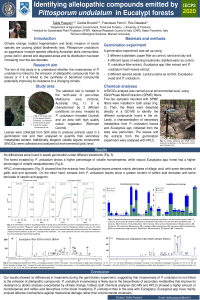
Changing climatic conditions played a major role in plants evolution and could modify the composition, structure and functionality of native plant communities, favoring invasive species. Studies conducted in south-eastern Australia have reported Pittosporum undulatum, a native tree, to be an aggressive invader of Eucalyptus forests. We tested the hypothesis that its negative impact on floristic diversity is due to the release of allelopathic compounds inhibiting the germination and growth of other plants. Thus, we compared the germination of Pittosporum undulatum, Eucalyptus ovata and lettuce on different substrates. Seeds were watered with leachates made from fresh P. undulatum leaves, litter collected from underneath P. undulatum or Eucalyptus trees, or distilled water.
P. undulatum seeds germinated more slowly than the other two species, however showed faster growth rates. E. ovata mortality rates seedlings were very high immediately after germination. While there were no significant treatment effects on germination rates, there were differences in morphology. The root system, in lettuce and E. ovata, was short and damaged when watered with fresh P. undulatum leaves extract.
Additionally, we investigated the possible emission of specific Biogenic Volatile Organic Compounds (BVOCs) which could have ecological functions or increase P. undulatum stress resistance. Using Solid Phase Microextraction (SPME) fibers, BVOCs were collected and analysed using Gas chromatography-mass spectrometry (GC-MS) to compare the emissions in eucalypt forests with and without P. undulatum. The main difference between the two sites was the higher D-limonene and α-pinene aerial concentration in P. undulatum infested sites.
Our results suggest that the high invasiveness of P. undulatum is mainly related to morphological and physiological characteristics rather than to allelopathic compounds emitted by this species. Additionally, the greater emission of D-limonene and α-pinene from P. undulatum compared to eucalypts could increase the resistance to abiotic stresses, such as drought or ozone.
Keywords
germination test
allelopathic compounds
invader
SPME
terpenes.
Manuscript
abstract.pdf
Poster
iecps_poster_Dalila_Pasquini.pdf
A novel plant-based biostimulant improves plant performances under drought stress in tomato
Optimization of ultrasound-assisted extraction of Pistacia lentiscus L. leaves in a green way to obtain the highest content of polyphenols using a response surface methodology