Event submissions
Published

This submission belongs to the session D. Phytochemistry and Bioremediation of the event The 1st International Electronic Conference on Plant Science
Published date
03 Dec, 2020
Citation
Cassandra Detti, Luana Beatriz Dos Santos Nascimento, Cecilia Brunetti, Francesco Ferrini, Antonella Gori, Optimization of ultrasound-assisted extraction of Pistacia lentiscus L. leaves in a green way to obtain the highest content of polyphenols using a response surface methodology, in Proceedings of The 1st International Electronic Conference on Plant Science, 1 December–15 December 2020, MDPI: Basel, Switzerland, doi: 10.3390/IECPS2020-08885
Share
Email
Facebook
Twitter
LinkedIn
Optimization of ultrasound-assisted extraction of Pistacia lentiscus L. leaves in a green way to obtain the highest content of polyphenols using a response surface methodology
'%3e%3cpath%20d='M12.6647%2010.9104C12.4176%2010.325%2012.0589%209.7933%2011.6088%209.34485C11.16%208.89511%2010.6283%208.53653%2010.0432%208.28891C10.038%208.28629%2010.0327%208.28498%2010.0275%208.28236C10.8437%207.69282%2011.3743%206.73252%2011.3743%205.64907C11.3743%203.85423%209.92005%202.40002%208.12522%202.40002C6.33038%202.40002%204.87618%203.85423%204.87618%205.64907C4.87618%206.73252%205.40677%207.69282%206.22296%208.28367C6.21772%208.28629%206.21248%208.2876%206.20724%208.29022C5.62031%208.53783%205.09365%208.89287%204.64167%209.34616C4.19192%209.79496%203.83334%2010.3266%203.58573%2010.9117C3.34247%2011.4846%203.21128%2012.0987%203.19925%2012.721C3.1989%2012.735%203.20135%2012.7489%203.20646%2012.7619C3.21157%2012.7749%203.21924%2012.7868%203.22901%2012.7968C3.23877%2012.8068%203.25045%2012.8148%203.26334%2012.8202C3.27623%2012.8256%203.29007%2012.8284%203.30406%2012.8284H4.09012C4.14776%2012.8284%204.19362%2012.7825%204.19493%2012.7262C4.22113%2011.7148%204.62726%2010.7676%205.34519%2010.0497C6.08802%209.30686%207.07452%208.89811%208.12522%208.89811C9.17592%208.89811%2010.1624%209.30686%2010.9052%2010.0497C11.6232%2010.7676%2012.0293%2011.7148%2012.0555%2012.7262C12.0568%2012.7839%2012.1027%2012.8284%2012.1603%2012.8284H12.9464C12.9604%2012.8284%2012.9742%2012.8256%2012.9871%2012.8202C13%2012.8148%2013.0117%2012.8068%2013.0214%2012.7968C13.0312%2012.7868%2013.0389%2012.7749%2013.044%2012.7619C13.0491%2012.7489%2013.0515%2012.735%2013.0512%2012.721C13.0381%2012.0947%2012.9084%2011.4856%2012.6647%2010.9104ZM8.12522%207.90243C7.52388%207.90243%206.95792%207.66793%206.53214%207.24215C6.10636%206.81636%205.87185%206.2504%205.87185%205.64907C5.87185%205.04773%206.10636%204.48177%206.53214%204.05599C6.95792%203.63021%207.52388%203.3957%208.12522%203.3957C8.72655%203.3957%209.29252%203.63021%209.7183%204.05599C10.1441%204.48177%2010.3786%205.04773%2010.3786%205.64907C10.3786%206.2504%2010.1441%206.81636%209.7183%207.24215C9.29252%207.66793%208.72655%207.90243%208.12522%207.90243Z'%20fill='%235D1EE1'/%3e%3c/g%3e%3c/svg%3e)
Cassandra Detti 1

Luana Beatriz Dos Santos Nascimento 1

Cecilia Brunetti 1,2

Francesco Ferrini 1,2

Antonella Gori 1,3
1. University of Florence, Department of Agriculture, Food, Environment and Forestry (DAGRI), Sesto Fiorentino (Florence), Italy.
2. National Research Council of Italy, Institute for Sustainable Plant Protection (IPSP), Sesto Fiorentino (Florence), Italy.
3. National Research Council of Italy, Institute for Sustainable Plant Protection (IPSP), Sesto Fiorentino (Florence), Italy
Abstract
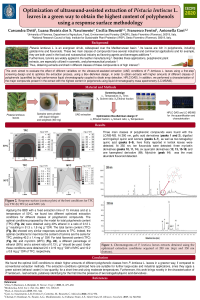
Pistacia lentiscus L. leaves are used in several applications, thanks to their polyphenolic abundance. Different methods are used for the extraction of these compounds. We aimed to optimize the ultrasond-assisted extraction (UAE) of P. lentiscus to obtain higher amounts of polyphenols in a greener way. A Box-Behnken design using temperature (30-50 °C), solvent volume (15-30 mL) and ethanol fraction (30-50 %) was conducted. Galloyl and myricetin derivatives were the most abundant compounds detected (HPLC-DAD-MS analysis). The regression analyses of total polyphenol (TPC), total tannins (TTC), total flavonoids (TFC) and myricitrin contents (MYC) showed good fit of the models. The maximum yields of TPC (51.3 ± 1.8 mg g-1 DW) and TTC (40.2 ± 1.4 mg g-1 DW) are obtained using 18 mL of 40 % ethanol at 50 °C. For flavonoids, an extraction with 20 mL of 50 % ethanol at 50 °C predicts the highest content (10.2 ± 0.8 mg g-1 DW), while 15 mL of 30 % ethanol at 30 ° C results in the maximum of MYC (2.6±0.19 mg g-1 DW). This greener process decreased in 25 % the percentage of ethanol and in half the time of the usual ethanolic extraction. Therefore, these UAE conditions can be applied to obtain polyphenolic enriched extracts from P. lentiscus leaves, which can be further employed for several industrial purposes.
Keywords
Anacardiaceae
design of experiments (DOE)
flavonoids
green extraction
HPLC-DAD
LC-MS
tannins
ultrasound assisted-extraction (UAE)
Manuscript
abstract.pdf
Poster
IECPS_POSTER_Cassandra Detti.pdf
Identifying allelopathic compounds emitted by Pittosporum undulatum in Eucalypt forests
Development of In Vitro Root Culture and miRNAs Analysis for Secondary Metabolites of Native Plants from the Mexican Bajio