Event submissions
Published

This submission belongs to the session A. Plant Protection, Response to stress and Climate Change of the event The 1st International Electronic Conference on Plant Science
Published date
03 Dec, 2020
Citation
Stacy D Singer, Kimberley Burton Hughes, Gaganpreet Kaur Dhariwal, Udaya Subedi, Kazi Kader, Abdelali Hannoufa, Surya Narayan Acharya, Mutation of MsSPL8 alleles via CRISPR/Cas9 mediated genome editing leads to superior abiotic stress resiliency and distinct morphological alterations in alfalfa, in Proceedings of The 1st International Electronic Conference on Plant Science, 1 December–15 December 2020, MDPI: Basel, Switzerland, doi: 10.3390/IECPS2020-08887
Share
Email
Facebook
Twitter
LinkedIn
Mutation of MsSPL8 alleles via CRISPR/Cas9 mediated genome editing leads to superior abiotic stress resiliency and distinct morphological alterations in alfalfa
'%3e%3cpath%20d='M12.6647%2010.9104C12.4176%2010.325%2012.0589%209.7933%2011.6088%209.34485C11.16%208.89511%2010.6283%208.53653%2010.0432%208.28891C10.038%208.28629%2010.0327%208.28498%2010.0275%208.28236C10.8437%207.69282%2011.3743%206.73252%2011.3743%205.64907C11.3743%203.85423%209.92005%202.40002%208.12522%202.40002C6.33038%202.40002%204.87618%203.85423%204.87618%205.64907C4.87618%206.73252%205.40677%207.69282%206.22296%208.28367C6.21772%208.28629%206.21248%208.2876%206.20724%208.29022C5.62031%208.53783%205.09365%208.89287%204.64167%209.34616C4.19192%209.79496%203.83334%2010.3266%203.58573%2010.9117C3.34247%2011.4846%203.21128%2012.0987%203.19925%2012.721C3.1989%2012.735%203.20135%2012.7489%203.20646%2012.7619C3.21157%2012.7749%203.21924%2012.7868%203.22901%2012.7968C3.23877%2012.8068%203.25045%2012.8148%203.26334%2012.8202C3.27623%2012.8256%203.29007%2012.8284%203.30406%2012.8284H4.09012C4.14776%2012.8284%204.19362%2012.7825%204.19493%2012.7262C4.22113%2011.7148%204.62726%2010.7676%205.34519%2010.0497C6.08802%209.30686%207.07452%208.89811%208.12522%208.89811C9.17592%208.89811%2010.1624%209.30686%2010.9052%2010.0497C11.6232%2010.7676%2012.0293%2011.7148%2012.0555%2012.7262C12.0568%2012.7839%2012.1027%2012.8284%2012.1603%2012.8284H12.9464C12.9604%2012.8284%2012.9742%2012.8256%2012.9871%2012.8202C13%2012.8148%2013.0117%2012.8068%2013.0214%2012.7968C13.0312%2012.7868%2013.0389%2012.7749%2013.044%2012.7619C13.0491%2012.7489%2013.0515%2012.735%2013.0512%2012.721C13.0381%2012.0947%2012.9084%2011.4856%2012.6647%2010.9104ZM8.12522%207.90243C7.52388%207.90243%206.95792%207.66793%206.53214%207.24215C6.10636%206.81636%205.87185%206.2504%205.87185%205.64907C5.87185%205.04773%206.10636%204.48177%206.53214%204.05599C6.95792%203.63021%207.52388%203.3957%208.12522%203.3957C8.72655%203.3957%209.29252%203.63021%209.7183%204.05599C10.1441%204.48177%2010.3786%205.04773%2010.3786%205.64907C10.3786%206.2504%2010.1441%206.81636%209.7183%207.24215C9.29252%207.66793%208.72655%207.90243%208.12522%207.90243Z'%20fill='%235D1EE1'/%3e%3c/g%3e%3c/svg%3e)
Stacy D Singer 1
Kimberley Burton Hughes 1
Gaganpreet Kaur Dhariwal 1
Udaya Subedi 2
Kazi Kader 1

Abdelali Hannoufa 3
Surya Narayan Acharya 1
1. Agriculture and Agri-Food Canada, Lethbridge Research and Development Centre
2. University of Alberta, Agriculture and Agri-Food Canada, Lethbridge Research and Development Centre
3. Agriculture and Agri-Food Canada, London Research and Development Centre
Abstract
Increase in demand for meat, milk and their products is expected to escalate considerably in coming years due to our ever-expanding population. While increase in forage crop production will therefore be a necessity to meet demand, our ability to attain high levels of forage crop productivity is likely to be constrained typical environmental pressures such as drought and salinity due to climate change. Alfalfa (Medicago sativa L.) is one of the world’s most widely grown forage species with a cropping area of over 30 million hectares worldwide. As such, there is a critical need to exploit advanced molecular breeding technologies in this species with the aim of rapidly developing alfalfa cultivars with improved biomass, as well as resiliency to various types of abiotic stress. It has been shown previously that the RNAi-mediated down-regulation of the miRNA156 target gene, SQUAMOSA PROMOTER-BINDING-LIKE8 (MsSPL8), enhances biomass production, as well as drought and salinity tolerance, in alfalfa. However, due to negative public perception and regulatory constraints surrounding the use of transgenic crops, it remains a challenge to implement such a crop in growers’ fields. CRISPR/Cas9-based genome editing provides an alternative breeding tool that yields germplasm bearing a mutation that is fundamentally identical to those achieved using conventional breeding approaches such as chemical mutagenesis, and the resulting plants can be made transgene-free in a straightforward manner. In this study, we successfully targeted MsSPL8 alleles using this technology in alfalfa, and isolated genotypes with mutations in approximately 25%, 50% and 75% of MsSPL8 alleles, respectively, in this tetraploid species. Furthermore, enhanced drought and salinity resistance, along with distinct morphological alterations including early flowering and reductions in internode length, were noted in the first generation of edited genotypes, which suggests that CRISPR/Cas9 can provide an effective breeding tool in alfalfa.
Keywords
Alfalfa
SQUAMOSA PROMOTER-BINDING-LIKE8
CRISPR/Cas9
Mutation
Abiotic stress
Manuscript
CRISPR abstract (IECPS, 2020).pdf
Poster
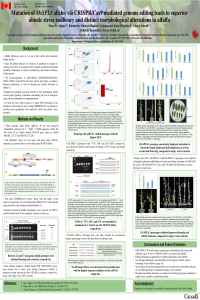
Poster_Stacy_Singer IECPS2020.pdf
Development of In Vitro Root Culture and miRNAs Analysis for Secondary Metabolites of Native Plants from the Mexican Bajio
Transcriptional down-regulation of various genes in alfalfa enhances tolerance to abiotic stresses