Event submissions
Published

This submission belongs to the session B. Plant Nutrition, Plant Physiology and Metabolism of the event The 1st International Electronic Conference on Plant Science
Published date
03 Dec, 2020
Citation
Meena Choudhary, Shabnam Bano, Uttar kumar Tomar, Biannual Seed Yield, Viability and Germination in Commiphora wightii (Arnott) Bhandari, in Proceedings of The 1st International Electronic Conference on Plant Science, 1 December–15 December 2020, MDPI: Basel, Switzerland, doi: 10.3390/IECPS2020-08889
Share
Email
Facebook
Twitter
LinkedIn
Biannual Seed Yield, Viability and Germination in Commiphora wightii (Arnott) Bhandari
'%3e%3cpath%20d='M12.6647%2010.9104C12.4176%2010.325%2012.0589%209.7933%2011.6088%209.34485C11.16%208.89511%2010.6283%208.53653%2010.0432%208.28891C10.038%208.28629%2010.0327%208.28498%2010.0275%208.28236C10.8437%207.69282%2011.3743%206.73252%2011.3743%205.64907C11.3743%203.85423%209.92005%202.40002%208.12522%202.40002C6.33038%202.40002%204.87618%203.85423%204.87618%205.64907C4.87618%206.73252%205.40677%207.69282%206.22296%208.28367C6.21772%208.28629%206.21248%208.2876%206.20724%208.29022C5.62031%208.53783%205.09365%208.89287%204.64167%209.34616C4.19192%209.79496%203.83334%2010.3266%203.58573%2010.9117C3.34247%2011.4846%203.21128%2012.0987%203.19925%2012.721C3.1989%2012.735%203.20135%2012.7489%203.20646%2012.7619C3.21157%2012.7749%203.21924%2012.7868%203.22901%2012.7968C3.23877%2012.8068%203.25045%2012.8148%203.26334%2012.8202C3.27623%2012.8256%203.29007%2012.8284%203.30406%2012.8284H4.09012C4.14776%2012.8284%204.19362%2012.7825%204.19493%2012.7262C4.22113%2011.7148%204.62726%2010.7676%205.34519%2010.0497C6.08802%209.30686%207.07452%208.89811%208.12522%208.89811C9.17592%208.89811%2010.1624%209.30686%2010.9052%2010.0497C11.6232%2010.7676%2012.0293%2011.7148%2012.0555%2012.7262C12.0568%2012.7839%2012.1027%2012.8284%2012.1603%2012.8284H12.9464C12.9604%2012.8284%2012.9742%2012.8256%2012.9871%2012.8202C13%2012.8148%2013.0117%2012.8068%2013.0214%2012.7968C13.0312%2012.7868%2013.0389%2012.7749%2013.044%2012.7619C13.0491%2012.7489%2013.0515%2012.735%2013.0512%2012.721C13.0381%2012.0947%2012.9084%2011.4856%2012.6647%2010.9104ZM8.12522%207.90243C7.52388%207.90243%206.95792%207.66793%206.53214%207.24215C6.10636%206.81636%205.87185%206.2504%205.87185%205.64907C5.87185%205.04773%206.10636%204.48177%206.53214%204.05599C6.95792%203.63021%207.52388%203.3957%208.12522%203.3957C8.72655%203.3957%209.29252%203.63021%209.7183%204.05599C10.1441%204.48177%2010.3786%205.04773%2010.3786%205.64907C10.3786%206.2504%2010.1441%206.81636%209.7183%207.24215C9.29252%207.66793%208.72655%207.90243%208.12522%207.90243Z'%20fill='%235D1EE1'/%3e%3c/g%3e%3c/svg%3e)
Meena Choudhary 1
Shabnam Bano 1
Uttar kumar Tomar 1
1. Genetics and Tree Improvement Division, Arid Forest Research Institute, Jodhpur-342005, Rajasthan, India
Abstract
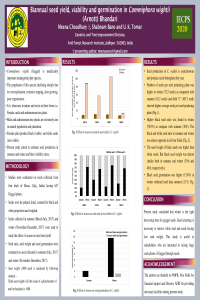
Commiphora wightii is an important medicinal tree of arid and semi-arid regions of India. It is commonly known as Guggal and belongs to family Burseraceae. It is dioecious in nature and male plants are extremely rare. Female plants produce seeds through apomixis. The slow growing nature, low seed viability and germination, excessive tapping for oleogum resin (known as guggul) put this plant under critically endangered categories in IUCN red data book. It is also reported earlier that this plant produces two types of seeds viz. black seed with higher viability and white seed with no or very poor viability. Therefore, Present study was carried out with the aim to identify the right mature seed harvesting period with higher viable seeds ratio which will be helpful in raising nursery and large-scale plantation of Guggul. The mature seeds were collected from 647 guggal plants (10 years old) from Deesa, Gujarat, India in summer (July, 2017) and winter (November and December, 2017). There is no significant difference in percentage of plants bearing mature seeds but number of mature seeds per seed producing plant was significantly higher in winter (72.51 seeds) as compared with summer (10.19 seeds). The proportion of black seed in summer and winter was almost opposite i.e. in winter 70.9% seeds were black whereas in summer only 30% black seeds were found. Seed germination data revealed that black seeds collected in winter showed higher seed germination (13.6%) than summer (2.1%). White seed collected in summer failed to germinate whereas very low seed germination was observed in winter (1.2%).
Keywords
viable black seed
guggal
dioecious plant
Manuscript
sciforum-036270-done.pdf
Poster
PLANT SCIENCE GuggaL POSTER.pdf
Transcriptional down-regulation of various genes in alfalfa enhances tolerance to abiotic stresses
Biomonitoring Air Pollution in Carob Leaves