Event submissions
EventsThe 3rd International Electronic Conference on Environmental Research and Public Health —Public Health Issues in the Context of the COVID-19 Pandemic
Published

This submission belongs to the session A. Infectious Disease Epidemiology of the event The 3rd International Electronic Conference on Environmental Research and Public Health —Public Health Issues in the Context of the COVID-19 Pandemic
Published date
11 Jan, 2021
Citation
Alexander N. Ishmatov, Virus-Laden Particles and Particulate Matter (Air Pollutants) with Viruses Attached: Terminology Matters. How Rumors that Air Pollutants Spread SARS-CoV-2 Are Born, in Proceedings of The 3rd International Electronic Conference on Environmental Research and Public Health —Public Health Issues in the Context of the COVID-19 Pandemic, 11 January–25 January 2021, MDPI: Basel, Switzerland, doi: 10.3390/ECERPH-3-08982
Share
Email
Facebook
Twitter
LinkedIn
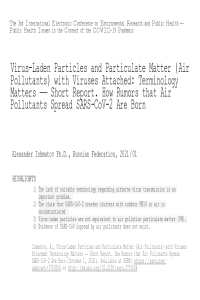
Virus-Laden Particles and Particulate Matter (Air Pollutants) with Viruses Attached: Terminology Matters. How Rumors that Air Pollutants Spread SARS-CoV-2 Are Born
'%3e%3cpath%20d='M12.6647%2010.9104C12.4176%2010.325%2012.0589%209.7933%2011.6088%209.34485C11.16%208.89511%2010.6283%208.53653%2010.0432%208.28891C10.038%208.28629%2010.0327%208.28498%2010.0275%208.28236C10.8437%207.69282%2011.3743%206.73252%2011.3743%205.64907C11.3743%203.85423%209.92005%202.40002%208.12522%202.40002C6.33038%202.40002%204.87618%203.85423%204.87618%205.64907C4.87618%206.73252%205.40677%207.69282%206.22296%208.28367C6.21772%208.28629%206.21248%208.2876%206.20724%208.29022C5.62031%208.53783%205.09365%208.89287%204.64167%209.34616C4.19192%209.79496%203.83334%2010.3266%203.58573%2010.9117C3.34247%2011.4846%203.21128%2012.0987%203.19925%2012.721C3.1989%2012.735%203.20135%2012.7489%203.20646%2012.7619C3.21157%2012.7749%203.21924%2012.7868%203.22901%2012.7968C3.23877%2012.8068%203.25045%2012.8148%203.26334%2012.8202C3.27623%2012.8256%203.29007%2012.8284%203.30406%2012.8284H4.09012C4.14776%2012.8284%204.19362%2012.7825%204.19493%2012.7262C4.22113%2011.7148%204.62726%2010.7676%205.34519%2010.0497C6.08802%209.30686%207.07452%208.89811%208.12522%208.89811C9.17592%208.89811%2010.1624%209.30686%2010.9052%2010.0497C11.6232%2010.7676%2012.0293%2011.7148%2012.0555%2012.7262C12.0568%2012.7839%2012.1027%2012.8284%2012.1603%2012.8284H12.9464C12.9604%2012.8284%2012.9742%2012.8256%2012.9871%2012.8202C13%2012.8148%2013.0117%2012.8068%2013.0214%2012.7968C13.0312%2012.7868%2013.0389%2012.7749%2013.044%2012.7619C13.0491%2012.7489%2013.0515%2012.735%2013.0512%2012.721C13.0381%2012.0947%2012.9084%2011.4856%2012.6647%2010.9104ZM8.12522%207.90243C7.52388%207.90243%206.95792%207.66793%206.53214%207.24215C6.10636%206.81636%205.87185%206.2504%205.87185%205.64907C5.87185%205.04773%206.10636%204.48177%206.53214%204.05599C6.95792%203.63021%207.52388%203.3957%208.12522%203.3957C8.72655%203.3957%209.29252%203.63021%209.7183%204.05599C10.1441%204.48177%2010.3786%205.04773%2010.3786%205.64907C10.3786%206.2504%2010.1441%206.81636%209.7183%207.24215C9.29252%207.66793%208.72655%207.90243%208.12522%207.90243Z'%20fill='%235D1EE1'/%3e%3c/g%3e%3c/svg%3e)
Alexander N. Ishmatov 1
1. Research Institute of Experimental and Clinical Medicine, Novosibirsk, 630117 Russian Federation (phone: 79132497837; fax: 7(383)335-94-05; e-mail: ishmatoff@centercem.ru).
Abstract
The causal role of air pollutants in COVID-19 transmission remains speculative, given ecologic biases and uncontrolled confounding. Furthermore, the definitions of essential concepts related to the relationship between air pollution and coronavirus are highly ambiguous, including the concepts “air pollution as a factor for health risk” and “SARS-CoV-2 spreads by particulate air pollution”, and the constituents of ”virus-laden particles”, “droplet nuclei”, “virus-bearing aerosols produced from human atomization”, and ”particulate matter (air pollutants) with viruses attached” remain controversial. This ambiguity has resulted in considerable misunderstandings between researchers. Unfortunately, premature and unsubstantiated claims that SARS-CoV-2 coagulates (creates clusters) with outdoor particulate matter (PM10) in the air and that SARS-CoV-2 can be transported by air pollutants became widely circulated in the media and have been cited by some studies as fact. Although the presence of the markers of SARS-CoV-2 (viral fragments of coronavirus) in environmental samples is an important finding, the media and researchers should be cautious regarding the claim that SARS-CoV-2 can create clusters with outdoor PM10 in the air and spread via particulate air pollution, as this statement is currently only a hypothesis that lacks direct or indirect supporting evidence. The issue of coagulation of virus-laden particles (respiratory droplets and droplets nuclei) with ultrafine particles (PM0.1) may have more important consequences for mitigating or intensify virus inactivation in urban air and needs to be studied.
Keywords
airborne transmission
air pollution
SARS-CoV-2
COVID-19
aerosol
Manuscript
038579.pdf
Poster
038579-slides.pdf
Coronavirus (COVID-19): What could be the environmental effects of disinfectant use in the pandemic?
Impact of law against domestic violence (DV) on the reproductive health of abuse victims in India.