Event submissions
EventsThe 3rd International Electronic Conference on Environmental Research and Public Health —Public Health Issues in the Context of the COVID-19 Pandemic
Published

This submission belongs to the session B. Environmental Exposures and Health of the event The 3rd International Electronic Conference on Environmental Research and Public Health —Public Health Issues in the Context of the COVID-19 Pandemic
Published date
11 Jan, 2021
Citation
Osvalda De Giglio, Ileana Federigi, Marco Verani, Giusy Diella, Francesco Triggiano, Carla Calia, Francesca Apollonio, Giusy Bonanno Ferraro, Pamela Mancini, Carolina Veneri, Giuseppina La Rosa, Annalaura Carducci, Maria Teresa Montagna, Coliphages as indicators of fecal contamination in wastewater treatment (SCA.Re.S. Project), in Proceedings of The 3rd International Electronic Conference on Environmental Research and Public Health —Public Health Issues in the Context of the COVID-19 Pandemic, 11 January–25 January 2021, MDPI: Basel, Switzerland, doi: 10.3390/ECERPH-3-08997
Share
Email
Facebook
Twitter
LinkedIn
Coliphages as indicators of fecal contamination in wastewater treatment (SCA.Re.S. Project)

Osvalda De Giglio 1

Ileana Federigi 2

Marco Verani 2

Giusy Diella 1

Francesco Triggiano 1

Carla Calia 1
'%3e%3cpath%20d='M12.6647%2010.9104C12.4176%2010.325%2012.0589%209.7933%2011.6088%209.34485C11.16%208.89511%2010.6283%208.53653%2010.0432%208.28891C10.038%208.28629%2010.0327%208.28498%2010.0275%208.28236C10.8437%207.69282%2011.3743%206.73252%2011.3743%205.64907C11.3743%203.85423%209.92005%202.40002%208.12522%202.40002C6.33038%202.40002%204.87618%203.85423%204.87618%205.64907C4.87618%206.73252%205.40677%207.69282%206.22296%208.28367C6.21772%208.28629%206.21248%208.2876%206.20724%208.29022C5.62031%208.53783%205.09365%208.89287%204.64167%209.34616C4.19192%209.79496%203.83334%2010.3266%203.58573%2010.9117C3.34247%2011.4846%203.21128%2012.0987%203.19925%2012.721C3.1989%2012.735%203.20135%2012.7489%203.20646%2012.7619C3.21157%2012.7749%203.21924%2012.7868%203.22901%2012.7968C3.23877%2012.8068%203.25045%2012.8148%203.26334%2012.8202C3.27623%2012.8256%203.29007%2012.8284%203.30406%2012.8284H4.09012C4.14776%2012.8284%204.19362%2012.7825%204.19493%2012.7262C4.22113%2011.7148%204.62726%2010.7676%205.34519%2010.0497C6.08802%209.30686%207.07452%208.89811%208.12522%208.89811C9.17592%208.89811%2010.1624%209.30686%2010.9052%2010.0497C11.6232%2010.7676%2012.0293%2011.7148%2012.0555%2012.7262C12.0568%2012.7839%2012.1027%2012.8284%2012.1603%2012.8284H12.9464C12.9604%2012.8284%2012.9742%2012.8256%2012.9871%2012.8202C13%2012.8148%2013.0117%2012.8068%2013.0214%2012.7968C13.0312%2012.7868%2013.0389%2012.7749%2013.044%2012.7619C13.0491%2012.7489%2013.0515%2012.735%2013.0512%2012.721C13.0381%2012.0947%2012.9084%2011.4856%2012.6647%2010.9104ZM8.12522%207.90243C7.52388%207.90243%206.95792%207.66793%206.53214%207.24215C6.10636%206.81636%205.87185%206.2504%205.87185%205.64907C5.87185%205.04773%206.10636%204.48177%206.53214%204.05599C6.95792%203.63021%207.52388%203.3957%208.12522%203.3957C8.72655%203.3957%209.29252%203.63021%209.7183%204.05599C10.1441%204.48177%2010.3786%205.04773%2010.3786%205.64907C10.3786%206.2504%2010.1441%206.81636%209.7183%207.24215C9.29252%207.66793%208.72655%207.90243%208.12522%207.90243Z'%20fill='%235D1EE1'/%3e%3c/g%3e%3c/svg%3e)
Francesca Apollonio 1
Giusy Bonanno Ferraro 3

Pamela Mancini 3
Carolina Veneri 3
Giuseppina La Rosa 3

Annalaura Carducci 2

Maria Teresa Montagna 1
1. Regional Reference Laboratory of Clinical and Environmental Surveillance of Legionellosis, Department of Biomedical Science and Human Oncology, University of Bari Aldo Moro, Piazza G. Cesare 11, 70124 Bari, Italy
2. Laboratory of Hygiene and Environmental Virology, Department of Biology, University of Pisa, Via S. Zeno 35/39, 56127 Pisa, Italy
3. Department of Environment and Health, Istituto Superiore di Sanità, Rome, Italy
Abstract
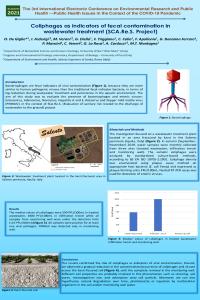
Bacteriophages are fecal indicators of viral contamination, because they are more similar to human pathogenic viruses than the traditional fecal indicator bacteria, in terms of log-reduction during wastewater treatment and persistence in the aquatic environment. The aim of this study was to evaluate the presence of bacteriophages and enteric viruses: Enterovirus, Adenovirus, Norovirus, Hepatitis A and E, Rotavirus and Pepper mild mottle virus (PMMoV), in the context of SCA.Re.S. (Evaluation of sanitary risk related to the discharge of wastewater to the ground) project.
The investigation focused on a wastewater treatment plant located in an area fractured by karst in the Salento peninsula (Apulia, Italy). In autumn (September-November) 2019, water samples were monthly collected from three sites (treated wastewater, infiltration trench and monitoring well). The somatic coliphage were analyzed by standardized culture-based methods, according to BS EN ISO 10705-2:2001. Coliphage density was enumerated using plaque assay method on appropriate host bacteria (E. coli Famp) and expressed as plaque forming units PFU/100mL. Nested RT-PCR assay was used for detection of enteric viruses.
The median values of coliphages were 590 PFU/100mL in treated wastewater, 1000 PFU/100mL in infiltration trench while all samples from monitoring well were under the detection limit. All samples were positive for at least one viral pathogen. PMMoV was detected only in monitoring well.
The results confirmed the role of coliphages as indicators of viral contamination. Overall, we observed a gradual reduction in the concentration/occurrence of coliphages and viruses across the karst-fissured soil, until the complete removal in the monitoring well. Different soil properties are probably involved in this phenomenon such as straining, soil pores, microorganism size, and adsorption onto soil particle. Moreover, we can also hypothesize natural degradation over time, phototoxicity or ingestion by multicellular organisms in the soil and/or monitoring well water.
Keywords
Enteric viruses
coliphages
wastewater treatment
Manuscript
039988.pdf
Poster
De Giglio.pdf
Analysis of the risk of contagion by COVID-19 taking into account the social determinants of health in Bogotá between February and August 2020.
The role of sex and family status on the relationship between exposition to violence and child-to-parent violence