Event submissions
EventsThe 3rd International Electronic Conference on Environmental Research and Public Health —Public Health Issues in the Context of the COVID-19 Pandemic
Published

This submission belongs to the session K. Posters of the event The 3rd International Electronic Conference on Environmental Research and Public Health —Public Health Issues in the Context of the COVID-19 Pandemic
Published date
11 Jan, 2021
Citation
Soraya Paz Montelongo, Carmen Rubio, Inmaculada Frías, Ángel J. Gutiérrez, Dailos González-Weller, Arturo Hardisson, Trace Elements levels in Rhodophyta algae from Tenerife, Canary Islands (North Atlantic Ocean region), in Proceedings of The 3rd International Electronic Conference on Environmental Research and Public Health —Public Health Issues in the Context of the COVID-19 Pandemic, 11 January–25 January 2021, MDPI: Basel, Switzerland, doi: 10.3390/ECERPH-3-09010
Share
Email
Facebook
Twitter
LinkedIn
Trace Elements levels in Rhodophyta algae from Tenerife, Canary Islands (North Atlantic Ocean region)

Soraya Paz Montelongo 1

Carmen Rubio 1
'%3e%3cpath%20d='M12.6647%2010.9104C12.4176%2010.325%2012.0589%209.7933%2011.6088%209.34485C11.16%208.89511%2010.6283%208.53653%2010.0432%208.28891C10.038%208.28629%2010.0327%208.28498%2010.0275%208.28236C10.8437%207.69282%2011.3743%206.73252%2011.3743%205.64907C11.3743%203.85423%209.92005%202.40002%208.12522%202.40002C6.33038%202.40002%204.87618%203.85423%204.87618%205.64907C4.87618%206.73252%205.40677%207.69282%206.22296%208.28367C6.21772%208.28629%206.21248%208.2876%206.20724%208.29022C5.62031%208.53783%205.09365%208.89287%204.64167%209.34616C4.19192%209.79496%203.83334%2010.3266%203.58573%2010.9117C3.34247%2011.4846%203.21128%2012.0987%203.19925%2012.721C3.1989%2012.735%203.20135%2012.7489%203.20646%2012.7619C3.21157%2012.7749%203.21924%2012.7868%203.22901%2012.7968C3.23877%2012.8068%203.25045%2012.8148%203.26334%2012.8202C3.27623%2012.8256%203.29007%2012.8284%203.30406%2012.8284H4.09012C4.14776%2012.8284%204.19362%2012.7825%204.19493%2012.7262C4.22113%2011.7148%204.62726%2010.7676%205.34519%2010.0497C6.08802%209.30686%207.07452%208.89811%208.12522%208.89811C9.17592%208.89811%2010.1624%209.30686%2010.9052%2010.0497C11.6232%2010.7676%2012.0293%2011.7148%2012.0555%2012.7262C12.0568%2012.7839%2012.1027%2012.8284%2012.1603%2012.8284H12.9464C12.9604%2012.8284%2012.9742%2012.8256%2012.9871%2012.8202C13%2012.8148%2013.0117%2012.8068%2013.0214%2012.7968C13.0312%2012.7868%2013.0389%2012.7749%2013.044%2012.7619C13.0491%2012.7489%2013.0515%2012.735%2013.0512%2012.721C13.0381%2012.0947%2012.9084%2011.4856%2012.6647%2010.9104ZM8.12522%207.90243C7.52388%207.90243%206.95792%207.66793%206.53214%207.24215C6.10636%206.81636%205.87185%206.2504%205.87185%205.64907C5.87185%205.04773%206.10636%204.48177%206.53214%204.05599C6.95792%203.63021%207.52388%203.3957%208.12522%203.3957C8.72655%203.3957%209.29252%203.63021%209.7183%204.05599C10.1441%204.48177%2010.3786%205.04773%2010.3786%205.64907C10.3786%206.2504%2010.1441%206.81636%209.7183%207.24215C9.29252%207.66793%208.72655%207.90243%208.12522%207.90243Z'%20fill='%235D1EE1'/%3e%3c/g%3e%3c/svg%3e)
Inmaculada Frías 1

Ángel J. Gutiérrez 1
Dailos González-Weller 2

Arturo Hardisson 1
1. Department of Toxicology, University of La Laguna, La Laguna, Tenerife, Canary Islands, 38071, Spain.
2. Health Inspection and Laboratory Service, Canary Health Service, S/C de Tenerife, Canary Islands 38006, Spain.
Abstract
Canary Islands, located in the North Atlantic Ocean, stand out for its great algae diversity and its climatic conditions. However, anthropogenic activities could increase the marine pollution. Some trace elements could pose a risk to biodiversity. Asparagopsis spp and Liagora spp algae, both from Rhodophyta or red algae group, are frequent in the Canary Islands’ coasts. So, the trace elements determination in both algae genera is interesting because due to their abundance these algae could be effective bio-indicators of marine pollution. The content of trace elements (B, Ba, Co, Cr, Cu, Fe, Li, Mn, Mo, Ni, Sr, V, Zn, Al, Cd, Pb) was determined in 30 samples of red algae (Asparagopsis spp and Liagora spp) from Porís de Abona (Arico, Tenerife, Spain) using inductively coupled plasma atomic emission spectroscopy (ICP-OES). Liagora spp recorded the highest mean concentrations of Fe (1190±1545 mg/kg dry weight) and B (80.2±34.2 mg/kg dw). Al (288±157 mg/kg dw) stands out in Asparagopsis spp. The high concentrations found indicate a high level of contamination of the collected area. Considering that this area is known by its marine diversity, actions must be taken to reduce pollution in this area of environmental interest.
Keywords
Trace elements
macroalgae
environmental risk
Canary Islands
marine pollution
Manuscript
041641.pdf
Poster
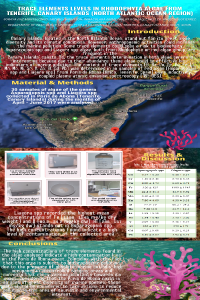
Trace Elements levels in Rhodophyta algae from Tenerife, Canary Islands (North Atlantic Ocean region)(2).pdf
The impact of COVID-19 outbreak on the level of worries and its associate to modified active mobility behaviour among Australian children
Health and social care workers’ quality of working life and coping while working during the Covid-19 Pandemic: Analysis of positive coping and work-related quality of life as resilience and protective factors impacting on wellbeing.