Event submissions
EventsThe 3rd International Electronic Conference on Environmental Research and Public Health —Public Health Issues in the Context of the COVID-19 Pandemic
Published

This submission belongs to the session K. Posters of the event The 3rd International Electronic Conference on Environmental Research and Public Health —Public Health Issues in the Context of the COVID-19 Pandemic
Published date
11 Jan, 2021
Citation
Ivana Škrlec, Jasminka Talapko, Emina Pustijanac, Tomislav Meštrović, Depression, Anxiety, Stress and Physical Activity in Health-Related University Students during COVID-19, in Proceedings of The 3rd International Electronic Conference on Environmental Research and Public Health —Public Health Issues in the Context of the COVID-19 Pandemic, 11 January–25 January 2021, MDPI: Basel, Switzerland, doi: 10.3390/ECERPH-3-09028
Share
Email
Facebook
Twitter
LinkedIn
Depression, Anxiety, Stress and Physical Activity in Health-Related University Students during COVID-19

Ivana Škrlec 1
'%3e%3cpath%20d='M12.6647%2010.9104C12.4176%2010.325%2012.0589%209.7933%2011.6088%209.34485C11.16%208.89511%2010.6283%208.53653%2010.0432%208.28891C10.038%208.28629%2010.0327%208.28498%2010.0275%208.28236C10.8437%207.69282%2011.3743%206.73252%2011.3743%205.64907C11.3743%203.85423%209.92005%202.40002%208.12522%202.40002C6.33038%202.40002%204.87618%203.85423%204.87618%205.64907C4.87618%206.73252%205.40677%207.69282%206.22296%208.28367C6.21772%208.28629%206.21248%208.2876%206.20724%208.29022C5.62031%208.53783%205.09365%208.89287%204.64167%209.34616C4.19192%209.79496%203.83334%2010.3266%203.58573%2010.9117C3.34247%2011.4846%203.21128%2012.0987%203.19925%2012.721C3.1989%2012.735%203.20135%2012.7489%203.20646%2012.7619C3.21157%2012.7749%203.21924%2012.7868%203.22901%2012.7968C3.23877%2012.8068%203.25045%2012.8148%203.26334%2012.8202C3.27623%2012.8256%203.29007%2012.8284%203.30406%2012.8284H4.09012C4.14776%2012.8284%204.19362%2012.7825%204.19493%2012.7262C4.22113%2011.7148%204.62726%2010.7676%205.34519%2010.0497C6.08802%209.30686%207.07452%208.89811%208.12522%208.89811C9.17592%208.89811%2010.1624%209.30686%2010.9052%2010.0497C11.6232%2010.7676%2012.0293%2011.7148%2012.0555%2012.7262C12.0568%2012.7839%2012.1027%2012.8284%2012.1603%2012.8284H12.9464C12.9604%2012.8284%2012.9742%2012.8256%2012.9871%2012.8202C13%2012.8148%2013.0117%2012.8068%2013.0214%2012.7968C13.0312%2012.7868%2013.0389%2012.7749%2013.044%2012.7619C13.0491%2012.7489%2013.0515%2012.735%2013.0512%2012.721C13.0381%2012.0947%2012.9084%2011.4856%2012.6647%2010.9104ZM8.12522%207.90243C7.52388%207.90243%206.95792%207.66793%206.53214%207.24215C6.10636%206.81636%205.87185%206.2504%205.87185%205.64907C5.87185%205.04773%206.10636%204.48177%206.53214%204.05599C6.95792%203.63021%207.52388%203.3957%208.12522%203.3957C8.72655%203.3957%209.29252%203.63021%209.7183%204.05599C10.1441%204.48177%2010.3786%205.04773%2010.3786%205.64907C10.3786%206.2504%2010.1441%206.81636%209.7183%207.24215C9.29252%207.66793%208.72655%207.90243%208.12522%207.90243Z'%20fill='%235D1EE1'/%3e%3c/g%3e%3c/svg%3e)
Jasminka Talapko 2
Emina Pustijanac 3

Tomislav Meštrović 4
1. Faculty of Dental Medicine and Health Osijek, Josip Juraj Strossmayer University of Osijek, Osijek, Croatia
2. Faculty of Dental Medicine and Health, Josip Juraj Strossmayer University of Osijek
3. Faculty of Natural Sciences, Juraj Dobrila University of Pula
4. University Centre Varaždin, University North, Varaždin, Croatia
Abstract
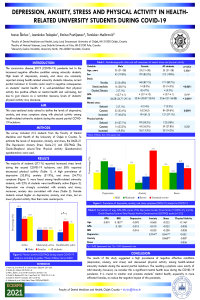
The coronavirus disease 2019 (COVID-19) pandemic led to the increased negative affective condition among university students. High levels of depression, anxiety, and stress are commonly reported among health-related university students. Likewise, current partial lockdown in Croatia could result in negative consequences on students’ mental health. It is well-established that physical activity has positive effects on mental health and well-being, but due to gym closure as a restriction measure, levels of students’ physical activity may decrease.
This cross-sectional study aimed to define the levels of depressive, anxiety, and stress symptoms along with physical activity among health-related university students during the second partial COVID-19 lockdown. The survey included 212 students from the Faculty of Dental Medicine and Health of the University of Osijek in Croatia. To estimate the levels of depression, anxiety, and stress, the DASS-21 (The Depression Anxiety Stress Scale-21) and GSLTPAQ (The Godin-Shephard Leisure-Time Physical Activity Questionnaire) questionnaires were used.
The majority of students (57.1%) reported increased stress levels during the second COVID-19 lockdown, and 58% reported decreased physical activity. A high prevalence of depressive (52.8%), anxiety (51.9%), and stress (54.7%) symptoms were found among health-related university students, with 33% of students were insufficiently active. Depression was strongly correlated with anxiety and stress; moreover, anxiety also correlated with stress. Female students scored higher on depression, anxiety, and stress, but on lower physical activity than their male counterparts.
The results of this study suggested a high prevalence of negative affective conditions (depression, anxiety, and stress) and decreased physical activity among health-related university students during the second partial lockdown. The resulting symptoms were mostly of mild intensity; however, we consider this a significant mental health issue during the COVID-19 pandemic. It is crucial to monitor and promote students' mental health, especially in more affected females, to reduce the negative impact of this pandemic.
Keywords
anxiety
COVID-19
depression
physical activity
stress
Manuscript
041954.pdf
Poster
041954-slides.pdf
Smartphone addiction through age and gender during Italian lockdown for COVID-19
The influence of manual therapy on biometric parameters in patients with improper body weight.