Event submissions
EventsThe 3rd International Electronic Conference on Environmental Research and Public Health —Public Health Issues in the Context of the COVID-19 Pandemic
Published

This submission belongs to the session D. Children’s Health of the event The 3rd International Electronic Conference on Environmental Research and Public Health —Public Health Issues in the Context of the COVID-19 Pandemic
Published date
11 Jan, 2021
Citation
Dorota Kleszczewska, Joanna Mazur, Anna Dzielska, Do neighbourhood and structural features affect health literacy in Polish adolescnts?, in Proceedings of The 3rd International Electronic Conference on Environmental Research and Public Health —Public Health Issues in the Context of the COVID-19 Pandemic, 11 January–25 January 2021, MDPI: Basel, Switzerland, doi: 10.3390/ECERPH-3-09031
Share
Email
Facebook
Twitter
LinkedIn
Do neighbourhood and structural features affect health literacy in Polish adolescnts?

Dorota Kleszczewska 1
'%3e%3cpath%20d='M12.6647%2010.9104C12.4176%2010.325%2012.0589%209.7933%2011.6088%209.34485C11.16%208.89511%2010.6283%208.53653%2010.0432%208.28891C10.038%208.28629%2010.0327%208.28498%2010.0275%208.28236C10.8437%207.69282%2011.3743%206.73252%2011.3743%205.64907C11.3743%203.85423%209.92005%202.40002%208.12522%202.40002C6.33038%202.40002%204.87618%203.85423%204.87618%205.64907C4.87618%206.73252%205.40677%207.69282%206.22296%208.28367C6.21772%208.28629%206.21248%208.2876%206.20724%208.29022C5.62031%208.53783%205.09365%208.89287%204.64167%209.34616C4.19192%209.79496%203.83334%2010.3266%203.58573%2010.9117C3.34247%2011.4846%203.21128%2012.0987%203.19925%2012.721C3.1989%2012.735%203.20135%2012.7489%203.20646%2012.7619C3.21157%2012.7749%203.21924%2012.7868%203.22901%2012.7968C3.23877%2012.8068%203.25045%2012.8148%203.26334%2012.8202C3.27623%2012.8256%203.29007%2012.8284%203.30406%2012.8284H4.09012C4.14776%2012.8284%204.19362%2012.7825%204.19493%2012.7262C4.22113%2011.7148%204.62726%2010.7676%205.34519%2010.0497C6.08802%209.30686%207.07452%208.89811%208.12522%208.89811C9.17592%208.89811%2010.1624%209.30686%2010.9052%2010.0497C11.6232%2010.7676%2012.0293%2011.7148%2012.0555%2012.7262C12.0568%2012.7839%2012.1027%2012.8284%2012.1603%2012.8284H12.9464C12.9604%2012.8284%2012.9742%2012.8256%2012.9871%2012.8202C13%2012.8148%2013.0117%2012.8068%2013.0214%2012.7968C13.0312%2012.7868%2013.0389%2012.7749%2013.044%2012.7619C13.0491%2012.7489%2013.0515%2012.735%2013.0512%2012.721C13.0381%2012.0947%2012.9084%2011.4856%2012.6647%2010.9104ZM8.12522%207.90243C7.52388%207.90243%206.95792%207.66793%206.53214%207.24215C6.10636%206.81636%205.87185%206.2504%205.87185%205.64907C5.87185%205.04773%206.10636%204.48177%206.53214%204.05599C6.95792%203.63021%207.52388%203.3957%208.12522%203.3957C8.72655%203.3957%209.29252%203.63021%209.7183%204.05599C10.1441%204.48177%2010.3786%205.04773%2010.3786%205.64907C10.3786%206.2504%2010.1441%206.81636%209.7183%207.24215C9.29252%207.66793%208.72655%207.90243%208.12522%207.90243Z'%20fill='%235D1EE1'/%3e%3c/g%3e%3c/svg%3e)
Joanna Mazur 2
Anna Dzielska 3
1. Institute of Mother and Child, Foundation, 01-211, Kasprzaka 17a, Warsaw, Poland
2. Collegium Medicum, University of Zielona Góra, 65-729, Zielona Góra, Poland;
3. Department of Child and Adolescent Health, Institute of Mother and Child, Kasprzaka 17a, 01-211 Warsaw, Poland
Abstract
BACKGROUND: Developing programmes to improve adolescents' health competences defined as health literacy (HL) seems to be crucial for their current and future health.
OBJECTIVE: To understand if living in regions with low deprivation and high social capital increases HL in adolescence.
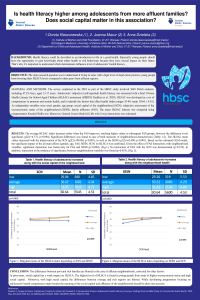
MATERIAL AND METHODS: The survey was conducted in the 2018 as part of the HBSC study involving 5648 Polish students aged 13-17, 47,3% boys. Adolescents’ self-reported HL was measured with a brief 10-item Health Literacy for School-Aged Children (HLSAC) instrument (IJERPH, Paakkari et al. 2020). HLSAC was developed as a set of competencies to promote and sustain health (5 dimensions of HL covered, index ranged 10-40, mean 30.64 ± 4.55). As independent variables: gender, age group, neighbourhood social capital scale (as social feature), subjective assessment of neighbourhood affluence (as structural feature), family affluence (FAS) were used. Comparison of mean HL indexes by nonparametric Kruskal-Wallis test and General Linear Model (GLM) with 2-way interactions were applied.RESULTS: The average HL index increases from 29.94 to 31.85 along with the neighbourhood social capital (p<0.001), as well as the neighbourhood affluence ( from 29.26 to 31.43; p<0.001). An significant interaction between FAS and the neighborhood affluence (p=0.004) means the accumulation of risk and protective factors (HL index ranges from 26.97 to 31,64) and a much stronger protective effect of the neighborhood features in the poor families as compared to average and high FAS groups.
CONCLUSION: Environmental features should be analyzed in research on social determinants of HL and in planning targeted interventions.
Keywords
health literacy
adolescents
neighbourhood,
Manuscript
042002.pdf
Poster
042002-poster.pdf
Psychological variables and sport practice during the lockdown caused by Covid-19: comparative analysis.
Mobilizing non-traditional public health partners to mitigate the effects of coronavirus infection and to reduce the risk of emerging disease