Event submissions
EventsThe 3rd International Electronic Conference on Environmental Research and Public Health —Public Health Issues in the Context of the COVID-19 Pandemic
Published

This submission belongs to the session K. Posters of the event The 3rd International Electronic Conference on Environmental Research and Public Health —Public Health Issues in the Context of the COVID-19 Pandemic
Published date
11 Jan, 2021
Citation
Michele Antonelli, Davide Donelli, Fabio Firenzuoli, Vitamin D and COVID-19: a PubMed-based overview of reviews, in Proceedings of The 3rd International Electronic Conference on Environmental Research and Public Health —Public Health Issues in the Context of the COVID-19 Pandemic, 11 January–25 January 2021, MDPI: Basel, Switzerland, doi: 10.3390/ECERPH-3-09051
Share
Email
Facebook
Twitter
LinkedIn
Vitamin D and COVID-19: a PubMed-based overview of reviews

Michele Antonelli 1

Davide Donelli 1
'%3e%3cpath%20d='M12.6647%2010.9104C12.4176%2010.325%2012.0589%209.7933%2011.6088%209.34485C11.16%208.89511%2010.6283%208.53653%2010.0432%208.28891C10.038%208.28629%2010.0327%208.28498%2010.0275%208.28236C10.8437%207.69282%2011.3743%206.73252%2011.3743%205.64907C11.3743%203.85423%209.92005%202.40002%208.12522%202.40002C6.33038%202.40002%204.87618%203.85423%204.87618%205.64907C4.87618%206.73252%205.40677%207.69282%206.22296%208.28367C6.21772%208.28629%206.21248%208.2876%206.20724%208.29022C5.62031%208.53783%205.09365%208.89287%204.64167%209.34616C4.19192%209.79496%203.83334%2010.3266%203.58573%2010.9117C3.34247%2011.4846%203.21128%2012.0987%203.19925%2012.721C3.1989%2012.735%203.20135%2012.7489%203.20646%2012.7619C3.21157%2012.7749%203.21924%2012.7868%203.22901%2012.7968C3.23877%2012.8068%203.25045%2012.8148%203.26334%2012.8202C3.27623%2012.8256%203.29007%2012.8284%203.30406%2012.8284H4.09012C4.14776%2012.8284%204.19362%2012.7825%204.19493%2012.7262C4.22113%2011.7148%204.62726%2010.7676%205.34519%2010.0497C6.08802%209.30686%207.07452%208.89811%208.12522%208.89811C9.17592%208.89811%2010.1624%209.30686%2010.9052%2010.0497C11.6232%2010.7676%2012.0293%2011.7148%2012.0555%2012.7262C12.0568%2012.7839%2012.1027%2012.8284%2012.1603%2012.8284H12.9464C12.9604%2012.8284%2012.9742%2012.8256%2012.9871%2012.8202C13%2012.8148%2013.0117%2012.8068%2013.0214%2012.7968C13.0312%2012.7868%2013.0389%2012.7749%2013.044%2012.7619C13.0491%2012.7489%2013.0515%2012.735%2013.0512%2012.721C13.0381%2012.0947%2012.9084%2011.4856%2012.6647%2010.9104ZM8.12522%207.90243C7.52388%207.90243%206.95792%207.66793%206.53214%207.24215C6.10636%206.81636%205.87185%206.2504%205.87185%205.64907C5.87185%205.04773%206.10636%204.48177%206.53214%204.05599C6.95792%203.63021%207.52388%203.3957%208.12522%203.3957C8.72655%203.3957%209.29252%203.63021%209.7183%204.05599C10.1441%204.48177%2010.3786%205.04773%2010.3786%205.64907C10.3786%206.2504%2010.1441%206.81636%209.7183%207.24215C9.29252%207.66793%208.72655%207.90243%208.12522%207.90243Z'%20fill='%235D1EE1'/%3e%3c/g%3e%3c/svg%3e)
Fabio Firenzuoli 2
1. AUSL-IRCCS Reggio Emilia
2. CERFIT, Careggi University Hospital
Abstract
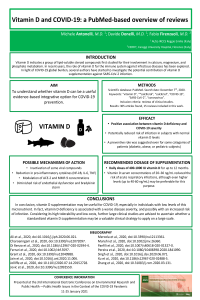
Introduction. In recent years, the role of vitamin D for the immune system has been explored. In light of the global burden of COVID-19, this literature overview aims to understand whether vitamin D can be a useful integrative option for COVID-19 prevention.
Methods. A PubMed-based overview of reviews (date of search: December 7th, 2020).
Results. After database search, 305 articles were found, and 15 reviews were included in this study. From a mechanistic perspective, vitamin D may inactivate some viral compounds, reduce proinflammatory cytokines (NF-kB, IL-6, TNF), modulate ACE-2 and MMP-9 concentrations, diminish the risk of endothelial dysfunction and bradykinin storm. In a meta-analysis, a positive association between vitamin D deficiency and COVID-19 severity was observed, and other researchers suggested that this association may also involve an increased risk of infection. A preventive role was hypothesized even for diabetic, obese, or pediatric subjects. However, in most reviews, the evidence base was considered insufficient to draw definitive conclusions. In a broad meta-analysis, it was reported that an administration of daily doses of 400-1000 IU vitamin D for up to 12 months was significantly associated with some degree of protection against acute respiratory infections. Some studies indicated that vitamin D serum concentrations of 20–30 ng/mL reduced the risk of acute respiratory infections, while others pointed out that higher levels (up to 40-60 ng/mL) may be preferable for this purpose.
Discussion. In conclusion, vitamin D supplementation may be useful for COVID-19, especially in individuals with low levels of this micronutrient. In fact, vitamin D deficiency is associated with a worse disease severity, and possibly with an increased risk of infection. Considering its high tolerability and low costs, further large clinical studies are advised to ascertain whether a standardized supplementation may be a valuable clinical strategy to apply on a large scale.
Keywords
Vitamin D
Supplementation
Preventive Medicine
COVID-19
Coronavirus
Review
Manuscript
042088.pdf
Poster
042088-poster.pdf
Dimensions and attributes used in QALY instruments: a systematic review
A DESCRIPTIVE STUDY OF THE DIFFERENCES IN THE TYPE OF ADMISSIONS OF THE HOSPITAL STAY IN A PSYCHIATRIC HOSPITALIZATION UNIT BETWEEN 2019 AND 2020