Event submissions
EventsThe 3rd International Electronic Conference on Environmental Research and Public Health —Public Health Issues in the Context of the COVID-19 Pandemic
Published

This submission belongs to the session B. Environmental Exposures and Health of the event The 3rd International Electronic Conference on Environmental Research and Public Health —Public Health Issues in the Context of the COVID-19 Pandemic
Published date
11 Jan, 2021
Citation
Virginia Vettori, Chiara Lorini, Bianca Bronzi, Guglielmo Bonaccorsi, Water benefit and global health: the water footprint of the dietary patterns and the acceptability of a 100% plant-based diet, in Proceedings of The 3rd International Electronic Conference on Environmental Research and Public Health —Public Health Issues in the Context of the COVID-19 Pandemic, 11 January–25 January 2021, MDPI: Basel, Switzerland, doi: 10.3390/ECERPH-3-09058
Share
Email
Facebook
Twitter
LinkedIn
Water benefit and global health: the water footprint of the dietary patterns and the acceptability of a 100% plant-based diet
'%3e%3cpath%20d='M12.6647%2010.9104C12.4176%2010.325%2012.0589%209.7933%2011.6088%209.34485C11.16%208.89511%2010.6283%208.53653%2010.0432%208.28891C10.038%208.28629%2010.0327%208.28498%2010.0275%208.28236C10.8437%207.69282%2011.3743%206.73252%2011.3743%205.64907C11.3743%203.85423%209.92005%202.40002%208.12522%202.40002C6.33038%202.40002%204.87618%203.85423%204.87618%205.64907C4.87618%206.73252%205.40677%207.69282%206.22296%208.28367C6.21772%208.28629%206.21248%208.2876%206.20724%208.29022C5.62031%208.53783%205.09365%208.89287%204.64167%209.34616C4.19192%209.79496%203.83334%2010.3266%203.58573%2010.9117C3.34247%2011.4846%203.21128%2012.0987%203.19925%2012.721C3.1989%2012.735%203.20135%2012.7489%203.20646%2012.7619C3.21157%2012.7749%203.21924%2012.7868%203.22901%2012.7968C3.23877%2012.8068%203.25045%2012.8148%203.26334%2012.8202C3.27623%2012.8256%203.29007%2012.8284%203.30406%2012.8284H4.09012C4.14776%2012.8284%204.19362%2012.7825%204.19493%2012.7262C4.22113%2011.7148%204.62726%2010.7676%205.34519%2010.0497C6.08802%209.30686%207.07452%208.89811%208.12522%208.89811C9.17592%208.89811%2010.1624%209.30686%2010.9052%2010.0497C11.6232%2010.7676%2012.0293%2011.7148%2012.0555%2012.7262C12.0568%2012.7839%2012.1027%2012.8284%2012.1603%2012.8284H12.9464C12.9604%2012.8284%2012.9742%2012.8256%2012.9871%2012.8202C13%2012.8148%2013.0117%2012.8068%2013.0214%2012.7968C13.0312%2012.7868%2013.0389%2012.7749%2013.044%2012.7619C13.0491%2012.7489%2013.0515%2012.735%2013.0512%2012.721C13.0381%2012.0947%2012.9084%2011.4856%2012.6647%2010.9104ZM8.12522%207.90243C7.52388%207.90243%206.95792%207.66793%206.53214%207.24215C6.10636%206.81636%205.87185%206.2504%205.87185%205.64907C5.87185%205.04773%206.10636%204.48177%206.53214%204.05599C6.95792%203.63021%207.52388%203.3957%208.12522%203.3957C8.72655%203.3957%209.29252%203.63021%209.7183%204.05599C10.1441%204.48177%2010.3786%205.04773%2010.3786%205.64907C10.3786%206.2504%2010.1441%206.81636%209.7183%207.24215C9.29252%207.66793%208.72655%207.90243%208.12522%207.90243Z'%20fill='%235D1EE1'/%3e%3c/g%3e%3c/svg%3e)
Virginia Vettori 1

Chiara Lorini 2
Bianca Bronzi 2

Guglielmo Bonaccorsi 2
1. Department of Health Sciences, University of Florence
2. Department of Health Sciences, University of Florence, 48 Blvd Morgagni Florence, FI 50134
Abstract
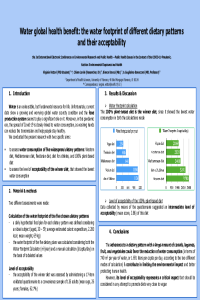
The spread of Covid-19 is closely linked to water and sanitation since cleaning hands can reduce its transmission and help people stay healthy. Unfortunately, about 800 million people cannot access to a safe and sufficient water supply. Dietary shifts could contribute to address the global water crisis since our food choices have a relevant role on human water impact. In this project, we calculated the water footprint index of five different dietary patterns (vegan diet, flexitarian diet, Mediterranean diet, diet for training, and Western diet) aimed to identify the diet with the lowest water impact. We also assessed its level of acceptability with the aim of understanding how and if people can change their eating habits.
An accredited dietitian estimated a weekly food plan (2200 kcal per day) for each dietary pattern. Two methods were used to calculate the index: the water footprint calculator (m3 per year), and evaluating tables related to the water consumption of foods and beverages (l/capita/day). Additionally, we administered a modified version of the 17-item “Food Acceptability Questionnaire (FAQ)” that it was translated, adapted, and administered to a convenience sample of N=126 subjects (mean age = 26 years; females = 62,7%).
The lowest water impact diet was 100% plant-based diet (WF=354 m3 per year; 2089 l/capita/day) and data collected suggested that its acceptability is at an intermediate level.
We concluded that the adherence to a vegan diet could favor the reduction of water consumption (WF=740 m3 per year; 1691 l/capita/day) and could help to save relevant amount of water that is valuable for human health.
Keywords
environmental sustainability
healthy diet
cross cultural validation
Manuscript
042140.pdf
Poster
VettoriETalPosterProceedings04.01.pdf
Comparison between Bioelectrical Impedance Analysis and Body Mass Index Methods in Determination of Obesity Prevalence of Chinese Preschoolers
Relationship between Influenza Vaccination Uptake and COVID-19 Death Rate in New York City Population