Event submissions
EventsThe 3rd International Electronic Conference on Environmental Research and Public Health —Public Health Issues in the Context of the COVID-19 Pandemic
Published

This submission belongs to the session A. Infectious Disease Epidemiology of the event The 3rd International Electronic Conference on Environmental Research and Public Health —Public Health Issues in the Context of the COVID-19 Pandemic
Published date
11 Jan, 2021
Citation
Asher Moreland, Christina Gillezeau, Naomi Alpert, Emanuela Taioli, Relationship between Influenza Vaccination Uptake and COVID-19 Death Rate in New York City Population, in Proceedings of The 3rd International Electronic Conference on Environmental Research and Public Health —Public Health Issues in the Context of the COVID-19 Pandemic, 11 January–25 January 2021, MDPI: Basel, Switzerland, doi: 10.3390/ECERPH-3-09059
Share
Email
Facebook
Twitter
LinkedIn
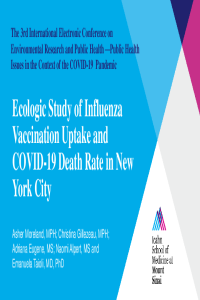
Relationship between Influenza Vaccination Uptake and COVID-19 Death Rate in New York City Population
'%3e%3cpath%20d='M12.6647%2010.9104C12.4176%2010.325%2012.0589%209.7933%2011.6088%209.34485C11.16%208.89511%2010.6283%208.53653%2010.0432%208.28891C10.038%208.28629%2010.0327%208.28498%2010.0275%208.28236C10.8437%207.69282%2011.3743%206.73252%2011.3743%205.64907C11.3743%203.85423%209.92005%202.40002%208.12522%202.40002C6.33038%202.40002%204.87618%203.85423%204.87618%205.64907C4.87618%206.73252%205.40677%207.69282%206.22296%208.28367C6.21772%208.28629%206.21248%208.2876%206.20724%208.29022C5.62031%208.53783%205.09365%208.89287%204.64167%209.34616C4.19192%209.79496%203.83334%2010.3266%203.58573%2010.9117C3.34247%2011.4846%203.21128%2012.0987%203.19925%2012.721C3.1989%2012.735%203.20135%2012.7489%203.20646%2012.7619C3.21157%2012.7749%203.21924%2012.7868%203.22901%2012.7968C3.23877%2012.8068%203.25045%2012.8148%203.26334%2012.8202C3.27623%2012.8256%203.29007%2012.8284%203.30406%2012.8284H4.09012C4.14776%2012.8284%204.19362%2012.7825%204.19493%2012.7262C4.22113%2011.7148%204.62726%2010.7676%205.34519%2010.0497C6.08802%209.30686%207.07452%208.89811%208.12522%208.89811C9.17592%208.89811%2010.1624%209.30686%2010.9052%2010.0497C11.6232%2010.7676%2012.0293%2011.7148%2012.0555%2012.7262C12.0568%2012.7839%2012.1027%2012.8284%2012.1603%2012.8284H12.9464C12.9604%2012.8284%2012.9742%2012.8256%2012.9871%2012.8202C13%2012.8148%2013.0117%2012.8068%2013.0214%2012.7968C13.0312%2012.7868%2013.0389%2012.7749%2013.044%2012.7619C13.0491%2012.7489%2013.0515%2012.735%2013.0512%2012.721C13.0381%2012.0947%2012.9084%2011.4856%2012.6647%2010.9104ZM8.12522%207.90243C7.52388%207.90243%206.95792%207.66793%206.53214%207.24215C6.10636%206.81636%205.87185%206.2504%205.87185%205.64907C5.87185%205.04773%206.10636%204.48177%206.53214%204.05599C6.95792%203.63021%207.52388%203.3957%208.12522%203.3957C8.72655%203.3957%209.29252%203.63021%209.7183%204.05599C10.1441%204.48177%2010.3786%205.04773%2010.3786%205.64907C10.3786%206.2504%2010.1441%206.81636%209.7183%207.24215C9.29252%207.66793%208.72655%207.90243%208.12522%207.90243Z'%20fill='%235D1EE1'/%3e%3c/g%3e%3c/svg%3e)
Asher Moreland 1
Christina Gillezeau 1
Naomi Alpert 1

Emanuela Taioli 1
1. Mount Sinai Institute of Translational Epidemiology
Abstract
Abstract: Background: Influenza vaccination has been postulated to mitigate COVID-19 severity and may be an effective prevention measure to mitigate the pandemic. The aim of this ecological study was to assess the area-level relationship between cumulative death rate for COVID-19 and historic influenza vaccination uptake in the New York City population. Methods: Predictors of COVID-19 death included self-reported flu vaccination in 2018, as well as four CDC-defined risk factors of severe COVID-19 infection available at the ecological level, which were diabetes, asthma, BMI 30-100 (mg/k2) and hypertension. We used publicly available data from the NYC Department of Health Coronavirus repository and survey data from the Community Health Survey . COVID-19 death rate according to modified zip code tabulation areas (MODZCTA) was the outcome for multilinear analysis. Results: At univariate analysis, the rate of COVID-19 deaths deceased by 5.869 units for every one-unit increase in flu vaccination uptake for each zip-code area (p < .0001). In the multilinear model, predictors accounted for 23% of the variability in the COVID-19 death rate (p < .0001). After adjustment for all available risk factors, influenza vaccination and diabetes prevalence were significant predictors of COVID-19 deaths (Badj = -4.217, p = 0.0024; Badj = 8.867, p = 0.0051 for vaccination and diabetes, respectively). Conclusions: Differences in COVID-19 mortality have been documented across New York City. Modified zip codes with a higher prevalence of influenza vaccination had lower rates of COVID-19 mortality, inciting the need to further explore the relationship between influenza vaccination uptake and COVID-19 mortality at the individual level.
Keywords
Influenza Vaccination
COVID-19
Manuscript
042144.pdf
Poster
POSTER_FINAL.pdf
Water benefit and global health: the water footprint of the dietary patterns and the acceptability of a 100% plant-based diet
INDENTIFICATION AND OVERCOMMITMENT IN THE HOSPITAL CONTEXT: A COMPARATIVE STUDY IN A SPANISH SAMPLE OF HEALTH PROFESSIONALS