Event submissions
Published

This submission belongs to the session S7. Poster of the event 1st International Electronic Conference on Toxins
Published date
13 Jan, 2021
Citation
Andrea Boente-Juncal, Sandra Raposo-García, Celia Costas, M Carmen Louzao, Paz Otero, Carmen Vale, Luis Botana, Activation of anion channels in human cells after long term exposure to the marine toxin azaspiracid, in Proceedings of 1st International Electronic Conference on Toxins, 16 January–31 January 2021, MDPI: Basel, Switzerland, doi: 10.3390/IECT2021-09114
Share
Email
Facebook
Twitter
LinkedIn
Activation of anion channels in human cells after long term exposure to the marine toxin azaspiracid
'%3e%3cpath%20d='M12.6647%2010.9104C12.4176%2010.325%2012.0589%209.7933%2011.6088%209.34485C11.16%208.89511%2010.6283%208.53653%2010.0432%208.28891C10.038%208.28629%2010.0327%208.28498%2010.0275%208.28236C10.8437%207.69282%2011.3743%206.73252%2011.3743%205.64907C11.3743%203.85423%209.92005%202.40002%208.12522%202.40002C6.33038%202.40002%204.87618%203.85423%204.87618%205.64907C4.87618%206.73252%205.40677%207.69282%206.22296%208.28367C6.21772%208.28629%206.21248%208.2876%206.20724%208.29022C5.62031%208.53783%205.09365%208.89287%204.64167%209.34616C4.19192%209.79496%203.83334%2010.3266%203.58573%2010.9117C3.34247%2011.4846%203.21128%2012.0987%203.19925%2012.721C3.1989%2012.735%203.20135%2012.7489%203.20646%2012.7619C3.21157%2012.7749%203.21924%2012.7868%203.22901%2012.7968C3.23877%2012.8068%203.25045%2012.8148%203.26334%2012.8202C3.27623%2012.8256%203.29007%2012.8284%203.30406%2012.8284H4.09012C4.14776%2012.8284%204.19362%2012.7825%204.19493%2012.7262C4.22113%2011.7148%204.62726%2010.7676%205.34519%2010.0497C6.08802%209.30686%207.07452%208.89811%208.12522%208.89811C9.17592%208.89811%2010.1624%209.30686%2010.9052%2010.0497C11.6232%2010.7676%2012.0293%2011.7148%2012.0555%2012.7262C12.0568%2012.7839%2012.1027%2012.8284%2012.1603%2012.8284H12.9464C12.9604%2012.8284%2012.9742%2012.8256%2012.9871%2012.8202C13%2012.8148%2013.0117%2012.8068%2013.0214%2012.7968C13.0312%2012.7868%2013.0389%2012.7749%2013.044%2012.7619C13.0491%2012.7489%2013.0515%2012.735%2013.0512%2012.721C13.0381%2012.0947%2012.9084%2011.4856%2012.6647%2010.9104ZM8.12522%207.90243C7.52388%207.90243%206.95792%207.66793%206.53214%207.24215C6.10636%206.81636%205.87185%206.2504%205.87185%205.64907C5.87185%205.04773%206.10636%204.48177%206.53214%204.05599C6.95792%203.63021%207.52388%203.3957%208.12522%203.3957C8.72655%203.3957%209.29252%203.63021%209.7183%204.05599C10.1441%204.48177%2010.3786%205.04773%2010.3786%205.64907C10.3786%206.2504%2010.1441%206.81636%209.7183%207.24215C9.29252%207.66793%208.72655%207.90243%208.12522%207.90243Z'%20fill='%235D1EE1'/%3e%3c/g%3e%3c/svg%3e)
Andrea Boente-Juncal 1
Sandra Raposo-García 1
Celia Costas 1
M Carmen Louzao 1

Paz Otero 1
Carmen Vale 2

Luis Botana 1
1. Departamento de Farmacología, Farmacia y Tecnología Farmacéutica, Facultad de Veterinaria, Universidad de Santiago de Compostela, Lugo, Spain.
2. Departamento de Farmacología, Farmacia y Tecnología Farmacéutica, Facultad de Veterinaria, Universidad de Santiago de Compostela, Lugo, Spain
Abstract
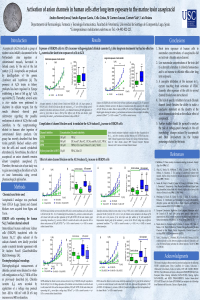
Azaspiracids (AZAs) comprise a group of marine toxins first documented in the Netherlands after ingestion of contaminated mussels, harvested in Ireland coasts, by the end of the last century [1-3]. Azaspiracids are known to be produced by dinoflagellates belonging to the genera Azadinium and Amphidoma [4]. In recent years, part of the research on marine toxins effects on human health have focused on their chronic effects. The presence of azaspiracid in fishery products has been regulated in Europe establishing a limit of 160 μg kg-1 AZA equivalents [5]. Since then, several acute in vitro studies were undertaken to elucidate their mechanism of action, but the results obtained showed great controversy regarding the possible cellular targets of AZAs that could contribute to the symptomatology elicited in humans after ingestion of contaminated fishery products. Our group has recently described that these toxins partially blocked sodium entry into the cells and caused cytoskeletal alterations [6], however the effect of these toxins on ion channels remains almost completely unexplored. Therefore, the main aim of our study was to gain more insight on the effects of azaspiracids on ionic homeostasis and cell volume regulation [7]. Thus, electrophysiological effects of nanomolar concentrations of azaspiracids (50 nM) after a 15-20 h exposition of human embryonic kidney cells (HEK293) which express the human Nav1.7 alpha subunit of the sodium channel were determined. Here, using electrophysiological techniques combined with several pharmacological approaches, we demonstrated that AZA-1 elicited a significant increase in anion efflux that could account for the pathophysiology observed in human intoxications.
References
- McMahon, T. Winter toxicity of unknown aetiology in mussels. Harmful Algae News 1996, 14, 2.
- Ofuji, K.; Satake, M.; McMahon, T.; Silke, J.; James, K.J.; Naoki, H.; Oshima, Y.; Yasumoto, T. Two analogs of azaspiracid isolated from mussels, Mytilus edulis, involved in human intoxication in Ireland. Nat Toxins 1999, 7, 99-102.
- Satake, M.; Ofuji, K.; Naoki, H.; James, K.J.; Furey, A.; McMahon, T.; Silke, J.; Yasumoto, T. Azaspiracid, a New Marine Toxin Having Unique Spiro Ring Assemblies, Isolated from Irish Mussels, Mytilus edulis. Journal of the American Chemical Society 1998, 120, 9967-9968.
- Wietkamp, S.; Krock, B.; Clarke, D.; Voß, D.; Salas, R.; Kilcoyne, J.; Tillmann, U. Distribution and abundance of azaspiracid-producing dinophyte species and their toxins in North Atlantic and North Sea waters in summer 2018. PLOS ONE 2020, 15, e0235015.
- European Commission. Regulation of the European Parliament and of the Council of 29 April 2004 laying down specific rules for the organisation of official controls on products of animal origin intended for human consumption, 854/2004/EC. In Official Journal, 2004; Vol. 50.
- Boente-Juncal, A.; Raposo-García, S.; Costas, C.; Louzao, M.C.; Vale, C.; Botana, L.M. Partial Blockade of Human Voltage-Dependent Sodium Channels by the Marine Toxins Azaspiracids. Chemical research in toxicology 2020, 10.1021/acs.chemrestox.0c00216.
- Vale, C.; Nicolaou, K.C.; Frederick, M.O.; Vieytes, M.R.; Botana, L.M. Cell volume decrease as a link between azaspiracid-induced cytotoxicity and c-Jun-N-terminal kinase activation in cultured neurons. Toxicol Sci 2010, 113, 158-168.
Keywords
Azaspiracid
European molluscs
anion channels
voltage-gated chloride channels.
Manuscript
Activation of anion channels in human cells after long term exposure to the marine toxin azaspiracid.pdf
Poster
39861-Activation of anion channels in human cells after long term exposure to the marine toxin azaspiracid.pdf
Functional characterization of a novel rCRiSP (recombinant cysteine-rich secretory protein) from Crotalus oreganus helleri